Turning the Volume Up to 11 is not Enough (part 2): Networks of Influence and Ideological Coherence

On February 3, 2014, the self-proclaimed “Islamic State” (ISIS or ISIL) published a video depicting captured Jordanian pilot Mu’adh al-Kasasiba wearing the notorious orange jump suit. For the background information on the secret negotiation attempt for his release, please check out the detailed contribution by Joas. For this Jihadica posting, let us concentrate on the propaganda side – and works – of ISIS, as announced in our first part.
This post looks at three aspects;

• How this video fits into the greater puzzle of jihadist ideology including the intersection between text based ideology and the demonstration (via video) of this ideology in practice.
• How the elements of the Swarmcast ensured the video would reach a wide audience and maintain a persistent presence.
• The limited impact of the response, named #opISIS, by hackers linked to Anonymous seeking to disrupt ISIS media networks.

Content matters, as does the means of delivery of jihadist propaganda data and material. Both elements highlight coherence: ideologically as well as technically. The ideological coherence, the persistence of its narratives and pseudo-theological fundament that is translated so well by jihadist media activists into audio-/ visual works shows parts of the resilience and the media strategy, the incorporation of the ‘jihadist tradition’. The video seeks to attract Arabic-speaking and non-Arab audiences, published in Arabic with encoded subtitles in English, French and Russian. ISIS exercises technical coherence and resilience in terms of disseminating the video and its propaganda in general – which, by the way is neither special nor outstanding or genius but simple use of a range of platforms (social media, forums, YouTube) by highly dedicated individuals, which we term as media mujahiddin.
The video is entitled Shifa’ al-sudur, a reference to Qur’an (9:14), and used by ISIS to justify and project the message that they are acting on behalf of God to “heal the believers’ feelings” as al-Furqan translates the title. The reference shifa’ al-sudur is part of the jihadist propaganda ambition to appease their target audience with audio-visual content that showcases, among many elements, “revenge” or at least “retribution” for the civilian suffering inside Islamic territories – reserved for the Sunni population only within this notion and mindset of course. The successful media strategy employed by ISIS focuses on audio/-visual output claiming practical application and translation of ideology into action. This is juxtaposed with assumed seniority of al-Qa’ida, who are crafting jihadist dogma but have little to no space (or territory) for implementation.
ISIS understands the importance of making use of the territory they control and deploys media units in every “province” (walaya). As a result, they publish up to 4-6 videos a day showing; the “life in the caliphate”, executions, sentences of physical punishment (hudud) framed as an evident legal system, religious policing of communities, the destruction of shrines of saints as well as a romantic view on fighting, sacrificing and being passionate for the local Sunni population of the “caliphate.” In general, Jihadists seek to deceive and coerce by trying to conceal their human fallibility while portraying themselves as God’s spokespeople. Therefore, every piece of their oftentimes highly professional and sometimes sophisticated propaganda is part of a greater puzzle.
In this greater puzzle everything is sanctioned, scripted, subjected to ideology, and is an integral part of the Sunni ‘jihadist tradition’ dominated by Arab ideologues and primary Arabic language publications (textual and audio/ -visual). Ideology in theory and practice serves as the motivation and guidance, it is built on the fundamentals of theology and pieces of Islamic jurisprudence (fiqh), used and interpreted to serve the extremist cause. The citation of historical scholars such as Ibn Taymiyya (d. 1328), as well as quoting selected parts of Qur’an and Sunna out of context, are powerful tools for extremist ideologues and media workers. It provides leverage for a distinct identity established on the premises of being ‘true Muslims’ offering the ‘true Islam’ and openly challenging and discrediting the “palace scholars” (‘ulama’ al-salatin) worldwide.
The ‘state-owned ‘ulama’’ are defined as corrupt scholars who neglect the true nature of Islam and thus have become followers of the “program of falsehood (batil)” whereas the jihadi as the only true, steadfast servant of God portrays himself as the follower of the “program of truth (al-haqq). This is one of the fundaments of Sunni jihadist perception of community that has now led to the creation of an “Islamic State” where the “true” and “proper” principles and methodology of Islam can be realized.

Visual Culture

Videos are the most important mouthpiece to show the manifestation and realization of jihadist creed (‘aqida) and methodology (manhaj) for which they claim to live and die. The video discourse allows a constantly repetition and showcasing of doctrines that disparage non-believers and sanction the collective punishment of “apostates” (murtadd) and Muslim “hypocrites” (munafiq).
This theological led discourse can be defined as “discursive guidance.” By the constant repetition of extremist laden theological interpretation (texts) and its practical implementation (videos), jihadi media consumers and participants are guided into a specific notion that serves as the fundament to become active and potentially commit attacks.
The first posting regarding this video provides an overview of the video distribution via Twitter and the attempts at counter messaging. It shows that it is not enough to merely increase the volume of counter messaging, or even to be retweeted frequently; (counter) messaging must be able to penetrate the Jihadist clusters, especially across the range of languages, hence targeting the targeted audiences. If counter-messaging remains isolated, the result is less a counter message and more a separate conversation.
Shouldn’t “counter-messaging” or a “counter-narrative” rather seek to penetrate and at best infiltrate jihadist media clusters online in hopes of persuading consumers to turn away? On different levels?
In a future posting the specific messages that are encoded into this video will be detailed, for now let us assess some aspects of the Swarmcast phenomena through which the video was distributed; specifically, speed and resilience. The final section looks at the response from hackers who launched another wave of attacks on accounts they believed to be sympathetic to ISIS, or jihadist groups more broadly.

Swarmcast:

This section assesses some aspects of the Swarmcast through which the video was distributed; specifically, speed and resilience. Although some commentators and policy makers are tempted by the idea that suspending a few most active accounts could limit jihadist activity by reducing the number of users following selected accounts (discussed further here), data analysis of content distribution highlights that the Swarmcast can withstand such an approach.
Speed:
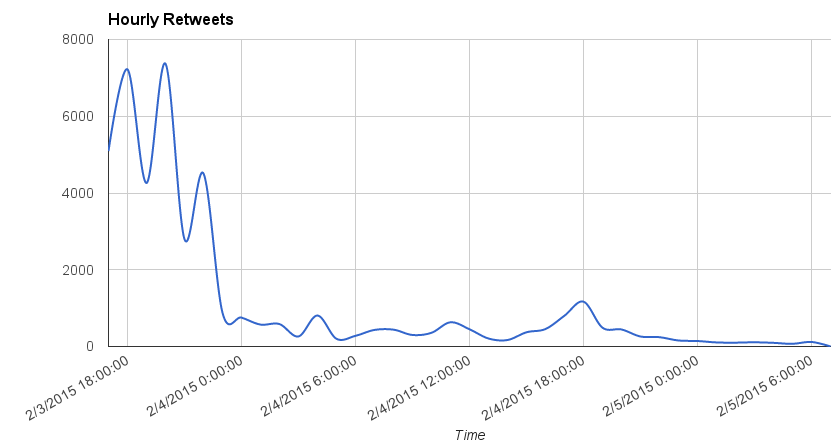
speedclick to enlarge

In the first six hours there were over 32,000 retweets containing the tag: #شفاء_الصدور . This is a combination of those actively disseminating the video and those engaged in counter-messaging. The volume of retweets and the speed with which that occurs renders the removal of accounts largely ineffective in disrupting the dissemination of content. By the time accounts are identified and suspended the content has been widely distributed.
Equally, the focus on retweets allows the analysis to focuses on a behavioral response – showing who Twitter users responded to – rather than those who are most active. Analysis of accounts that other users think are important is often more effective than examining the most active accounts – as these may have a lot to say, but that doesn’t mean anyone is listening.
Engagement Profiles:
The Engagement profile of frequently retweeted accounts shows the same pattern of rapid information dissemination, with most activity occurring in the first six to eight hours. The intensity of engagement with accounts attempting counter-messaging is broadly speaking at the same time. This is a significantly faster response than that during the release of “the Clanging of Swords, part 4” (48 hours on that occasion). This speed of response may be because of the video having been published on a weekday, rather than a Saturday.
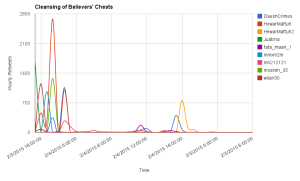
engagement profilesclick to enlarge (interactive)

The data shows that trying to remove individual videos or user accounts one-by-one, leads to a global game of whack-a-mole, a strategy ISIS seems to be employing on the battlefield as well.
This absorbs resources, while the media mujahedeen move fast enough to maintain a persistent online presence.

Resilience:
As discussed in previous pieces, degree of interconnection between accounts gives the cluster of users disseminating Jihadist content a level of resilience which, in addition to speed discussed above, enables the network to maintain a persistent presence. This highlights the importance of challenging the networks that distribute content rather than chasing after lists of individual accounts.
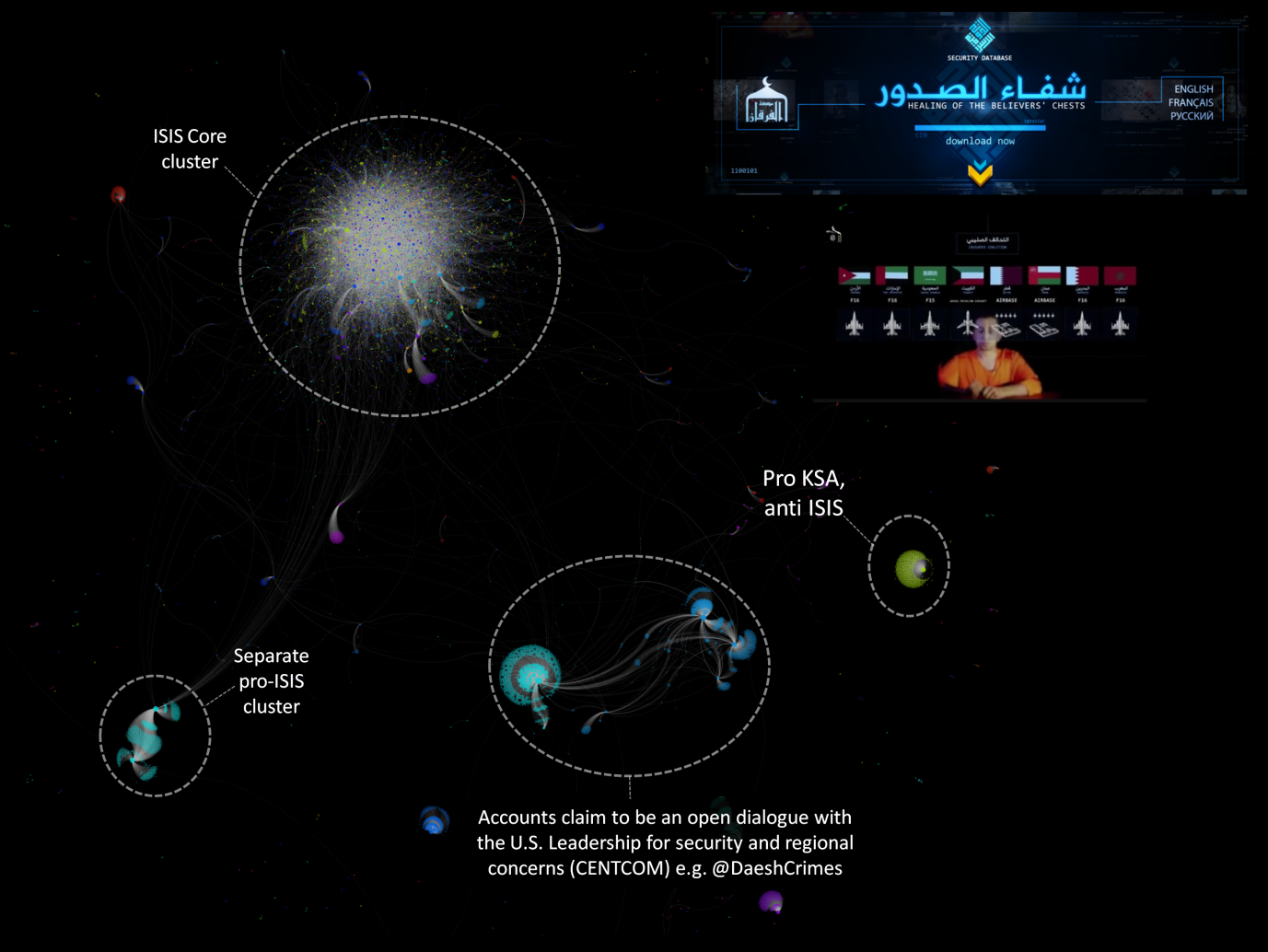
As discussed in the earlier post the network image visually attests that there are different clusters of users sharing content and that users sharing counter-messaging were almost entirely isolated from core media mujahedeen accounts.
resilienceclick to enlarge

Focusing on the core cluster identified on the image, this cluster is large enough and has a level of interconnection to achieve resilience and persistence. The core cluster contains 9,719 accounts. If the outlying groups are removed, this number goes down to 6,826 accounts connected by 17,713 author / retweeted relationships. In this group, 575 accounts were retweeted at least once by five or more other users. Of accounts who are retweeted at least once, the average number of users that retweeted them was 12.7 (with a median of 3). This indicates that while there are some particularly influential accounts, much of the distribution occurs through a broad network of interconnected accounts.

This observation is further borne out by the metrics produced by social network analysis, which also show in greater depth the roles key actors play in the network.

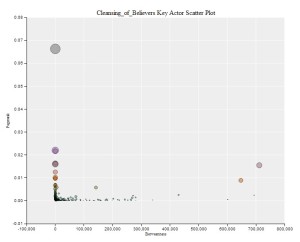
Important findings from this approach include that the counter messaging is much more centralised around a couple of accounts. In contrast, the decentralised dissemination of Jihadist content – the swarmcast – means a range of accounts are reaching different communities, with sufficient levels of redundancy to allow information to continue flowing despite the suspension of some accounts.

This combination allows the swarmcast to maintain a persistent presence and reach communities which the Counter effort does not. This analysis using the network metrics, confirms the visual analysis from the network image and is also supported by the Key Actor graph. The Key Actor graph and specifically the horizontal spread of accounts shows that a relatively large number of accounts were important in the distribution of information to specific communities.
scatter plotclick to enlarge (interactive)

The combination of analyses and metrics produced by social network analysis, confirms findings from earlier studies, that the media mujahedeen distributes content rapidly, through a resilient network capable of reconfiguring when some accounts are suspended.


#opISIS:

There have been repeated stories over the last year of jihadist accounts being suspended, including in the aftermath of the beheading of James Foley, or the attempts by hackers linked to Anonymous to disrupt accounts as part of Operation No2ISIS.

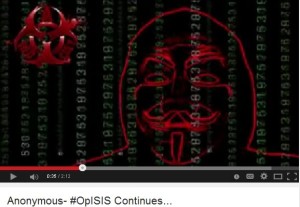
On 6th February an article posted on Counter Current News claimed Anonymous had just “destroyed months of recruiting work for the terrorist network known as ISIS” and listed the accounts which they now claimed to control. The article also contained a video which describes the actions and rationale of the Anonymous RedCult team as part of #OpISIS.
opISISclick on the image for the video on YouTube

It is unclear how accounts are being selected as part of #OpISIS. However, when comparing the list of accounts that had been hacked, posted on the 6th February and comparing it to the users tweeting about #شفاء_الصدور – none (zero) of the users in the original list were involved in the release of the Cleansing of Believers’ Chests.

An updated list posted on the 9th February, listed over 700 accounts. Only 3.1% of those identified as priority targets with over 10 thousand followers appeared in the network of users disseminating the #شفاء_الصدور video. However, of all the accounts posted in the Feb 9th update, around 9.3% of these users were part of the dissemination of the Cleansing of Believers’ Chests.

Given the dispersed nature of the network and the relatively small proportion of users who were affected by #OpISIS and had been disseminating #شفاء_الصدور, the Jihadist swarmcast continues to exhibit speed and resilience. This allows the ‘media mujahedeen’ and those sympathetic to ISIS to maintain a persistence presence for their content online.
Battlefield Yemen: The Islamic State’s Challenge to AQAP

Since the caliphate declaration of late June 2014, Yemen has emerged a key battleground in the intra-jihadi struggle pitting the Islamic State against al-Qaeda. The country hosts what is arguably al-Qaeda’s most prestigious affiliate, al-Qaeda in the Arabian Peninsula (AQAP). But as far as the Islamic State is concerned, that organization ceased to exist when the caliphate was declared. Thereafter all jihadi groups were expected to dissolve themselves and incorporate within the all-supreme caliphate.

Preemptive bay‘a

In mid-November, the Islamic State, driving home this point, officially declared its “expansion” to Yemen, among other target countries, proclaiming “the dissolution of the names of the groups in them and declaring them to be new provinces of the Islamic State.” A series of bay‘as— statements of allegiance to Caliph Abu Bakr al-Baghdadi—were issued simultaneously on November 10 from Yemen, Arabia, Egypt, Libya, and Algeria. Three days later, Baghdadi “accepted” the pledges, conferring on the new territories the status of “provinces.” In two of the countries—Egypt and Algeria—the bay‘as came from preexisting jihadi groups known for their ties to the Islamic State. But in Yemen the statement of allegiance came not from that country’s well-established jihadi group—AQAP—but rather as a challenge to it.

Al-Qaeda’s Yemeni affiliate, as Saud al-Sarhan has detailed in an important new study, is deeply divided over which side in the jihadi civil war to support: the Islamic State or al-Qaeda. Previously, the group had tried to adopt a more-or-less neutral stance. But the bay‘a, apparently calculated to force AQAP’s hand, compelled it to choose sides. And it definitively chose al-Qaeda. Predictably, pro-Islamic State jihadis online are outraged. The pro-Islamic State Yemeni community, however, has been more nuanced in response.

Yemen’s Islamic State supporters

As Sarhan noted, the two most noteworthy Yemeni promoters of the Islamic State are ‘Abd al-Majid al-Hittari (@alheetari), an independent preacher, and Ma’mun Hatim (@sdsg1210), an AQAP scholar. Both were early supporters of the Islamic State when its conflict with al-Qaeda heated up in late 2013, and both lent their imprimaturs to the Ghuraba’ Media Foundation’s February “Statement of Brotherhood in Faith for Support of the Islamic State.” Signed by 20 jihadi scholars, this called on all Muslims fighting in Syria to give bay‘a to Baghdadi, and on all Muslims across the world to support the Islamic State.

Both Hittari and Hatim were likewise supportive of the Islamic State’s declaration of the caliphate on June 29, 2014. Hittari wrote an essay in its favor, telling Baghdadi he would “urge the Muslims [of Yemen] to prepare to obey you.” Hittari furthermore endorsed Baghdadi’s decision upon declaring the caliphate to dissolve all competing jihadi groups across the world. As the caliphate declaration had noted, “the legitimacy of your groups and organizations is void.” Concurring, Hittari told Baghdadi: “I believe that your dissolution of the Islamic groups is a successful step on the path to uniting the Muslim community around its state and its emir.”

Hatim, for his part, congratulated those who “made the dream [of the caliphate] a reality.” And in mid-June he also gave his support to the strategy of dissolving other groups. In a long audio recording online he addressed “my brothers in the branches of al-Qaeda, in all countries and regions and lands,” urging them to unite within the Islamic State, which would be “the first of your steps toward [achieving] victory and political capability.” Ma’mun Hatim did not speak for the entire AQAP leadership, however.

Bay‘a for bay‘a

Unlike al-Qaeda in the Islamic Maghrib, AQAP did not issue an early statement rejecting the Islamic State’s caliphate. Nor did it adopt the central al-Qaeda leadership’s dismissal of the Islamic State as a mere “group” as opposed to a “state.” AQAP sought to walk a neutral line. But the surprise bay‘a on November 10 changed that.

A week and a half later, in a video dated November 19, AQAP came out with its first significant refutation of the Islamic State, contesting its claim to have dissolved AQAP and to have founded a province in its stead. In a 30-minute address, senior AQAP scholar Harith al-Nizari reiterated his group’s desire for neutrality in the intra-jihadi conflict in Syria, urging all parties to consult an independent shari‘a court. But he denounced what he called the Islamic State’s effort to “export the fighting and discord [in Syria] to other fronts,” namely Yemen.

Two steps taken by the Islamic State were in particular disagreeable. The first was the caliphate declaration, which Nizari deemed illegitimate. Neither the proposed “caliphate” nor its “caliph,” he said, met the necessary conditions stipulated in the shari‘a. Furthermore, the time was not right for appointing an “imam,” or caliph. The second was the Islamic State’s more recent effort to eliminate AQAP via the preemptive bay‘a. “We call on our brothers in the Islamic State,” Nizari said, “to retract the fatwa to dissolve the groups and divide them…We consider them responsible for what could result…of the shedding of unlawful blood on the pretext of expansion and extending the authority of the state.”

Clarifying AQAP’s ultimate loyalties, Nizari defended Ayman al-Zawahiri’s al-Qaeda against charges of “deviation,” and he rejected the idea that AQAP could simply fold and gave bay‘a to the Islamic State as that would violate the terms of the group’s current bay‘a to al-Qaeda. He then reaffirmed his group’s loyalty to the al-Qaeda leadership: “We reject the call to split the ranks of the mujahid groups, and we renew the bay‘a to our commander, Shaykh Ayman al-Zawahiri, and, via him, the bay‘a to Mullah ‘Umar.” The nature of this latter bay‘a to Mullah ‘Umar was left unspecified, but it plays to al-Qaeda leaders’ recent efforts (see here and here) to cast the Taliban ruler in a caliphal role.

Refuting AQAP

Harith al-Nizari’s address was of course met with condemnation from pro-Islamic State writers online. Four scholarly refutations were quick to appear (see here, here, here, and here), all by pseudonymous authors. Three of them are prolific and well-known—Abu Khabbab al-‘Iraqi (@kbbaab), Abu Maysara al-Shami, and Abu l’-Mu‘tasim Khabbab (@abu_almuttasim). The latter’s refutation earned the endorsement of Hittari.

These pieces made several of the same points. First: AQAP’s pretense of neutrality is a sham, for there can be no neutrality. One is either on the side of “Divine Truth” (the Islamic State) or on that of “falsehood” (al-Qaeda). Second: Against Nizari’s claim to the contrary, the caliph and caliphate of the Islamic State no doubt meet the “conditions” mandated by Islamic law. On this matter AQAP is simply “lying” and deceiving; its leaders’ lust for power is preventing them from admitting what they surely know. Third: The Islamic State is no source of “discord”; rather it is the intransigence of groups like AQAP, which refuse to join the caliphate, that accounts for disunity. Fourth: AQAP’s claim to have a bay‘a to Mullah ‘Umar is incoherent. As one author points out: “Why is it OK for Mullah ‘Umar to gather bay‘as from territories in which he has no authority…while that is forbidden for Baghdadi?” And did not Nizari say that this is not the right time for appointing a caliph? If so, then how can he give Mullah ‘Umar bay‘a as putative caliph?

The anger and frustration in these refutations are apparent. Yet not all pro-Islamic State jihadis castigated Nizari so ardently. A prominent one of their number—a certain Abu ’l-Hasan al-Azdi—actually cautioned against attacking AQAP, urging measured argument. Responding to Abu Maysara al-Shami’s refutation, he said it would be wise not to antagonize jihadis who have yet to support the Islamic State; such argumentation only deepens the “chasm of the conflict.”

Dueling approaches in Yemen

In Yemen itself, the events of November drew different responses from the two main pro-Islamic State advocates there, ‘Abd al-Majid al-Hittari and Ma’mun Hatim. Each now represents a different way of being a pro-Islamic State jihadi in the country.

Hittari was unreservedly supportive of the Islamic State, applauding its “expansion” and condemning AQAP’s response. AQAP leader Nizari, he said, had failed to “comprehend the wisdom of the [current] stage [of jihad].” That is, the stage of the caliphate. One is either with it or against it. He encouraged the Islamic State to hold fast to its current strategy in Yemen.

Hatim was of a different mind. In a series of revealing Tweets, he argued that the Yemeni bay‘a to the Islamic State of November 10 was flawed. He did not denounce those who gave the bay‘a. Indeed, he revealed that he knows who they are: “the majority of them are among the best people I have known, and a large number of them are my students and brethren.” Nor did he reject the notion of the Islamic State’s expanding: “We are not opposed to the expansion of the [Islamic] State.” The problem was the means, not the ends: “We have to consider the correct and legitimate means for [achieving] its expansion.” In the present circumstances of Yemen, “the harmful consequences that will obtain from the bay‘a and the proclamation of a new group in one theater are many, many times greater than the desired benefit of that announcement and the division.” With regard to those circumstances, he spoke of “facing a fierce, multi-front war” in Yemen, referring to AQAP’s battles with the Yemeni government, the Houthi Shi‘a movement, and the United States.

From Hatim’s perspective, there are two ways to support the Islamic State in Yemen. “We,” he said, referring to pro-Islamic State jihadis, “are before two choices. Either we rush the bay‘a, meaning division, separation, weakness, and failure, or we act patiently in the coming days, ensuring that opponents’ understanding is rectified and their views clarified.” What Hatim wants—“what we strove for and called for”—is “a group bay‘a,” meaning a bay‘a given by AQAP to the Islamic State, not one meant to undermine the group. But that has yet to materialize. Aspiring to such an outcome, however, remains in his view a better option than fragmenting Yemen’s jihadis.

Some jihadis online have faulted Hatim’s siding with AQAP. As one representative critic stated, “maybe war”—not patience—“is the inevitable treatment for the ailment.” But at least one major pro-Islamic State jihadi online, Abu Khabbab al-‘Iraqi, defended the Yemeni to a degree. Hatim should be reproved for “his hesitation to give bay‘a to the Islamic State and come under its banner,” he said, but this should be done as to a “loved one,” not an enemy.

The Yemeni third way

There would thus appear to be a bit more flexibility on the part of pro-Islamic State jihadi ideologues when it comes to Yemen as opposed to elsewhere. At least two of these—Abu ’l-Hasan al-Azdi and Abu Khabbab al-‘Iraqi—have told their peers to tone it down in criticizing those Yemenis reluctant to join the caliphate. This is a flexibility hitherto absent from pro-Islamic State jihadi discourse, which has previously shown no tolerance for any kind of neutrality. It is as yet unclear whether the Islamic State’s new Yemeni “province” will really compete with AQAP. But it seems likely that any confrontation will be significantly delayed by Hatim’s staking out of a plausible Yemeni third way.

A Jihadi Civil War of Words: The Ghuraba’ Media Foundation and Minbar al-Tawhid wa’l-Jihad

Amid the ongoing conflict between al-Qaeda and the Islamic State, jihadi ideologues and media appear more divided than ever before. Notwithstanding U.S.-led airstrikes in Iraq and Syria that some thought could unite jihadi ranks, the jihadi civil war is raging on unabated, and nowhere more so than on the ideological and media front. Among more traditional media, it is now the norm for jihadi web forums to identify—even openly—with one belligerent or the other. Some forums, such as Platform Media and Tahaddi, promote the Islamic State, with Shumukh more or less also on board; Fida’ and ‘Arin, among others, clearly favor al-Qaeda.

Yet the real jihadi battle of wits is not being waged on or between the forums. The ideological battlefield is defined, rather, by a number of upstart media outlets on Twitter supportive of the Islamic State, on the one side, and a few established websites of older jihadi scholars supporting al-Qaeda, on the other. Among the mass of competitors are two most worthy of attention. These are Mu’assasat al-Ghuraba’ lil-I‘lam (“The Ghuraba’ Media Foundation”), a pro-Islamic State Twitter outlet, and Minbar al-Tawhid wa’l-Jihad (“The Pulpit of Monotheism and Jihad”), a pro-al-Qaeda website overseen by the Jordanian jihadi Abu Muhammad al-Maqdisi.

The Newcomer and the old-timer

The competition between the Ghuraba Media Foundation and Minbar al-Tawhid wa’l-Jihad (hereafter Ghuraba’ and Minbar, respectively) is very much one between new media and old. It highlights the generally more youthful profile of Islamic State supporters contra their more senior, pro-al-Qaeda counterparts.

Minbar (www.tawhed.ws) was founded in or around 2002 by al-Maqdisi (b. 1959), arguably the most well-known jihadi scholar alive. It features the largest online library of jihadi books, essays, fatwas, and audio recordings, and is further known for its “Shari‘a Council” of select scholars who respond to queries from visitors on a range of subjects, including jihad. Like other questionable Arabic websites, its domain name is registered in Samoa (.ws). Minbar does not regularly partake in social media.

The newcomer, Ghuraba’, has a completely different modus operandi, relying instead on social media and free upload sites. Founded in late 2013, it is largely a Twitter phenomenon, having started with the handle @alghuraba_ar. While Twitter’s censors routinely delete it, the outfit quickly reappears at each inconvenience, simply adding a number to its handle. (It is currently @alghuraba_ar04.) To create more permanent links to its files, Ghuraba’ relies on websites like justpaste.it, and for storage it uses sites such as gulfup.com and sendspace.com. Every week Ghuraba’ publishes, in slick PDF documents, multiple essays and books, most of which are devoted to defending the Islamic State against its detractors. Its growing archive of writings (for the moment available here) is becoming a rival, however modest, to Minbar’s jihadi library. The authors it regularly features have likewise become something of a rival to Minbar’s Shari‘a council.

Shari‘a councils of war

On August 16, 2014, Minbar unveiled a new lineup for its relaunched Shari‘a council, defunct since September 2013. The two men last writing for it, Abu al-Mundhir al-Shinqiti and Turki al-Bin‘ali, had adopted a pro-Islamic State position and, it appears, left their posts on the council. These two had also written lengthy works in favor of the Islamic State, subsequently removed by Minbar. By late 2013 Minbar was evidently censoring all pro-Islamic State writings, and Ghuraba’ began publishing the works of Shinqiti and Bin‘ali.

The new Shari‘a council has displayed Minbar’s now well-known bias for al-Qaeda and animus toward the Islamic State. Among the five new members is Sami al-‘Uraydi (b. 1973; @sami_oride), a Jordanian currently serving as a shari‘a official with the al-Qaeda-affiliated Jabhat al-Nusra in Syria. Another is one ‘Abdallah ibn Ahmad al-Bun al-Husayni, a man of uncertain identity who describes himself as “one of Shaykh Abu Muhammad al-Maqdisi’s students.” His first efforts for Minbar were devoted to attacking, in a long refutation, three pro-Islamic State scholars: Turki al-Bin‘ali, Abu Khabab al-‘Iraqi, and ‘Umar Mahdi Zaydan, the former two being regular contributors to Ghuraba’. In large measure, this is a shari‘a council of war.

Ghuraba’, for its part, does not have an official shari‘a council but does host a coterie of regular contributors with essentially the same function. Among the more prominent of these writers are two Mauritanians (Abu ‘Ubayda al-Shinqiti and Abu Salama al-Shinqiti), an Iraqi (Abu Khabab al-‘Iraqi), a Moroccan (Zakariya’ Bu Gharara), a Sudanese (Musa‘id ibn Bashir, recently arrested), and several others of unidentifiable origin (Abu Mus‘ab al-Athari, ‘Ubayda al-Athbaji, Abu Bara’a al-Sayf, and “Ahlam al-Nasr,” described as “the Islamic State’s poetess,” among others).

Bin‘ali, a Bahraini now residing in the Islamic State, was also a prolific contributor to Ghuraba’ before his abrupt disengagement from the internet in July. His one-time ally Abu al-Mundhir al-Shinqiti, a Mauritanian (not to be confused with the other Mauritanian Shinqitis), is another story. Last summer he emerged after a months-long absence to announce his sudden opposition to the Islamic State after previously supporting it, becoming the subject of a heated exchange between Ghuraba’ and Minbar.

Mutual recriminations

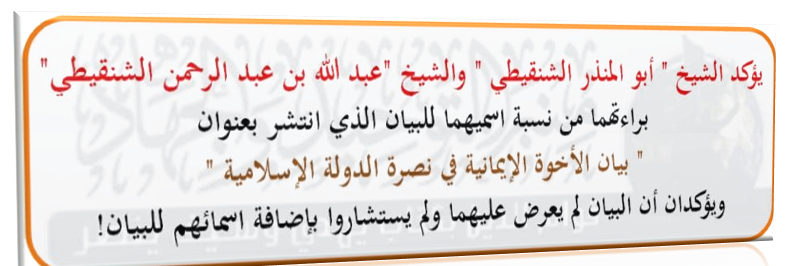
The origin of this dispute was an open letter of support for the Islamic State issued by Ghuraba’ in February of last year (for the outfit’s own English translation, see here). Called “The Statement of Brotherhood in Faith for Support of the Islamic State,” it was signed by twenty jihadi shaykhs including Shinqiti, whose name came first. The letter called on all Sunni fighters in Iraq and Syria to give fealty (bay‘a) to the Islamic State’s leader, Abu Bakr al-Baghdadi—an implicit attack on al-Qaeda’s Jabhat al-Nusra. The thrust of the statement certainly fit with Shinqiti’s pro-Islamic State views, which Ghuraba’ had previously published (see here, here, and here).

In mid-July, following the caliphate declaration, Shinqiti suddenly reversed his position, coming out with a fatwa denouncing the Islamic State’s caliphal claim and waxing critical of the group. (While he himself has not acknowledged any reversal, al-Maqdisi has made clear that Shinqiti indeed “reviewed his opinion and corrected his stance.”) In line with this development, Minbar issued a statement on its homepage in late July with the news that Shinqiti was disavowing Ghuraba’s “Statement of Brotherhood in Faith.” Controversially, Minbar furthermore claimed that Ghuraba’ never consulted Shinqiti as to including his name on the “Statement.”

The same day, Ghuraba’ responded with a series of tweets affirming that Shinqiti had indeed been consulted and accusing Minbar of lying. The Ghuraba’ administrator cast this dispute as part a greater contest between Minbar and Ghuraba’:

“It seems Maqdisi and his Minbar can no longer bear our undertaking to publish books and essays by scholars and shaykhs supporting the Islamic State…We in Ghuraba’ Media have opened our hearts and our foundation to the estranged (ghuraba’)* scholars and seekers of religious knowledge whom Maqdisi sought to silence and prevent from speaking the truth…Ghuraba’ Media has become a veritable alternative to Maqdisi’s Minbar, which for years has exercised a monopoly on media activity concerned with religious knowledge and shari‘a…”

The next day Minbar shot back, defending its reputation and integrity and explaining that Shinqiti himself had requested the disavowal. There followed a letter from Shinqiti, who restated his disavowal and attributed his five months of silence to “reasons of health and security.” Neither side has backed down in this dispute, continuing to accuse the other of lying.

Raging on

Over the next month Ghuraba’s unofficial shari‘a council came out with three short pieces (see here, here, and here) blasting Minbar and defending their foundation. One of these authors addressed Minbar thus: “Your battle with the Islamic State is surely a losing battle. So pick up your pens and ready your paper, for this is a battle that will endure, not expire…The Ghuraba’ Media Foundation has been and will remain the redoubtable fortress for defense of the truthful jihad warriors, as we deem them, of the Islamic State.” Indeed, this battle of pens has yet to let up. In late August one Minbar scholar put together a summa of the criticisms used to repudiate the Islamic State’s caliphate declaration; in mid-September a Ghuraba’ scholar responded with a point-by-point rebuttal.

It is worth remarking that Ghuraba’ is not the only media outfit of its kind. There is an array of jihadi media agencies on Twitter engaging in similar activities, including the Battar Media Foundation (@me_bttar), the Wafa’ Foundation for Media Production (@alwaf_aa), and the ‘A’isha Media Center (@MarkazAisha4), to name just a few. (It is all really too much to keep up with.) In August and September more than a dozen of these “foundations” and “centers” came together under the umbrella of “The Media Front In Support of the Islamic State,” an effort apparently interrupted by Twitter censorship. Ghuraba’ is not even the most prominent of these outfits, but it is by far the most significant in terms of rivaling the vaunted Minbar.

The civil war on display here between Ghuraba and Minbar is a microcosm of the greater jihadi civil war raging across the world and particularly in the greater Middle East. If jihadi ideologues and media are any measure of the state of affairs, it is a conflict that is set to endure—the long war beset with a long war of its own.


[*] The word ghuraba’, as in the media outlet’s name, means “estranged ones” or “strangers.” It derives significance from the following statement attributed to the Prophet Muhammad that is popular among Salafi Muslims: “Islam began as a stranger and will return as a stranger as it began, so blessed be the strangers.”

Caliphate Now: Jihadis Debate the Islamic State

Since the mid-November beheading in Aleppo of allied commander Muhammad Faris of Harakat Ahrar al-Sham, a barrage of negative media attention has afflicted Abu Bakr al-Baghdadi’s Islamic State of Iraq and Sham (ISIS). ISIS was concerned by its public image problem even before this signal mistake. In a September statement, Islamic State official spokesman Abu Muhammad al-‘Adnani defended his emirate from a perceived media onslaught, thought to be led by “the unbelieving West” and its regional allies and aimed at discrediting ISIS: playing up its feuds with other mujahidin in Syria and playing down its battlefield accomplishments. Another campaign to discredit the Islamic State, however, cannot be attributed to Western origin. It arises from within the jihadi community itself.

In November the two most high-profile jihadi ideologues alive today issued searing critiques of ISIS and its emir, al-Baghdadi. Abu Muhammad al-Maqdisi and Abu Qatada al-Filistini, imprisoned in Jordan in the Umm al-Lu‘lu‘ facility in Zarqa‘ and the Muwaqqar prison outside Amman, respectively, came out in quick succession against the underlying premise of the Islamic State: namely, that it constitutes the reemergence of the original Islamic state, or caliphate, and that its leader, who adopts the title amir al-mu’minin (Commander of the Faithful), is the putative head of this renascent caliphate. ISIS has argued that it cooperates with other mujahidin in Syria, which is true. Yet it also quite clearly aspires to absorbing them all within its state structure. (On the political ideology of ISIS, see here.)

Over the past year most jihadi literature seems to have supported ISIS and its implied caliphal claims (see here and here for previous analysis). The double-headed rebuke from al-Maqdisi and Abu Qatada marks a departure from this praise chorus, possibly with painful consequences for the Islamic State.

Abu Qatada’s letter

Abu Qatada al-Filistini’s critique was the first to surface, appearing online on November 1. Born in 1960, Abu Qatada is a Jordanian of Palestinian background whose real name is ‘Umar ibn Mahmud Abu ‘Umar. Forcibly repatriated to Jordan in July 2013 after a decade-long detention in the United Kingdom, where he received asylum in 1994, he currently stands accused of supporting terrorist activities in his home country.

His short rebuke of ISIS and al-Baghdadi takes the form of an open letter to the mujahidin in Syria, advising them as a veteran jihadi and witness to countless battlefield gains squandered by infighting. The mistakes of “previous experiences,” he warns, ought to be heeded, for the current “disunity and disputation” among Syrian mujahidin “terrify and horrify every admirer.”

This division he attributes first of all to jihadi “leaders” enamored of power and leadership. The context suggests that he has al-Baghdadi foremost in mind. Challenging his title of amir al-mu’minin, Abu Qatada avers: “There exists no emir firmly established such that he should be treated as the caliph—or with similar names and titles.” Jihadi groups today are fighting to achieve strength for establishing “the Islamic state.” But no organization is yet worthy of that name. It is an error for mujahidin to fight for their organization “as if it is an end in itself and not a means [to an end].” In the harshest words of his letter, Abu Qatada accuses anyone who would call himself “caliph” or “amir al-mu’minin” of espousing Shi‘i political doctrine, wherein “commanders and leaders are seen as divinely appointed rather than chosen by human beings.”

Abu Qatada also attacks fellow jihadi ideologues for lending support to ISIS. Their fatwas, he says, reflect “naïveté and childishness,” and their authors are “elementary students” or “pretenders to religious knowledge.” By categorically supporting one side in Syria they make unity and reconciliation ever more difficult. Abu Qatada advises the formation of a “shari‘a elite” composed of learned religious scholars with authority to issue binding judgments on political disputes.

The “Zarqawi” wing responds

Five days after it was published, a leading jihadi ideologue in Jordan, the Irbid-based shaykh ‘Umar Mahdi Zaydan, issued a five-page rebuttal of Abu Qatada’s letter. While Zaydan is a lesser-name figure compared to Abu Qatada or al-Maqdisi, he has according to two recent media reports (see here and here) played a key ideological role in supporting ISIS against its jihadi detractors. A former acquaintance of both al-Maqdisi and Abu Mus‘ab al-Zarqawi, Zaydan, about 40 years old, represents the latter’s more intransigent political tendency.

Jordanian researcher Mohammad Abu Rumman recently identified “two principal trends” in the jihadi movement in Jordan and Syria: “The first is the more pragmatic wing, represented by al-Maqdisi and Abu Qatada; it adopts a position favorable to Jabhat al-Nusra, considering it a corrective to the path of al-Qa`ida in Iraq. The second trend is the extremist wing, represented by the followers of al-Zarqawi, or those who have been called neo-Zarqawis. One of their most prominent leaders is ‘Umar Mahdi [Zaydan], who has called publicly for allegiance to be given to the [Islamic] State [of Iraq and Sham] and al-Baghdadi.” In Jordan, Abu Rumman notes, the pragmatic wing of jihadism is the intellectually and culturally more powerful. The Zarqawi wing, however, has had more influence on the ground; far more Jordanians fight for ISIS than for Jabhat al-Nusra.

Zaydan’s rejoinder to Abu Qatada is entitled “Refuting the Statement of the One Who Considered the Islamic Caliphate a Part of the Shi‘i Religion.” According to Zaydan, Abu Qatada’s comparison of the Islamic State of Iraq and Sham to the Sh’i imamate is offensive. This letter, he notes, despite its oblique language not specifying names or groups, is doubtless an attack on ISIS and al-Baghdadi: “a clear accusation against him, his leaders, and his soldiers of ignorance, capriciousness, and love of power.”

Abu Qatada goes wrong, according to Zaydan, by refusing to recognize the special significance of the Islamic State, which is not just one jihadi “group” among others. It is the reborn Islamic state. Quoting Osama bin Laden, Zaydan asserts that ISIS is an “imara shar‘iyya” (lawful emirate) or “imara kubra” (supreme command). It is not, as Abu Qatada claimed, an “imarat jihad” or “imarat harb” (battlefield command). Zaydan makes clear elsewhere that he views al-Baghdadi’s Islamic State as nothing else but “the Islamic Caliphate.”

Zaydan is clearly offended by Abu Qatada’s further claim, which is that ISIS’s supporters are invariably “childish and naïve.” Listing the names of twelve jihadi ideologues and their works supporting ISIS, Zaydan asks, “Are all of these naïve…and childish?” The list of supporters includes Abu al-Mundhir al-Shinqiti, Abu Sa‘d al-‘Amili, Abu Humam al-Athari, Abu al-Hasan al-Azdi, and Abu Ja‘far al-Hattab. (All of them have been discussed previously on Jihadica.)

In his conclusion, Zaydan suggests that al-Maqdisi, his former teacher, would agree that Abu Qatada chose an inappropriate time to “attack the mujahidin” of ISIS. Unfortunately, Zaydan was unaware that on November 5 al-Maqdisi too had authored a short rebuke of ISIS. (On al-Maqdisi, see here, and see Joas Wagemakers’s new book.)

Al-Maqdisi’s letter

Al-Maqdisi’s critique of ISIS appeared twelve days later on November 17 as a short memorandum to certain mujahidin in Syria soliciting his advice: “They informed me that they attach importance to my advice and are not heedless of my guidance; indeed they teach my books to their soldiers.” Calling for greater unity among the mujahidin in Syria, al-Maqdisi’s letter is more measured and less admonishing than Abu Qatada’s. It likewise denies, however, the Islamic State’s claim to emirate or proto-caliphate status.

Al-Maqdisi stresses “the clear difference between battlefield commands…and the politically capable [Islamic] state.” The path to proper Islamic statehood, he affirms, follows certain “stages” that lead to “political capability.” Skipping any of these stages—i.e., declaring a state prematurely as ISIS has done—is dangerous as it foments internal warfare. Addressing “our brothers in Jabhat al-Nusra and our brothers in the Islamic State of Iraq and Sham,” al-Maqdisi advises that they fight “under one banner and under one emir.” That emir is obviously not al-Baghdadi, for he also advises that before this they “seek unity under the aegis of a shura council.” In a more explicit rejection of al-Baghdadi’s status as emir, he emphasizes that Syria’s jihadi leadership ought to be of Syrian origin, the better to appeal to the Syrian people. Al-Baghdadi is of course Iraqi.

Al-Maqdisi ends his letter with an appeal to fellow jihadi scholars to support the banner of tawhid (unity) in Syria and not show partiality to one group or another. With these words he seems intent on curbing junior jihadi ideologues’ excitement over ISIS. The implication is that they should refrain from calls for bay‘a, or the pledge of allegiance, to be given to al-Baghdadi.

An enduring debate

The debate over the Islamic State’s readiness for statehood, or its “political capability” (tamkin), is by no means new. In 2006 the Islamic State of Iraq’s shari‘a council issued a 90-page document addressing just this issue. It noted that the original state of the Prophet Muhammad was founded on much less territory and with far less capability than the new Islamic state in Iraq.

This is just one of a number of points of contention over ISIS that has generated a daunting amount of disputatious literature. One jihadi author, claiming to represent Jabhat al-Nusra, recently produced several hundred pages of rebuttal to the three pro-ISIS works of Abu Humam al-Athari, Abu al-Hasan al-Azdi, and Abu Ja‘far al-Hattab (see here, here, and here). This in turn inspired a counter-refutation—a merciful 25 pages—by yet another pseudonymous author.

Until now the momentum in this debate has favored ISIS and al-Baghdadi, but the new contributions from Abu Qatada and al-Maqdisi may prove a serious obstacle in their advance. At the very least they highlight the stark divide in the jihadi movement today between supporters of a hardline, “caliphate now” strategy and those of more pragmatic mind.

A Little-Known Syrian Jihadi Magazine

In various previous posts, I have paid attention to the Syrian-British Jihadi-Salafi ideologue Abu Basir al-Tartusi, for example because of his criticism of other jihadis and his support for the Free Syrian Army at the expense of Jabhat al-Nusra. His position, differing somewhat from that of other major radical scholars, was interesting because it was more conciliatory towards non-Islamists and remnants of previous regimes and also because it was less dismissive of the widespread calls for democracy that the Arab Spring showed.

The Arab Spring also pulled Abu Basir out of the semi-isolation that he was in when he was still living in Britain. Since the early protests against the Syrian regime, he has been very active in promoting the downfall of President Bashar al-Asad, with an unprecedented amount of footage of his speeches, lessons, etc. appearing on YouTube. Part of this greater exposure in the media was a Facebook page that al-Tartusi had, called The Islamic Resistance to the Syrian Regime. This “Islamic Resistance” also published a magazine that I have not heard mentioned anywhere and that I also could not find on Aaron Zelin’s Jihadology website, which probably means it’s not very well-known. This post looks at the topics dealt with in this magazine.

Short-lived

The first thing that you notice about the magazine, entitled simply “The Magazine of the Islamic Resistance, is that publishing it must have been a rather short-lived affair. The entire magazine numbers only five issues (here, here, here, here and here), with the first one appearing in March/April 2012 and the latest one – despite the fact that it was supposed to be published every fortnight – in May 2013. Given the long time period between the different issues, one could argue that no. 5 is not the last one and that no. 6 has simply not been published yet, although it has been over six months since the last issue, so that does not seem likely.

The second thing that is striking about the magazine is the fact that Abu Basir plays a very prominent part in it. (Parts of) his articles feature regularly in the magazine’s pages and the back pages of issues 2-5 explicitly mention al-Tartusi’s website, as well as the aforementioned Facebook page of the Islamic Resistance to the Syrian Regime. The magazine as a whole often features material that has been published elsewhere before and is also quite thin (12 pages), thereby giving the impression that not too much work has been put into producing it. One could argue that such magazines are made under less than ideal circumstances, what with the country being embroiled in a civil war, but that has not stopped other jihadi magazines from looking rather slick.

Information, Encouragement and Defamation

The magazine’s contents are diverse, but can basically be summed up by the words information, encouragement and defamation. Particularly at first, the magazine sought to inform its readers by giving them a list of attacks perpetrated by the Free Syrian Army (no. 1, p. 3) or a story about the history of Dar’a (no. 1, p. 5). This continued by posting bits from Abu Basir’s “scrapbook of the revolution and the revolutionaries” (for more on this, see here), yet as time went by these became less and less informative and more and more crudely anti-regime.

As I recall from my research several years ago on Saudi jihadi magazines such as Sawt al-Jihad and Mu’askar al-Battar, both published by Al-Qaida on the Arabian Peninsula (and about one of which Nico Prucha has written a very interesting book, by the way), one of the things the editors of such magazines try to do is to encourage their readers to continue the fighting, to keep the faith and not to lose hope. (Such behaviour is often seen among social movements trying to ensure the support of their followers.) This can be done by celebrating victories, showing progress that has been made or pointing to goals that have already been reached, for instance. In this magazine, such encouragement is found in singing the praises of the people who actually go out and fight in Syria (no. 2, p. 7), lauding Syria as a country worth fighting for (no. 2, p. 8) or calling on people to help free prisoners (no. 3, p. 10).

The most “encouraging” aspect of the magazine, particularly in the later issues, was undoubtedly the increasing number of rather graphic photographs of dead Syrian children and gruesome wounds suffered by the people hit in attacks. Perhaps such photographs were simply published to show what the regime had done, yet it is tempting to see them as implicit (or sometimes not so implicit) calls for revenge. This dovetails with the third thing the magazine tries to do, namely to defame the Syrian regime and its ‘Alawi beliefs. Perhaps the most frequent theme of articles in the magazines is the crimes of the Syrian regime, which is quite understandable, and the supposedly deviant nature of the ‘Alawites in general.

Epitome

Two things come to mind when flicking through the pages of these magazines: firstly, the increasing emphasis on defaming the regime and ‘Alawis seems to reflect the more and more radical nature of the Islamist groups fighting the Syrian regime; secondly, given the small number of issues published, the early demise of this magazine seems to mirror the fortunes of the Free Syrian Army and the moderate Islamist opposition that Abu Basir supported at the beginning. If recent reports are correct, these factions play a much smaller role than they did at the beginning, with groups such as Jabhat al-Nusra and the Islamic State of Iraq and Sham (ISIS) now calling the shots. As such, the magazine seems to be the epitome of the moderate Islamist opposition in Syria: it started out with plenty of ambition, but eventually seems to have been reduced to something small and relatively irrelevant.

66 Important Jihadist Twitter Accounts (part 2)

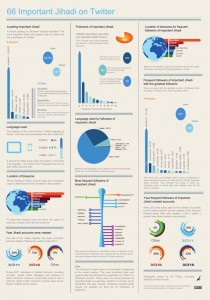
In our earlier post, together with Ali Fisher we detailed and assessed 66 accounts listed by Shumukh al-Islam jihadi Forum member Ahmad ‘Abdallah as ‘important jihadist’ members on twitter. We looked primarily at the users individually, using the data of these 66 accounts to create this infographic to give our readers an overview of these users.

In this post we focus on what we are able to find out about them as a group and provide an interactive network map to show the links between these advocated ‘important jihadist’ twitter accounts.

Relational dynamics

Analysing the relational dynamics between these accounts as a group and those who choose to follow them is a key part of understanding the online strategies of The most important jihadi and support sites for jihad and the mujahideen on Twitter”.

As we identified previously, the accounts had been categorized in different types by Ahmad ‘Abdallah. This underlines the diverse range of information, which was recommended to further the jihadist endeavour in general. In addition to understanding the specific accounts, the data can be used to analyse the network of individuals who follow the 66 ‘important jihadist’ accounts. The relationships are important as they influence the way individuals search for information, what they find and the behaviours they adopt.

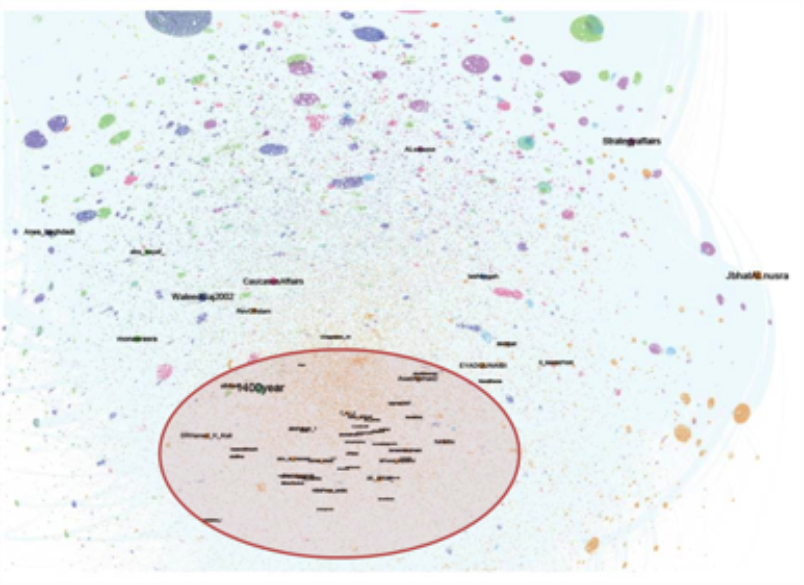
We began by identifying the followers of the 66 ‘important jihadist’ accounts. If each of these accounts were followed by a different group of Twitter users, then this would mean that collectively they were reaching 1.8 million users. However, @mujtahidd alone is followed by over 1.1 million followers, and the real number following the remaining important jihadi accounts is much lower than 700,000. This is because some users follow more than one of the ‘important jihadist’ accounts. Using network analysis, we found that the network following one or more of these accounts (excluding @mujtahidd) was 377235 users and 852948 follower/following relationships. The image below represents the network of important accounts and their respective followers. Each Twitter account is represented by a dot, and those with a follower / following relationship are connected by a line.

The graph (above) shows the network of users identified to be following at least one of the ‘important jihadist’ accounts (excluding @mujtahidd). The colours have been used to highlight the groups of users who follow the same users (or same combination of the 66 ‘important jihadist’ accounts). A quick view of the network image reinforces the previous observation that most of the users are following only one or two of these high-profile accounts in the jihadist online media mind-set. The importance of this combined approach is the ability to analyse the combinations of accounts which users have chosen to follow.

For example, this view of the network shows the concentration of user names near the bottom of the image, (highlighted in red) indicating that there are a number of accounts with fewer followers where the overlaps in follower groups are more pronounced. The Jabhat al-Nusra twitter account (discussed in greater detail here) also has a number of followers in common with the cluster of users highlighted.

Focusing on the Network of the 66 ‘important jihadist’ Accounts

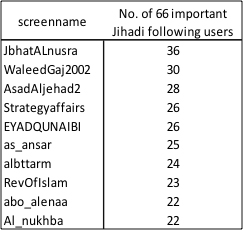
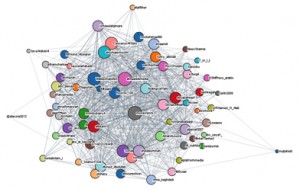
In addition to the potential to look at the followers of the 66 accounts claimed to be ‘most important’ by the Shumukh al-Islam posting, their profiles and time zones, the relationships between these specific 66 accounts can also provide analysts with insights. For example, JbhatALnusra, WaleedGaj2002, AsadAljehad2 are most frequently followed by the 66 ‘important jihadist’ accounts. Conversely, SaveArakan4, Mhaajrr, housse_100, and alassra2012 appear on the list of the 66, but few other ‘important jihadist’ accounts follow them.  The ranking (shown below) is based on frequency of being followed by the 66 ‘important’ accounts are also reflected in the eigenvector calculations for the network. The relationships between the 66 accounts are shown in the image below, and be explored in greater detail by clicking on the image, which will open the interactive version. When using the interactive image, clicking on a node will focus on the connections of that user, double click to open the twitter account of that user.

Please note that the interactive image works best in the Chrome Browser.

The network as a whole represents 958 relationships between the 66 ‘important jihadist’ users with a network diameter of 5 (the distance between the furthest two nodes calculated on the directed graph). The network density is 0.2 on the directed graph (1 would represent a complete graph, where all connections would exist).

Key nodes in the network

In our previous post, we emphasized “we are analyzing these accounts that are defined in this [Shumukh al-Islam] posting as most important for jihadi sympathizers, but it does not necessarily mean that the individual Twitter accounts are an integral part of this worldview.” In this follow-up work, however, we, perhaps not surprisingly, found that the majority of the connected accounts are hard core jihadi media activists. From the above listed, we shall have a look at some of the high-profile hard core jihadist Twitter accounts.

As we analysed JbhatALnusra previously (here, here),  let’s have a look at

@WaleedGaj2002

The account has over 45,000 followers while only following 387. Apparently this is the account of “former Guantanamo detainee and eyewitness of the Qila-e-Jangji massacre in Afghanistan” Walid [Muhammad] al-Hajj, from Sudan. According to his latest tweets, he still seems to be on the same page as the mainstream al-Qa’ida jihadis are, appraising Bin Laden and being cherished by other Twitter members for having known the shaykh personally. For further details, here is an interview with al-Jazeera. He was released in 2008. His leaked file is available via The New York Times.

@Strategyaffairs

This is a prolific and quite industrious jihadi media activists with over 100,000 followers and just over a little of 4,000 tweets. He is also active in most classical jihadist forums as ‘Abdallah bin Muhammad. Occasionally he has tweeted statements by the Yemeni AQAP prior to the ‘official’ broadcast within the forums and contextualized as well as posted the statements both within the forums and Twitter. Other Shumukh al-Islam members, for instance, used his Twitter-input to further the AQAP statements within the forum raising @Strategyaffairs status in general (example).

@EYADQUNAIBI

Doctor Iyad Qunaybi is somewhat of a rising star within the radical on- and offline scene. He is active on all social media outlets and his videotaped speeches are also transcribed and published within the jihadist forums. He rose to fame within this subculture in the past year and a half during the troubled times in Egypt and also responded to the jihadi affairs of life in general. By being included on Abu Muhammad al-Maqdisi’s database tawhed.ws, his standing was boosted. Few of his writings and audiobits are available on his author page on tawhed.ws under Iyad al-Qunaybi. His input is valued, re-tweeted and re-disseminated within the forums, on Facebook, and further published on sites such as justpaste.it, see here for example.

@as_ansar

This is the official Twitter account of the bi-lingual Shabakat al-Ansar al-Mujahideen. The main forum is in Arabic and down and out for some time now. The English forum works. With the main forum gone for the while being, this is a good example on how Twitter has become a tangible alternative to the media driven jihadists, for the Twitter accounts remain alive and very active with their over 26,000 followers, untouched by any disruptions of the forums. The YouTube link above is an “invitation to Muslims to visit the forum” and recommends and instructs the use of Tor to conceal one’s identity online.

@Al_nukhba

This account could be described as a jihadi media hub. The members, active on the forums for years, are highly committed and regularly produce transcriptions of jihadist media productions. This is naturally very helpful for any analyst but is also quite a service for the jihadi audience. Usually speeches of main leaders and ideologues as well as major video productions of as-Sahab, al-Malahem etc. are transcribed and can be conveniently downloaded as a PDF or Word document. For a first hand impression on the quantity and quality of this media department’s work, check out their contributions on the Shumukh al-Islam forum here.

On their main website data collections and videos can be downloaded and also searched for. It is a well built and maintained datawarehouse for extremist content that is first and foremost uploaded and disseminated via the classical forums. The Twitter account has about 6,000 followers, over 500 tweets, and is following no one.

This had been one of the pioneer jihadi Twitter accounts and advertised their social media passion as early as 2009. Perhaps the name nukhbat al-I’lami al-jihadi, “the Jihadi Media Elite”, stems from Abu Mus’ab al-Suri’s “Message to the British and European Peoples and Governments regarding the Explosions in London”, July 2005, where he outlined the Internet as the most important medium to propagate and spread the jihadists demands and frame of reference in general. He referred to “the jihadi elite” residing in Europe to partake in this venture.

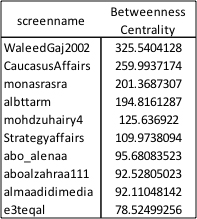
The ‘betweenness’ calculation highlights those users through which the shortest paths across the network most frequently pass. These users are often found near the centre of the network image. From the perspective of ‘betweenness’, in addition to some of the users mentioned above, also appear to have an important role bridging between different elements of the network.

To provide some additional insight in this, here is some basic information on

@Caucasusaffairs

The name of this account is program, everything related to the Caucasus, the Caucasus Emirate (analysis) with the focus on Chechnya is published here in mainly Arabic but also Russian. With over 44,000 followers while following over 400 and about 8,000 tweets this account is a valuable asset besides the main forums and their pertaining subsections. It mainly retweets the Arabic language media outlet “Echo of Caucasus” which is one of the main media hubs in Arabic for many years. You may note the four fingered black hand on the yellow background, a symbol to the Rabaa al-Adawiya protest camp whereby many pro-Mursi citizens were killed in Egypt recently. For more on this topic, check out the fantastic Closer blog here. The use of this icon in the Chechen context is yet another attempt by the media savvy jihadists to globalize their agenda and serves as proof for the repeated claim of the “war against Islam”. In the meantime this icon has been further ‘jihadised’ by adding the typical black banner, see here for example.

What does this tell us?

The density of the network has two results. First it creates mutually reinforcing clusters of information which can crowd out other perspectives and contribute to the development of a zeitgeist, or a new electronic propaganda frontier, as discussed in relation to activity of Jabhat al-Nusra.

Second, the density of the network tends to protect it against basic disruption strategies, for example the removal or suspension of individual accounts. As Paul Baran’s work On Distributed Communications has demonstrated only a small level of redundancy is required to build a communications systems to withstand heavy enemy attacks. Although this work was done in the context of the 1960s and was particularly focused on challenges faced in the 1970s, the insight provided by the study also relates to online activity and the need for more complex strategies to disrupt dense communication networks.

Jihadi Twitter activism – Introduction

Ali Fisher and I have recently exchanged thoughts and data regarding the increasing Jihadi use of Twitter. By taking an interdisciplinary approach of social-media analysis and cluster network assessment, we decided to start a series on Jihadica on the parts of the overall jihadi, primarily Arabic language propaganda resonating among the audiences online. We plan on delivering updates on the subject as we move along and kick-off the series with an overall introduction to the theme.

In future posts in the series, we will highlight and decipher some of the core content most often shared on Twitter, allowing conclusions to be drawn about the parts of jihadist propaganda which resonate with a wider audience (and hence shared over and over again).

Introducing the theme

The recent essay by Abu Sa‘d al-‘Amili on the state of global online jihad (discussed here) lamented a general decline in participation in jihadi online forums. Furthermore, al-‘Amili issued a “Call (nida’) to the Soldiers of the Jihadi Media” demanding that they “return to their frontiers (thughur)” elevating their status. Al-‘Amili himself is one of the high-profile clerics, a “prolific “Internet Shaykh” (Lia) on the forums, but is also quite active on twitter (@al3aamili).

Two interrelated causes identified by Abu Sa‘d al-‘Amili were the periods when forums were offline and the migration of users to social networking sites such as Twitter and Facebook. This is exacerbated by the movement of “major [jihadi] writers and analysts” (kibar al-kuttab wa-l-muhallilin) from the forums to social media platforms. This has perhaps increased the momentum of members of tier-one jihad forums to expand onto twitter while twitter as a massive communication relay has become the basis for a new generation of sympathizers, posing another intersection. Twitter is a further medium of choice to (re-) disseminate propaganda material in general and is a platform where activists, sympathizers, and actual fighters upload audiovisual and other types into the jihadi hub.

Jihadists have aggressively expanded the use of twitter, in addition to Facebook and YouTube, especially since the outbreak of violence in Syria. During 2011 members of Jihadist forums issued media-strategies and advisory to fellow members prior, as for example is stated in this posting here of the al-Ansar forum. The posting, initiated by the member Istishhadiyya is basically a very elemental guide, comprehensive and for beginners, highlighting the effective and fast communication capability. The same posting was copy-and-pasted by Shumukh member Basha’ir shortly afterwards. A handbook, compiled by Twitter user @osamh ended up on the jihadi forums to further underline the importance of Twitter as well as its difference to Facebook, where jihadists already have a strong presence.

It took a while for jihadi activism to fully unravel on Twitter, and they have maintained a cohesive as well as detailed presence on this social media platform since the Syrian conflict turned violent in 2012.

Twitter, and as such social media in general, is in the meantime an integral part of jihadists’ media endeavors on the Internet, with the majority of jihadi forums having their official account advertised for on the main pages of the forums.

The role of the media activists, or in jihadist speak the “media mujahid” has since the death of Osama bin Laden in May of 2011 been promoted, highlighted and approved. AQ related documents have made this role model prominent. The role model of the “media martyr” any “media mujahid” can be become, is backed by the call to take the fight on a greater level on al channels online issued by al-Fajr in their response of the killing of bin Laden:

“The Internet is a battlefield for jihad, a place for missionary work, a field of confronting the enemies of God. It is upon any individual to consider himself as a media-mujahid, dedicating himself, his wealth and his time for God.” (Analysis here, Arabic original here)

At first, the strategies to promote Twitter among members of jihadi forums failed to develop substantial traction, but this changed drastically during 2012. When jihadists in and outside of Syria started to use and incorporate twitter as a medium to disseminate and re-post al-Qa’ida and other propaganda material.

Twitter activism and jihadi supporters

At first Syrian non-violent activists used, and continue to use, twitter as a medium to document human rights abuse and war crimes of the Assad regime, but jihadists quickly adapted that content and the platform for their propaganda.

Social-media smart and professional jihadists adopted this treasure grove for their propaganda. By rebranding and reframing the content created by civil society activists, jihadi propaganda used these grievances to support a key jihadist self-perception; the obligation to respond by force to defend and protect the Sunnites in Syria.

Due to the effect and success of the Syrian based Jihadi groups, other jihadi groups as well as the main forums are adopting the twitter activism, advertising official forum accounts on the main pages with users within the forums using twitter hashtags (#) or references to twitter users (for example: @al_nukhba). A list of “The most important jihadi and support sites for jihad and the mujahideen on Twitter” was recently posted on the Shumukh al-Islam forum, allowing users to identify key accounts they might wish to follow.

Individual sympathizers and all those feeling inclined to contribute to the media jihad re-disseminate authoritative files of al-Qa’ida on twitter on a larger scale. Now all major jihadi media departments, part of militant networks, have their own channels on Twitter, linking to content from the jihadi forums and other social media platforms, primarily YouTube, Facebook, and pictures in general.

Twitter has turned into a primary hub for the distribution of jihadi agitprop files. These Jihadi information sharing networks using Twitter coexist, autonomously, with the classical forums. These networks carry, for example, samples of the wide range of jihadi propaganda files, in some cases placed first on Twitter, posted via mobile phones from the front lines. As a brief overview, a few samples consisting of:


  • martyrs in general and martyrdom operatives (istishhadiyyun) announced and identified by their hashtag and Twitter account;
  • calls for donations with phone numbers and social media contact information; taking care of the orphans of the martyrs among other civil elements;
  • general material of incitement, and the impact of online attained propaganda files used offline are popular and gain plenty of traction,

What are they sharing?

In addition to disseminating their own propaganda, jihadi media activists repurpose content from social movements and non-jihadi groups for their own purposes, framing the non-jihadi actions or demonstrations as part of the global militant struggle. This has created another ‘grey area’ where analysts have to carefully monitor and decipher such content. The forum administrators and media-activists also are starting to incorporate and misuse Twitter for their purposes, in coordinated attempts to virtually infiltrate legitimate social movements by using the same hash tags and a similar rhetoric to create ideological cohesion – and placing extremist views and files in that virtual sphere while claiming to fight on the ground for the sake of the people.

To analyze jihadi media networks, their sympathizers and followers we have used a combined approach focused on a unique interdisciplinary analysis of the data acquired by technical means and the subsequent and immediate analytical process of its content.

Using these methods we have asked a range of questions, how have jihadi propagandists been able to gain traction and a foothold online? How do they disseminate propaganda content to a global, multilingual audience and what resonates most with that audience? What are the networks through which their content flows and what are the different roles users play within these networks? Ultimately do the different jihadi twitter accounts reach a range of different communities, or is it a small densely interconnected echo chamber?


Are the Jihadi Forums Flagging? An Ideologue’s Lament

Last month prominent jihadi ideologue Abu Sa‘d al-‘Amili published a critical essay on the state of online global jihad. Released by Fursan al-Balagh Media (@fursanalbalaagh) on February 17, the eight-page essay stirringly lamented a general decline in participation in jihadi online forums (websites such as Shumukh al-Islam and Shabakat al-Fida’ al-Islamiyya) and pleaded with users to reinvigorate the forums as the proper centers of jihadi discussion and intellectual production online. (For the history of these forums and their important role in jihadi activity, including their ties to al-Qaeda and its affiliates, see here.)

While it is certainly a stretch to say that the forums are falling into desuetude, al-‘Amili’s lament ought to be taken seriously, if only on account of the author’s status in jihadi circles. The pseudonymous shaykh is a prolific jihadi presence online, with numerous essays and fatwas and even a collection of poetry to his name. Who al-‘Amili actually is remains a mystery. He has previously justified guarding his true identity—and any and all details of his background—out of security concerns, citing Qur‘an 74:31: “And none knows the soldiers of your Lord except He.”

His essay in question, “On the Languishing of the Jihadi Forums: Causes and Solutions,” is a passionate appeal to his fellow jihadi netizens. Al-‘Amili describes the forums as a “factory” whose workers ought to be participating in production but who apparently are not working very hard. He admonishes forum members for not honoring the “responsibilities” that forum membership entails, including guarding the forums’ “reputation,” “credibility,” and “preeminence” in the field of jihadi media.

The rest of the essay consists of two parts, the first enumerating the reasons behind the decline of the forums and the second providing suggestions for turning this situation around.

Why the forums are flagging

The first reason for the forums’ “languishing,” according to al-‘Amili, is the periodic disruptions to which they are subjected by “our enemies,” meaning Western governments. In spring of last year, for example, most of the major jihadi forums were shut down for a number of days or weeks. The result of such shutdowns, says the author, is that some forum members seek out temporary online alternatives, though most simply abandon their previous activity out of either fear or negligence.

The second reason is increasing fear of monitoring and tracking by state governments, which has resulted from these routine forum outages.

The third is the “departure into battle” (al-nafir) of forum members heading to theaters of jihad such as Syria. Al-‘Amili proudly notes that “the jihadi forums are universities graduating bands of ansar al-jihad” (supporters of jihad). These “departers” are not to be considered a loss to the forums, though their departure does result in decreased activity. (For a study that confirms the phenomenon of forum members moving to jihad fronts, see here.)

The fourth reason for the forums’ decline, and the one which al-‘Amili focuses on the most, is jihadis’ migration to social networking sites such as Twitter and Facebook. Such movement was born out of necessity during the periods when the forums were shut down, he says. This bore fruit temporarily, but in the long run relying on social media is an error that will derogate from the centrality of the forums—“our protected strongholds.” The movement of “major [jihadi] writers and analysts” (kibar al-kuttab wa-l-muhallilin) to social networking sites is also part of this problem, as ordinary forum members have migrated with them in order to follow their writings.

The fifth and final reason for decline is a vicious circle problem following from the withdrawal of both major writers and ordinary members. When the former’s writings have received little attention on the forums from the latter, the major writers have been further discouraged from contributing directly to the forums. Thus the withdrawal of the one reinforces the withdrawal of the other.

How to reinvigorate the forums

The first of al-‘Amili’s “suggested solutions” to reversing the forums’ purported state of disrepair is reaffirming the importance of the forums “as a defensive, lethal weapon for confronting the enemies of the Islamic community.” As much as soldiering on the battlefield, actively participating on the forums ought to be considered jihad in the fullest sense of the word.

Second is for members to have more confidence in the forums’ security and in their own security as users. The forum administrators, he says, are more concerned with the general membership’s safety than with their own; they are utterly devoted to forum security and would never forsake “their soldiers.” It is simply unjustified, he says, to turn away from the forums out of fear that they have been compromised. Nor is it justified to turn away out of fear that participating will lead to being monitored. Members need only use the “identity-disguising programs” (baramij al-takhaffi) designed by “your technician brothers” on the forums to protect their online anonymity.

Third is for major jihadi writers to use the forums as the main outlet for their writings, thus drawing ordinary members back to the forums in tow. Here he directs a plea to “the major [jihadi] writers and shaykhs and analysts” to return to the forums. These latter ought to be “the main theater of your jihad and the principal point of departure for your guidance and your analysis.”

Fourth is to recognize the inadequacy of social media as an alternative to the forums, a point on which al-‘Amili is adamant. On social media, he says, we are only “guests,” for these sites are run by “our enemies.” Inevitably there will come a day when “they shut their doors in our faces.” What is more, relying on social media poses an inherent danger to jihadis as “the enemies” can use these sites against us at any time. If we preference social media we will be “duped” into diminishing and spoiling our efforts. The forums ought to be jihadis’ “base and foundation” online.

Fifth is to attract new technical experts, graphics designers, and translators to “jihadi media organizations”—which publicize on the forums—to improve the effectiveness of the media and messages posted there.

An effective prescription?

If al-‘Amili’s five stated reasons for decline are accurate, is it possible, following the author’s prescription, to reinvigorate the forums? The short answer seems to be no: periodic forum outages have been damaging and the attraction of social media is on the rise. But one must also consider that al-‘Amili is exaggerating the extent of whatever “languishing” is actually taking place. For one thing, jihadi participation in social media has not necessarily undermined the position of the forums.

Recently, Shumukh members posted long lists of jihadi Facebook and Twitter accounts suggested for following. Among the Twitter accounts listed was one belonging to a certain Abu Sa‘d al-‘Amili (@al3aamili)—yes, the very author of this essay warning readers of the dangers of social media. Al-‘Amili, in fact, has tweeted quite often since December 2012.

Indeed, social media has probably benefited the state of online global jihad by exposing the jihadi message to more potential sympathizers and recruits. This has had the effect of decentralizing the online jihadi environment, leading to relatively less participation on the forums in the form of discussion and analysis. But the forums are hardly in a state of disrepair; comments and analyses are constantly being posted, often in a parallel effort with Facebook and Twitter jihadi accounts. This is very much the case with the “major writers” whom al-‘Amili mentions—and among whom al-‘Amili may be counted. Their writings tend to originate with independent jihadi media outlets that post to Twitter and Facebook, as well as to the forums.

Rather than languishing, the forums have succeeded in retaining their special position as an unusually private setting for exclusive discussion, which sometimes leads to collaborative efforts. Furthermore, as the main conduits for conveying official al-Qaeda media to the online jihadi community, they continue to enjoy a vaunted status as semi-official websites for al-Qaeda and its affiliates. They may be suffering somewhat, but the jihadi forums are hardly on the down and out.

Al-Qaeda Advises the Syrian Revolution: Shumukh al-Islam’s “Comprehensive Strategy” for Syria

Three weeks ago members of Shumukh al-Islam, al-Qaeda’s premier online forum, began collaboration on a “comprehensive strategy” for the ongoing Syrian jihad. In a thread started by a certain “Handasat al-Qaeda,” several dozen members of the access-restricted site set down a plethora of observations and recommendations.

A week later, on February 9, the same member to initiate the thread condensed these contributions into a single strategic document, intended to represent the forum membership’s thinking as a whole. The author identified the document as sensitive and not to be shared except via email with jihadis lacking access to Shumukh. (The Shumukh forum, which has direct ties to al-Qaeda, is password-protected and does not readily register new users.) In the spirit of transparency, I have taken the liberty of translating the document in its entirety (see below).

In all likelihood, Shumuk’s so-called “comprehensive strategy” for Syria has less value for jihadis on the battlefield as actionable strategy than it does for researchers as a window into how important jihadi thinkers are processing the unending Syrian civil war. In this regard, the document is particularly revealing in two respects.

First, contrary to the triumphalist tone of much Syrian jihadi media, the Shumukh members are not upbeat in their description of ongoing and anticipated events. For the present, there is hope mixed with desperation and fear; for the future, a strong sense that the jihadis will suffer strangulation from all sides. In their worldview, some form of Western intervention to stymie jihadi success is all but assured; the West, with its Israeli and Iranian allies, will seal Syria’s borders and proceed to eliminate the jihadi threat, carving up Syria and elevating the “Islamists” to power.

Second, Shumukh’s recommendations presuppose a very long war in Syria. These include such things as rapidly increasing the number of recruits before the borders are sealed, making sure to take control of the regime’s heavy and unconventional weapons, establishing a unified media organization for more effective propaganda, and refraining, at all costs, from allying with “Islamists” such as the Muslim Brotherhood, no matter how attractive this might seem.

Read in full, Shumukh’s “comprehensive strategy” for Syria presents an unmistakably grim prognostication for jihadism’s future in Syria—indeed a grim prognostication for Syria’s future in general. It is an attempt to think realistically about the challenges to true jihadi success in Syria in the coming months and years.

Translation of Shumukh al-Islam’s “comprehensive strategy” for Syria:

As you know, brothers, the intention of this thread is to bring together the greatest possible number of strategic ideas and proposals from which our mujahidin brothers and their supporters, especially those on the fighting front in Syria and its surrounding areas, may benefit. We would like here for our forums, in addition to their traditional role of support, publication, mobilization, and exhortation, to be centers for research and sophisticated studies that issue reports and advisory recommendations by which we may progress, by firm and well-studied steps on our path toward the virtuous caliphate, and arrive by God’s help and support at the desired objective in the quickest time possible and at the lowest possible cost. This is just as our enemies have centers for research and advisory studies, directed by contemptuous experts and thinkers, constantly issuing recommendations and reports which their countries’ governments act upon.

Here we will combine what we managed to summarize of previous and other entries, reducing them to a number of important and all-inclusive strategic points. These will give us, and our brothers in Syria and its environs, a clear picture of what our enemies are planning for us and what we must do to resist them, nay what we must do to take charge of our present and future activities and to compel our enemies to respond to what we—not they—are planning.

First, there are two points which constitute red lines and on which there can be no debate with anyone, whether in Syria or elsewhere. The first is ruling on the basis of the Islamic Shari‘ah, that is, striving to establish an Islamic state that rules according to the book of God and the normative practice of His Prophet, peace and prayers be upon him, in accordance with the understanding of the pious forefathers of this [Islamic] community and the interpretation of their pious successors. The second is non-recognition of any Sykes-Picot boundaries between our Islamic countries, near or distant, except insofar as Islamic activity may require harmless formalities, like the requirements of travel and logistical cooperation, on account of what this serves us in gathering soldiers and support and the like.

In light of the foregoing points, here we will set down certain recommendations, as well as [describe] certain events anticipated—by God’s will—to transpire.

Events anticipated and ongoing:

First, most of our thinkers expect the struggle in Syria to endure for a long time, and it is necessary therefore to make the needed provisions for this.

Second, there is currently an ongoing race, and there will be Crusader-Israeli-Iranian efforts, to wrest control of or destroy the chemical weapons facilities within Syria before they come under the control of those whom this criminal alliance believes are a danger to it: namely, the jihadis or Hezbollah[i] from the perspective of the Jews and the Crusaders, and the jihadis from the perspective of the Iranian Zoroastrians and the Crusaders.[ii]

Third, a Crusader power will, inevitably, arrive on Syrian territory, using multiple pretexts such as “preserving peace” or “protecting the Jews” or “protecting the poor and innocent Alawite community!!!!”

Fourth, there will be efforts to partition Syrian territory—or partition will be imposed upon it—with a view to protecting the Alawite sect so that the latter may serve as a Crusader-Jewish-Zoroastrian nail in the throat of the Sunnis in greater Syria. This is an outcome which must be guarded against no matter how many Islamists engage in the conspiracy, either as clients cognizant of the conspiracy, or as fools ignorant of it.

Fifth, the revolution and the mujahidin are currently being besieged in an effort to prevent their acquiring arms, while at the same time military, logistical, and financial support are being provided to the Alawite regime. There are, of course, a number of reasons for this, all of them being interests of the alliance mentioned above:

  • prolonging the war until the desired arrangement of cards and puppets can emerge;
  • bleeding the financial reserves of the regime and sucking dry everything in this foolish Alawite’s possession;
  • transforming those financial reserves into arms and weapons stocks for the regime, that it might use them against its people in bombarding and destroying them, or that they might fall as booty into the hands of the revolution’s fighting units;
  • exploiting the revolutionaries’ seizure of the regime’s weapons in order to destroy what remains of it [the regime].

With time, everyone will be exhausted, all weapons in Syria will be destroyed, and all signs of civilization will be obliterated and cast back to what existed before the Stone Age. Thus will the path be paved for direct and indirect military intervention in Syria, and for redrawing the map in accordance with the wishes of the Zionist-Crusader-Zoroastrian alliance.

Sixth, different forms of intervention will multiply in Syria, which will become filled with contradictory ideas leading to major disagreements among opposition forces, as well as among the independent fighting units of foreign origin fighting on the battlefield in league with these forces.

Seventh, and with the transformation of the revolution’s course into an “Islamist” one, “drawing on the support of God and intending to establish His rule on the ground,” it is the “secular Islamists” who will be brought to power, power being their main objective. In this they will be encouraged by the forces of the international conspiracy, but on the condition that they [the Islamists] oppose with all their might this jihadi Islamic tide aspiring to the virtuous caliphate. What will happen, in other words, is that pseudo-Muslims will be attacking Muslims, thus sparing the infidel powers the evil of fighting themselves. Of course, this group (i.e., the secularist pseudo-Muslims) is that which will be provisioned with weapons from now on, so that instead of against the Alawites they [the weapons] may be used against the [conspiracy’s] real enemy, which is those who wish to implement the rule of the Islamic Shari‘ah.

Eighth, after the exhaustion or downfall of the regime, the Zionist-Crusader-Zoroastrian alliance and its allies in Syria will, if possible, reorient its compass in a new direction, sealing off all borders to forestall an influx of jihadi recruits and any kind of logistical support for them. This will be with a view to besieging them [the jihadis] and beginning a confrontation with those of them present inside the country.

Ninth, the shared interests [in besieging the jihadis] mentioned in point eight will expand to encompass the Brotherhood government in Turkey, the client Son of the Crusaders in Jordan and his Brotherhood friends, Lebanese Hezbollah, the Safavid government in Iraq, the hypocrite government in the Hijaz, the Muslim Brotherhood government in Egypt, and others who are clearly with them.

Tenth, in sum, perhaps it will be that our brothers in Syria are exposed to extraordinary pressure, assault, forced retreat, ignominy, and many, many other things. But all of this, God permitting, will be of a piece with the greatness of the trial and the test, and the greatness of the responsibility assumed for pushing the community of one and a half billion Muslims toward salvation. And few are those, unfortunately, deserving of such credit.

As for the recommendations that are advised:

First, patience…and more patience, and trust in God alone in all things, and dependence upon Him, be He praised and exalted. For He is the Bringer of success and the All-Knowing about His servants.

Second, keeping in our eyes the principal objective at all times no matter what the challenges. This is: the annihilation of the Alawites, then the establishment of God’s law in the land of Syria—in preparation for erecting the larger virtuous caliphate on all of the earth—and removing all obstacles standing in the way.

Third, making the necessary provisions and taking the necessary measures for what will follow the fall or toppling of the regime. In fact, these are of greater concern to us than the ongoing war, be one a mujahid inside Syria or a supporter somewhere around the world.

Fourth, collecting the greatest possible amount of heavy and unconventional weapons and guarding them in full security, as there will be great need for them in the future.

Fifth, increasing recruitment [of mujahidin] extensively and securely—securely meaning the possibility of recruiting large fighting units for service with Jabhat al-Nusrah while instructing individuals in the correct [Islamic] creed and path, periodically polishing them [in this way], and selecting those whose credibility has been established for dependable battalions…and things such as this—as well as establishing links and alliances, insofar as these do not contravene God’s law, with the many influential forces in Syria, such as other Islamic organizations, tribal shaykhs, and others.

Sixth, working to increase greatly the inflow of recruits to Syria, both because of what need the brothers have there and because the openness of these borders will not persist; rather the borders will soon be closed. But this inflow need not require emptying other [jihad] fronts of the fighters and young men who are needed there; rather [the latter should spare only] what they have above and beyond their local need and in proportion to the need of our brothers in Syria if it be greater.

Seventh, all forces of Ansar al-Shari‘ah throughout the world (in Tunisia, Egypt, Libya, Lebanon, Jordan, Yemen, and even in Europe) must take concerted action in two ways:

  • First, work to increase the number of lectures and activities relating to preaching, consciousness raising, and communications—with regard to the media, there is today a concerted media war against the brothers in Syria and especially from the channel “al-Jazeera,” for recently this lying channel has attributed all the various operations and activities in Syria to the “Free Syrian Army”; this is a criminal and programmatic effort to brainwash the viewers and render the past and future of the revolution empty of any activity or space for Islamic fighters—and work to inform the Islamic community of the truth of the struggle [in Syria], of its nature as global and not merely limited to Syria, or as merely opposing oppressive regimes, but rather as opposing the murderous Alawites, those of the Zoroastrians standing in the background holding imperial Persian dreams, and a Crusader-Jewish alliance that provides unlimited support to anyone wishing to destroy the community of Islam.
  • Second, work to gather contributions and support for our brothers in Syria and ensure that they reach them, as well as working via the proper mechanism to sustain necessary recruitment activity and engaging in demonstrations highlighting the extent of the interconnectedness of our interests around the world. For we are a single community, not divided by geographical or other boundaries. All must know that the issue of Syria is a pivotal issue for us, and that no participant in a conspiracy against the brothers there will ever be spared, no matter how far away he may be.

Eighth, the military and civilian units of global jihad supporters in Jordan, Iraq, Lebanon, and Palestine must be fully prepared for mobilization if that is required. What this means is that there first be peaceful activities, as we have indicated [in point seven], but that they be accompanied by the threat of plunging the entire region into a vast war if our brothers in Syria are besieged or conspired against whether [by elements] from beyond Syria or by the brothers of the revolution itself. The interests of anyone participating in such a conspiracy would be targeted. Fingers should be on the trigger. Indeed, this point is most important for establishing a balance of fear that allows the brothers in Syria the support necessary to be able to concentrate on their activities within the country.

In this vein, the brothers from the Islamic State of Iraq, may god strengthen them, who are the true strategic depth for the brothers in Syria, must work to prevent the Safavids from having any presence on the eastern Syrian border. They must ensure sustained logistical support and prevent the Safavids from partaking in any effort to besiege the brothers in Syria in the future, as well as stop overland support and other things that would diminish pressure on the Alawites in the west of Syria.

Ninth, the fighting units of Jabhat al-Nusrah, may God grant them victory, and their allies should turn their fire and missiles in the direction of Alawite cities with great intensity. For such will work to upset their security and encourage them to flee, particularly those possessing wealth, thus leading to the collapse of the regime’s bases of support. The latter consist of the finances provided by Alawite businessmen, and which is necessary for funding the different groups of the shabiha.

Tenth, the fighting units of Jabhat al-Nusrah and their allies should work to establish a broad and unified shura council and to create an executive committee for carrying out the work of governance, in order to fill the void and manage people’s affairs in the areas under our control. In this way services and other forms of aid may be rendered, people may be educated and enlightened about the creed and Islam, and they may be informed about the international conspiracy against them.

Eleventh, establishing an office or large media organization that would work around the clock for Jabhat al-Nusrah and the fighting units in Syria allied with it, providing the people with the necessary facts. For the media in this generation are equivalent to half the army, and sometimes international wars are led by means of the media alone. This [proposed] office can produce local broadcasts, ensuring that these reach every home in Syria and thus allowing the true, undistorted voice of the mujahidin access to the ears of the people.

Twelfth, it is incumbent upon all preachers and religious scholars to bear their legal responsibilities to guide and enlighten the [Islamic] community. For your brothers in Syria, in the coming days, will be in the utmost need of what you can do [for them].

Thirteenth, establishing a professional intelligence apparatus to carry out special operations: that is, to clean up anything dirtying the path to the creation of an Islamic state.

Fourteenth, urging our brothers in Jabhat al-Nusrah to seize control of geographically strategic areas; also urging them to seize barracks containing heavy weaponry so as to increase the conventional weapons stocks that will be of the greatest importance in the future.

[Finally,] a notice: Personally, I do not at the present time advise striking what is referred to as “Israel.” Doing so would widen the circle of enemies and [war] fronts around our brothers while they are in an inflexible state of full exertion. [I would only advise it] in the event [“Israel”] immediately join the battles alongside the Alawites against the mujahidin, or if we were responding to Israeli tests of our determination, which they will carry out once the mujahidin have or are nearing complete control of Syria.

This is what was possible for us to bring together of points and recommendations. We ask God Almighty to grant us success by means of them, to grant our brothers in Syria success by means of them, to grant them victory, and to establish for them the virtuous caliphate, by the permission of Him—be He exalted.


[i] In a typical play on words, Hezbollah is rendered in this document Ḥizb al-Lāt, meaning the “party” not of God but rather of a well-known pre-Islamic pagan deity.

[ii] The author has a very confused understanding of Middle Eastern alliance politics, a common feature of jihadi writings.

Al-Qaida advises the Arab Spring: Syria

With the Arab Spring going strong in several countries, al-Qaida (in a broad sense, so including ideologues and scholars supportive of the organisation) still finds it necessary to comment on what is happening. In a series of posts, I will deal with the advice al-Qaida is giving the people of several countries, starting with Syria.

Praise

One of the men “advising” the Syrians currently revolting against the regime of President al-Asad is Ayman al-Zawahiri, the current leader of al-Qaida. In an epistle meant solely to greet, encourage and heap praise on the people he is addressing, al-Zawahiri spends one of the first paragraphs of his letter saying “salamun ‘alaykum” to his audience no fewer than eight times. He addresses them as “the mujahidun who command good and forbid evil”. This seems to be an attempt to claim that al-Qaida-like people are the ones trying to overthrow the Syrian regime, which is a good thing from his point of view because it allows him to create the idea that his organisation is alive and kicking and busy overthrowing “infidel” rulers, as it should be. From the Syrian people’s point of view, however, it is doubtful whether this is going to do them any good. As radical scholar Abu l-Mundhir al-Shinqiti pointed out in a fatwa that I wrote about in a previous post, it may actually be more advisable for Syrian jihadis to lay low, not giving the regime any extra excuse to crack down on them with the argument that the demonstrators are, in fact, terrorists. Al-Zawahiri doesn’t seem to realise this, urging his audience to tell President al-Asad that he is “a partner in the war on Islam in the name of terrorism and a protector of the borders of Israel”. Even more explicitly – in a phrase that sounds better in Arabic than it does in English – he tells them to say to al-Asad: “We have broken the shackles of fear and smashed the prison of weakness. The free [men] of Syria and its mujahidun have decided that they will live as honourable people and die as martyrs (ya’ishu a’izza’ wa-yamutu shuhada’).”

Al-Zawahiri also keeps going on about the supposedly strong American ties to the Syrian regime. He states that “America, which has co-operated with Bashar al-Asad throughout his reign, now claims that it is on your side”. He advises the Syrian protestors to say to the U.S. and President Obama that “we are the sons of the conquerors, the offspring of the mujahidun and the heirs of the murabitun (fighters operating from garrison cities).” The battle fought against the Syrian regime, al-Zawahiri claims, will obviously continue until “we raise the banners of victorious jihad” over Jerusalem. How exactly this is to be achieved in the face of a brutal regime that is not afraid to kill thousands of its own people is not entirely clear.

Syrian sectarianism

A more rational and level-headed approach is taken in another document, this one by Abu Basir al-Tartusi, a scholar living in London who is in no way part of the core leadership of al-Qaida but is one of the major thinkers reponsible for the organisation’s ideology. The originally-Syrian Abu Basir is churning out writings on Syria faster than you can say “the people want to topple the regime”, which may force me to dedicate another post to this country. In any case, Abu Basir wouldn’t be a true Salafi if he didn’t start by criticising the sect of the al-Asad family, the ‘Alawites, which Salafis (and, to a lesser extent, Sunnis in general) view as deviant or even infidel. He claims that they – among other things – are batinis (i.e. people who believe the Qur’an has an inner, esoteric meaning apart from its outer, exoteric meaning), idol worshippers and people who claim that caliph ‘Ali b. Abi Talib is God.

These ‘Alawites, Abu Basir claims, do not care about their homeland, or about its citizens. They have never amounted to anything and have never given any thought to what the people need. Abu Basir claims that the Syrian sectarian system is largely to blame for this, probably because the large number of sects and the differences between them encourage their members to act only on behalf of their own group, at the expense of loyalty to the country and the people as a whole. As a result, this regime has only brought awful things such as destruction, division and poverty. Surprisingly, however, given Abu Basir’s views of ‘Alawites in general, his approach is nuanced enough to distinguish between ‘Alawites who are part of the governing circle of President al-Asad and the majority of ‘Alawites, who suffer from poverty just like other Syrians. His wrath is therefore directed towards the regime and he thus advises the Syrian people to unite and express only one demand: the fall of the regime. Raising any other demand, Abu Basir claims, would be quite unwise, presumably because he realises that Syrians are not united enough to form a coalition on the basis of any demand other than the fall of the regime.

Practical advice

In two other writings (here and here), Abu Basir continues about the situation in Syria and stresses the need for peaceful resistance but also the legitimacy of self-defence. The regime, he says, has killed or wounded tens of thousands of people and the latter should therefore learn how to protect themselves by setting up security committees that can defend the protestors. These committees, he states, should not participate in demonstrations or in any peaceful activities, so as not to give the regime an extra reason to crack down on protestors. Abu Basir also wants “the noble free officers” (i.e. the ones that abandoned the regime’s army) to increase in number, expand their military activities and co-ordinate them with the aforementioned security committees.

Apart from advising the Syrian people on using non-peaceful methods, he tries to convince them that violence is justified. While he keeps stressing that peaceful resistance is good and commendable, he fails to see its use after so much bloodshed and scolds Syrians for refusing even to take violent means into consideration after it has become clear that sit-ins and other peaceful means have proved useless. He encourages the people to obtain arms and even quotes a verse from the Qur’an about military preparedness to underline the legitimacy of the use of violence. After having compared the Syrian regime with the French colonialism of the past, he wonders what the difference between the two of them really is and calls on the remnants of the army to fear God and take their responsibility towards Syria and its people by defending them and their honour “against the imperialism of the sectarian regime of al-Asad”.

If and how this advice is accepted by Syrians in general and jihadis in particular is unclear. What is clear from Abu Basir’s writings, however, is that he obviously cares about Syria. The tone of his work here is not one of fighting against “infidel” rulers who fail to apply the shari’a but much more one of concern for his native land, which he even refers to as “the beloved Syria”. Whether this is also the case with other commentators “advising” demonstrators in other countries is something I intend to explore in future posts.

Latest Jihadica
Subscribe to receive latest posts
Follow us