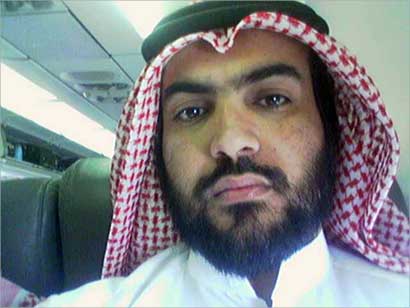
The Adventures of Sinam

On August 9, a member of the Islamic State of Iraq announced–via an intermediary on the Ekhlaas forum–the death of Sinam al-Ramadi. Sinam was an al-Qaeda member who operated in Ramadi and who participated on a number of forums, including Faloja.

On the day of the announcement, an Ekhlaas member named Halima posted an eyewitness account of Sinam’s capture. The account is interesting for the light it sheds on al-Qaeda’s activities in Anbar province and for what it tells us about the hectic lives of forum fighters–Jihadi forum members who are also active militants.

Halima writes that on Thursday, August 7 a certain Dr. Khattab `Ali al-Hayani was arrested in Haqlaniya, near Haditha. U.S. troops and Iraqi police had discovered evidence in Hayani’s home proving that he was Sinam al-Ramadi, one of the members of al-Qaeda in Ramadi. Sinam had left Ramadi for Kirkuk, Diyala, Bayji, and finally Haditha, where he was “considered one of the al-Qaeda returnees to the regions of western Anbar.” (I think this means that he was an al-Qaeda member in Anbar who had fled following the success of the tribal Awakening and later returned.) It was already known that Sinam had created al-Qaeda cells living in the environs of Haditha and that he had a death sentence passed against him for killing a Christian clergyman in Mosul.

Sinam was arrested after being followed by an American spy plane, which had spotted him after an Iraqi Hummer exploded between Barwana and Bayji. Sinam was stopped near the Haditha dam and badly wounded after he and his comrades resisted arrest. Halima relates that an American general said to him, “Are you the one who hassled us so much on the Internet?” Sinam couldn’t have been more than 24 years old, according to Halima.

There’s some things in Halima’s account that don’t make sense. It’s hard to believe that a U.S. general was involved in Sinam’s capture or that Halima overheard their conversation. And Halima does not write of Sinam’s martyrdom, which was being celebrated on the forums, but rather his bloody capture. (The title of Halima’s post does suggest that Sinam was executed later for killing the clergyman.)

Still, Halima’s details about Sinam’s route fit with what we know of al-Qaeda’s recent migration out of Anbar. And her story of Sinam’s arrest also dovetails with recent news about the al-Qaeda cell operating in Haqlaniya.

Document (Arabic): 8-9-08-ekhlaas-post-regarding-death-of-sinam-al-ramadi

Document (Arabic): 8-9-08-ekhlaas-biography-of-sinam-al-ramadi

Spinning the Failure of the Islamic State of Iraq

More evidence that the failure of the Islamic State of Iraq is severely demoralizing Jihadis, at least in the Arabic-speaking world.

Asad al-Jihad2, a popular commentator, has written a new booklet, “The State of Islam Remains Defiant.” In it, he seeks to assuage growing doubts about the viability of the Islamic State of Iraq:

Upon reflection, some may say, “The Islamic State of Iraq is still in the right. So why are things becoming so difficult for it, its enemies joining against it from all sides?” (p.7)

The answer is that God is testing the resolve of the mujahids in Iraq, the same answer Yaman Mukhaddab gave in July to dispel the pessimism of the Hesbah forum members.

On the Faloja forum, Hafid al-Husayn has a similarly defiant title for his post: “The State of Islam Remains, Despite the Tricks of the Tricksters.” Hafid acknowledges that things are not going well, but he blames the U.S. and its dirty tricks, which include the following:

  • Spreading lies about the Islamic State of Iraq to turn the public against it. It wrongfully accuses the ISI of targeting civilians and sectarian killings.
  • Using Arabic channels to spread these lies
  • Seeking the publication of fatwas by religious clerics against the ISI
  • Secretly co-opting Iraqi resistance groups and turning them against the ISI

Jihadi uberpundit Husayn b. Mahmud believes the tricks are working, turning insurgent groups against one another. He chastises his fellow mujahids:

So great is the contempt that your enemy has for you that he announces his plan and guides you to the hole he has dug for you. Then you walk to the hole and throw yourselves in voluntarily!!

Abu Osama1 on Firdaws is similarly clear eyed in his assessment of the ISI’s predicament, but he is more optimistic. He acknowledges that the number of explosions has decreased and the number of civilian deaths has gone down, but he argues that al-Qaeda is just playing dead and biding its time.

None of the authors can bring themselves to say that the condition of the Islamic State in Iraq is terminal, but that’s the barely-concealed prognosis.

Document (Arabic): asad-al-jihad2-the-state-of-islam-remains-proud

Document (Arabic): 8-13-08-faloja-describing-recent-success-of-us-io-campaigns-against-isi

Document (Arabic): 8-12-08-faloja-husayn-b-mahmud-angry-about-success-of-us-dividing-jihadi-groups

Document (Arabic): 8-13-08-firdaws-aq-just-playing-dead-in-iraq1

Jihadis Apprehensive About the Future

Jihadica reader Jallen asks some good questions about the pessimism of Jihadis regarding Iraq:

How long have forum members been pessimistic over Iraq? Is the pessimism widespread or just a few members in one forum? Is pessimism over Iraq matched by increased optimism over Afghanistan or are these independent?

It depends which forum you read. On Hesbah, there is a more frank discussion of the fortunes of al-Qaeda in Iraq (at least judging from the posts that leak out). This is probably because Hesbah is a closed forum full of old Jihadi hands, so members don’t have to be so guarded. The opposite is true on Ekhlaas, where newbies take turns one-upping each other with paeans to al-Qaeda. No one wants to be a downer.

But since the end of 2007, I’ve noticed a steady increase in posts on Ekhlaas that say, “Just wait, a major victory is right around the corner!” You wouldn’t write that unless you were worried that things weren’t going so well at the moment.

To give you a sense of the genre, here’s a summary of a post from a few days ago by forum member Murabit Muwahhid (Monotheist Frontier Fighter):

  • Everyone is in a state of anticipation these days.
  • There have been consecutive announcements of the martyrdoms of first and second tier al-Qaeda leaders.
  • People in Europe fear martyrdom operations there.
  • There have been a series of attacks on the Islamic State of Iraq and attempts to break its power.
  • There have been victories for the mujahids in Somalia and Yemen.
  • “Are we living in difficult days or are we and the world waiting for (even more) difficult days?”
  • Will the coming days be marked by more of our leaders dying, such that the U.S. will proclaim victory over terrorism?
  • Or will these victories be followed by major setbacks that will put the lie to their proclamations?
  • It looks like the coming days will be difficult for everyone.

The post has a more defiant tone:  We may be down, but we’re not out.  It is also ambivalent about the fortunes of the Jihadi community.  (And for those convinced that Jihadis are indifferent to news of their leaders’ deaths, take note.)

The morale of the forum fighters is the lowest I’ve seen it, at least among Jihadis who live in the Middle East. Afghanistan is a bright spot, but it doesn’t seem to offset the despair of Arab Jihadis, who can’t understand why al-Qaeda hasn’t gained traction in the Middle East.

The bleaker things look for the Islamic State in Iraq–the embryo of the new caliphal order–and the longer al-Qaeda goes without a major attack in Israel, the U.S., or its closely-allied countries, the more anticipation builds that al-Qaeda will do something spectacular. When it fails to deliver, morale wanes.

The al-Qaeda narrative that has developed since 9/11 is that it tricked the U.S. into invading the Middle East, where it got bogged down and bled dry.  Once the U.S. leaves and the Islamic State in Iraq is secure, al-Qaeda will move into Syria and Lebanon, and from there stage attacks on Israel.

But the failure of AQ in Iraq, the inability of AQ to strike in Europe and the U.S., and its lack of traction in the Middle East are interfering with the narrative and a new one has not emerged, at least not one that excites Arab Jihadis.  Like Murabit Muwahhid hints, it will take a major attack to reaffirm the narrative.

But circumstances at the moment allow the U.S. to create a counter narrative: al-Qaeda started in Afghanistan and it will end in Afghanistan.  With the death of the top leadership that ordered the attacks on America, the cycle will be complete.

Document (Arabic): 8-4-08-ekhlaas-are-the-coming-days-difficult

Iraq a Sinking Ship for al-Qaeda, Afghanistan the Lifeboat

Earlier this week, I noted that members of the Hesbah forum are increasingly pessimistic about Iraq. And in May I wrote about the death of Sulayman al-`Utaybi, an al-Qaeda leader in Iraq who had left for Afghanistan after his dismissal from his post. Here’s what I wrote at the time:

That he headed straight for Afghanistan makes me wonder if this is a sign of things to come as AQ gets squeezed out of Iraq.

Now the Washington Post gives us further evidence that Iraq is a sinking ship for al-Qaeda and Afghanistan is the lifeboat, at least for the senior leadership. Amit Paley has written a well-sourced article on the departure of Abu Ayyub al-Masri (aka Abu Hamza al-Muhajer), the head of al-Qaeda in Iraq, for Afghanistan. Here’s what we learn from the article (sources in parentheses):

Foreign fighters

  • AQ is diverting new recruits to Afghanistan and Iraq. (U.S. officials)
  • The number of foreign fighters going to Iraq a year ago was 110/mo. Earlier this year it was 50/mo. Now it is 20/mo. (senior U.S. intel analyst)
  • The flow of most of AQI’s foreign fighters, money, and weapons is controlled by Badran Turki Hishan al-Mazidih (aka Abu Ghadiya), a Mosul native who is based in Syria. (U.S. intel officials)

AQI Leadership

  • Masri designated Abu Khalil al-Souri to run AQI when he left for Afghanistan. Souri came to Iraq in 2003. (Ansari, AQI leader in Fallujah)
  • Souri is one of 33 fighters, known as “the first line,” who came with Zarqawi in 2003. (Milehmi, senior AQI leader north of Fallujah)
  • Souri’s name is attached to a July 10 AQI communique, a document usually signed by Masri.
  • Masri has gone to Afghanistan twice before to meet with Jihadis and come back. (Milehmi, senior AQI leader north of Fallujah)
  • Masri went to Afghanistan to review situation of AQI with Bin Laden. (Qaisi, commander of AQI recruitment unit)

Route to Afghanistan

  • Masri went to Afghanistan through Iran (Ansari, AQI leader in Fallujah)
  • Masri and two others went into Iran on June 12 through border town of Zorbatia (Col. Abdullah, Iraqi intel official in Ramadi)
  • Masri went through Iran with 15 leaders (captured AQI member Abu Abeer al-Muhajer via an Iraqi police officer)

AQ Splinter Group

  • Abu Taha al-Lihebi is leader of an AQI group in eastern Anbar. He and his group split from AQI because Masri condoned attacks on the Awakening movement and on civilians, which lost the group support. (Abu Taha al-Lihebi)
  • Lihebi’s group disavows suicide ops to distinguish itself from AQI. (Abu Taha al-Lihebi)

It’s not surprising that Iran is a transit point to Afghanistan (see my previous posts on the Harbi group from Kuwait) or that Masri is consulting with al-Qaeda Central (another nail in the “leaderless jihad” coffin).  It’s also not surprising that AQI is losing support because its senior leadership decided to shit where it slept.

I am surprised that most of AQI’s material and human resources are so tightly coordinated by an AQ operative in Syria.  The Sinjar data suggests that the flow is more decentralized.

What also stands out to me is that the AQI splinter group renounced suicide ops to distinguish itself from AQI, an interesting turn for those who see the adoption of suicide bombings as either a natural result of being a devout Muslim or the result of militant groups competing to outdo each other.  In this case, competition is a factor, but it’s going the opposite direction.

Jihadis Despair of Iraq

Yaman Mukhaddab, a popular contributor to al-Hesbah (the most exclusive Jihadi forum), wrote an essay on July 21 in which he expressed alarm at the low morale and pessimism of some of his fellow forum members on account of al-Qaeda setbacks in Iraq.

One brother, he notes, said that the jihad in Iraq is ending like the jihad in Algeria (badly).

Another brother criticized Mukhaddab for being optimistic about Iraq.

A third said the situation is out of control and the outcome is already known.

Mukhaddab responds that such pessimism is unwarranted.  As scripture says, victory will come after severe testing.  And things can turn around at any time.  If AQ is able to strike the U.S. or if the U.S. strikes Iran, the mujahids in Iraq will benefit greatly (he doesn’t explain why).

Mukhaddab ends by reminding his readers that there was a similar level of despondency after the U.S. invaded Afghanistan but things turned out well in the end.

Despite his optimism, the fact that Mukhaddab would admit that other Jihadis on al-Hesbah–where the most influential pundits hold court–are souring on Iraq means that al-Qaeda is truly almost done there and that foreign fighters will be looking for greener pastures.

Document (Arabic): 7-21-08-ekhlaas-yaman-mukhaddab-criticizes-pessimism-about-iraq

Walking the Talk: Forum Members Travel to Afghanistan and Iraq (Pt. 4)

When we left Harbi, he had met a Algerian Jihadi who told him how to get to Iraq.

According to Furqan al-Junubi’s account, Harbi and two other Kuwaitis–Abu Salih (`Abd Allah Salih al-`Ajami), and Abu Talha (Nasir) al-Dawsari–pledged to go to Iraq and die there. They called this “The Pledge of the Houris” (the virgins promised to those allowed to enter Paradise–martyrs are a shoe in). Al-Miskin al-Muhajir was with them, but he could not go due to personal circumstances (he was able to go to Afghanistan latter–see part 1).

I haven’t been able to find much on Dawsari, but there’s plenty on `Ajami. He was actually being held in Guantanamo until the U.S. transferred him to Kuwaiti custody in 2005; the Kuwaits acquitted him of all charges. By the time `Ajami met Harbi, he was married, had one child, and was financially comfortable. Those who knew him thought he had been rehabilitated.

After several days, the three men departed for Iraq. Junubi relates that Harbi left behind a large house, eight children (now ten), and a substantial sum of money. (Harbi was a car salesman.  From the looks of this, he also seems to have been a racing enthusiast. You can see Harbi at the 0:38 mark.)
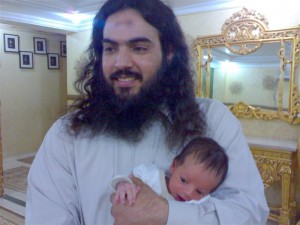
Before Harbi left, Junubi, the author of our account, wrote and wished him well. Harbi replied that they would soon meet in Paradise. Harbi’s response was dated April 5, 2008, which is probably after he had left Kuwait (one of his traveling companions, `Ajami, died in late March).

Junubi relates that the three men wen to Iraq through a coordinator, but he doesn’t say where their transit point was. It has now come to light that the men went through Syria. Indeed, one of the last photos of Harbi was taken by himself on the flight to Syria.
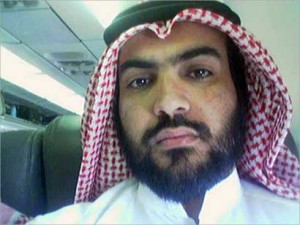
According to press reports, `Ajami called his family from Syria to tell them where he was headed and why. The next time they would hear news of him was when they received an anonymous call informing them that `Ajami had carried out a suicide bombing. Harbi’s family got the same call a few weeks later.

According to a Furqan video that was posted on June 21, `Ajami carried out a March 23 suicide attack on the Harmat neighborhood of Mosul. A little over a month later, Harbi carried out an April 26 attack on the Tel al-Rumman police station in Mosul. (Bill Roggio at Long War Journal has a good summary of the contents, based partially on Nibras Kazimi’s analysis).

The video is over 30 minutes long and tedious in parts, but many of the useful bits can be viewed here. Harbi is the bearded, long-haired man in the center of everything (his coiffure and beard seem to be deliberately modeled on that of Khattab, a Jihadi commander in Chechnya that Harbi emulated, according to Junubi).

The first clip you see is that of Harbi talking about jihad and then chanting a nashid (hymn) with his brethren (notice the childrens’ voices in the background). The next clip is Harbi standing next to the vehicle he will use to blow himself up. After that is his attack on Tel al-Rumman, followed by `Ajami’s attack on the Harmat neighborhood. Last is Harbi again leading a group chanting a hymn.

In the full video, Harbi gives his final testament (wasiyya), summarized here. In it, he criticizes a hardline Kuwaiti Salafi scholar, Hamid al-`Ali, for badmouthing the Islamic State of Iraq. He then explains to his family that he decided to leave for Iraq because the Companions of Muhammad did not choose to sit with their families when fighting was called for.  (Harbi may have been feeling a little guilty–Junubi tells us that his mother was very ill when he left.) Harbi then chastizes other Jihadis for sitting behind their computers and doing nothing.

At the end of his testament, Harbi stands next to his car bomb. As he pats the explosive tank, he says:

I have everything: a house, a car, two wives, and eight children. But now I find happiness in my heart that I did not find in any other place.

There’s a lot to talk about here and it probably deserves a separate post, but just few closing thoughts to end the series:

  • A mixture of indignation, glory seeking, camaraderie, and promise of eternal reward motivated Harbi and `Ajami to pledge themselves to die in Iraq. Since both had been detained and likely treated harshly, they may have been motivated by a desire for personal revenge as well.
  • Syria is the transit point for our group, as it is for many other Gulfis seeking martyrdom in Iraq. But note that it is an Algerian Jihadi, not a local Kuwaiti, that informs the Kuwaiti group of the route.
  • After reading Junubi’s account, one Ekhlaas member asked 1) why Harbi went to Iraq rather than Afghanistan and 2) why he chose to be a martyrdom operative when he had enough experience to be a trainer. In other words, why didn’t a skilled Jihadi like Harbi put his talents to better use. Junubi answers that Harbi went to Iraq because it is much easier to travel there than to Afghanistan. Moreover, many go to Iraq because it is close by. On the second question, Junubi discloses that Harbi had thought about becoming a coordinator but decided he wanted to die a martyr and not fight (presumably since the latter did not guarantee martyrdom).

Document (Arabic): 6-26-08-ekhlaas-furqan-al-junubi-story-of-harbi-and-bawasil
Leaderless Jihad in Iraq? Not So Much

The U.S. military has just released a large number of captured al-Qaeda documents from Iraq to CNN. It seems that most (all?) of the documents are from the headquarters of the security commander for Anbar province, Faris Abu Azzam (killed 18 months ago). There are no links to the original documents, so we’re left with Michael Ware’s excellent rundown of the juicy bits. In the past, West Point’s Combating Terrorism Center has been the main conduit for these sorts of materials, but in recent months the military has been going direct with major news outlets. Based on Ware’s summary, here are some of the documents in the collection:

  • 2005 memo warning that executing sinners and traitors in public will alienate their families and invite their revenge
  • December 2005 minutes of senior al-Qaeda commanders meeting in western Iraq to plan a three-month campaign that will begin in mid-January 2006. The campaign, called Operation Desert Shield, is multi-phrased, uses a variety of tactics, and focuses on supply lines, bridges, helicopters, and helicopter landing pads to stop reinforcement and resupply. Only the senior leaders will know the broad outlines of the plan.
  • January 7 2006 memo that asks Iraqi spies at U.S. bases to provide data on the best camps to hit
  • Undated memo that compiles reports from AQ field commanders, identifying which bases, checkpoints, and police stations should be hit. Listed next to each target is a recommended method of attack
  • March 2006 after action reports that record the successes and failures of the plan hatched at the December 2005 meeting
  • Pay sheets for infantry battalions and fire support (rocket and mortar) battalions
  • Al-Qaeda application forms
  • Death lists of opponents
  • Lists of prisoners in al-Qaeda custody, including their verdicts and sentences and their phone numbers (taken from American tip lines for informers)
  • Motor pool records of vehicles
  • Iraqi Ministry of Interior document naming all foreign fighters in government custody
  • Debriefings of those captured by the U.S.. Includes information on interrogation techniques used by American soldiers.
  • Request from an Iraqi contractor for permission to oversee a U.S.-sponsored building project on a U.S. base in return for his spying services and stealing weapons
  • 80 unreleased execution videos. Most of them are beheadings.

The new documents do not tell us a lot about the composition of al-Qaeda in Iraq right now, but they do shed light on its corporate culture:  It is highly bureaucratized and meticulous. Having sat through poorly-sourced lectures on how AQI is a flat organization whose members swarm in fourth-generation unison, I am hopeful that these documents will put this idea to rest.

Latest Jihadica
Subscribe to receive latest posts
Follow us