Guest Post: The Story of Eric Breininger

[Editor’s note: This post was written by Christopher Radler and Behnam Said, who are intelligence analysts based in Hamburg, Germany. For links to the original document, see the comments to the preview post.]

On 3 May a message announcing the death of Eric Breininger (b. 3 August 1987) and three of his fellow combatants was posted on several German jihadist websites. Breininger, who travelled to the border region between Pakistan and Afghanistan in the winter 2007, was one of the most infamous German jihadists. From Waziristan Breininger, a.k.a. “Abdul Ghaffar al-Almani”, sent several videotaped messages to the jihadist community in Germany, asking them to join the jihad or at least to support it financially. Since September 2008 the German Federal Criminal Police Office (BKA) searched for Breininger, based on his assumed affiliation with a foreign terrorist organization.

A day after the announcement of his death, Breininger’s alleged autobiography, entitled Mein Weg nach Jannah (My Way to Paradise) was released on jihadi websites. The 108-page document mainly deals with Breiningers path into violent islamist militancy. It is not clear however, if Breininger wrote the document himself. In the messages he delivered from Waziristan, he spoke a very simple and often grammatically incorrect German. By contrast, the language of the published book is far more elaborate and correct. On the other hand, the content and details in the book argue for the authenticity of the document. Interestingly, the spelling of names differs throughout the book, which could indicate a collaborative effort. So we can assume that Breininger either 1) wrote it down by himself and had some help from his friends, or 2) told his story to some of his fellow jihadists and they wrote it down, as Spiegel journalist Yassin Musharbash suggested. Overall, however, we favour the first assumption.

After stating the reasons for writing down his autobiography, that is to say to disprove the lies spread by the media and to guide Muslims and non-Muslims to the path of Allah, he describes his conversion.

Radicalization and Recruitment in Germany
Breininger starts by telling us about his pre-Islamic life. Living together with his mother and sister since his parents’ divorce, he had the life of “a typical western teenager“, i.e. he went to parties and had relationships with girls. He calls this lifestyle  “following condemned Satan’s way“ (p. 6). Breininger further describes his search for the meaning of life that initially did not lead to satisfying results. However, in his workplace he came into contact with a Muslim colleague who gave him the first lessons in the Salafi way of Islam and took him to a local mosque where he felt very comfortable.

One day, Breininger and his “mentor” (who remains unnamed) were on their way home from work. They ran into “Abdullah” (a.k.a. Daniel Schneider, member of the terrorist Sauerland cell who was recently sentenced to 12 years for plotting to bomb US targets in Germany) and a person named Houssain al-Malla. Breininger was introduced to Schneider and al-Malla. It was the latter who provided the final inspiration for Breiniger to convert. After his conversion he devoted himself to the study of Islamic audiolectures and books. He quit school and spent more time with his new “brothers”. In the meantime, his former girlfriend had become Muslim and subsequently they contracted their marriage according to Islamic Law. It turned out, however, that this girl converted only to please Breininger, not out of genuine conviction. So Breininger ended the relationship and moved into Daniel Schneider’s appartment, where both of them regularly received al-Malla. Together they consumed a lot of jihadist propaganda downloaded from the Internet. The effect was dramatical:

“I knew that I had to take measures against the crusaders who where humiliating our brothers and sisters. Also every Muslim should stand up for a life according to the law of Allah and for the reason that we must build an Islamic state” (p. 53).

Breininger also states that they were appalled by the news from torture and prison abuse. Here we have another proof that it is these grievances caused by westerners themselves that help to radicalize.

Religio-ideological development
Breiningers first mentor in Germany invited him to his home and told him about the unity of God (tawhid) and the fundamentals of belief (´aqida). Breininger lays down the fundamentals of his belief by copying and pasting part of a book into his autobiography, dealing with the doctrine of tawhid.

Later on, after meeting Daniel Schneider and Houssain al-Malla, Breininger learned about the doctrine of “loyalty (towards believers and god) and enmity (towards infidels especially)” (al-wala` wa-l-bara`). Loyalty and enmity, Breininger tells us, are “the most important fundamentals in islam and are the two main conditions for the true belief” (p. 56). He underlines his point by quoting the former leader of the Iraqi al-Qaeda (AQ) branch Abu Mus’ab az-Zarqawi (p.58).

In the following part he writes about Jihad as an individual duty (fard al-´ayn), noting that “every Muslim who does not attend his duty to go out to follow Allahs path and to fight” is obviously a sinner (fasiq) and will be punished by God (p.59/60). As support he quotes the pamphlet The Defense of Muslim Land – The First Obligation after Iman by Abdullah Azzam.

Travelling for Jihad
After Breininger’s decision to participate in violent jihad and his abortion of his original plan to go to Algeria, he travels to Egypt and studies Arabic in Cairo. Four months later al-Malla joins him there and eventually convinces Breininger to travel to Afghanistan. Thus they went by airplane to Iran and subsequently took a bus to Zahidan near the Pakistani border. With the help of a human trafficker named “Mustafa” and after bribing an officer at the border they proceeded their journey to Waziristan covered with burqas (!) in a cab. Finally arrived at a safehouse of the Islamic Jihad Union (IJU), they were joined by mujahidin from Tajikistan and Turkey and were transferred to Afghanistan. Here they started a training which outlines as follows:

– Fajr prayer, dhikr, sports and stretching, one minute for breakfast, weaponry, time until dhuhr-prayer for memorizing
– Dhuhr prayer, tactics and “Anti-terror-fighting“ (close combat fighting)
– Asr Prayer, one minute for eating (bread and tea), weaponry-test (in case you failed you received punishment), dhikr
– Maghrib prayer, memorizing Qur’an until Isha-prayer
– Isha prayer, one hour guard duty once in a while

After al-Malla leaves the group for reasons unknown to Breininger (!) the latter’s situation begins to deteriorate because there were no other German-speakers amongst his comrades. Nevertheless, he completes his first training which is immediately followed by a second one. Here, the focus lies on the training with heavy weapons like recoilless guns, anti-aircraft weaponry and mines. Also the usage of GPS and radio equipment was part of the training. After moving to the so called “Istishhadi-house” (house of martyrdom-seekers) he describes some operations, one of them conducted together with mujahidin from the Taliban and AQ. It raised our eyebrows when we read that a chemical agent was used in a martyrdom operation against “murtaddin” in Khost. According to Breininger more than 100 “apostates and infidels” died (allegedly partly in the aftermath of the assault when the chemical agent began to take effect).

Assuming that Breiningers account is true,  this suggests ongoing cooperation between different organizations in Afghanistan. It also suggests, very worryingly, that Taliban and/or affiliated groups may be using crude chemical weapons.

German Taliban Mujahidin
After three years as a member of the IJU Breininger still had problems communicating with his comrades. When he was approached by his commander and told that some German Muslims had recently completed their training and planned to join the Taliban, Breininger decided to do so as well. The Taliban had no objections to the founding of a subgroup, so the “German Taliban Mujahidin” (GTM) emerged. Thanks to Breininger´s account we finally know about the background of this group that virtually emerged out of nothing and kept analysts busy for a long time. Especially since the Taliban never officially approved the GTM as part of their movement.

Threatening the Far Enemy
Breininger ends his story with an appeal to German Muslims to support the jihad financially:

“If the brothers would buy one doner kebab less a week it would be possible to buy almost 20 sniper bullets to fight the kuffar” (p. 102).

This appeal is followed by a call to Muslims to join the mujahidin because many of them want to start a family. The environment allows the breeding of children “free from the kufr of western society (…) This new generation of mujahidin grows up multilingual. They usually learn Arabic, Turkish, English, Pashtu, Urdu and their parent’s tongue” (p. 103).

Breininger’s conclusion gives us an idea about the long-term strategy of jihadist groups and clearly shows that the threat for Western countries is anything but averted yet:

“With God’s permission this offspring will become a special generation of terrorists [sic] that is not listed in any of the enemy’s databases. They speak their enemy’s languages, know their manners and customs and are able to mask and infiltrate the land of the kuffar because of their appearance. There they will insha’allah be able to conduct one after another operation against Allah’s enemies thereby sowing fear and terror in their hearts” (p. 104).

A Brief History of Jihadism in Turkey

Despite the Istanbul attacks in 2003, the Turkish fight against terrorism has remained largely synonymous with the fight against Kurdish separatists. To my knowledge, there are few if any in-depth academic studies of Turkish jihadism. Not even the 2003 Istanbul attacks have been closely examined by scholars, despite a wealth of available Turkish sources. At most, there are studies of how the Turkish media covered these events, and the emphasis is on the narrative being used by non-jihadists to describe the phenomenon (see e.g. Gökhan Gökulu’s 2005 M.A. thesis “Terör Eylemlerinin Medyaya Yansıması”). With the exception of Mehmet Faraç’s book İkiz Kulelerden Galata’ya: El Kaide Turka and the reporting of a few other journalists, Turkish writers and intellectuals seem surprisingly uninterested in the phenomenon itself. Although it has been thought that the secular Turks were almost immune to militant Islamism, the Turkish jihadist community appears to be growing.

The first Turks entered the jihadi scene in the late 1980s. Ferzende Kaya has interviewed a few of the surviving Turkish fighters from the Afghan war against the Soviets in the 1980s. The first Turkish jihadists went to Afghanistan as early as May 1980. According to Kaya, most of the veterans of the war either died in combat or retired from jihadism as they returned home.

Brian Glyn Williams offers a rare account of how a new generation of Turkish jihadists were recruited and trained in the 1990s. He puts its genesis down to the influx of Turkish Islamists who entered Islamist universities in Pakistan after 1994. The students, argues Williams, frequently crossed to border into Afghanistan to get what he calls “hands-on education”. Very little is known about this period, and I am uncertain what source material Williams bases these claims on.

Whether or not they arrived there by way of Pakistani universities, Turks arrived in Afghanistian in large enough numbers to keep a Turkish-language jihadi training programme running. By 2001 a Turkish group had coalesced around a Turkish Emir called Habib Akdaş. They were based in the Khalden camp in Eastern Afghanistan. Sometime between 9/11 and the American-led attack about a month later, the group left for Turkey. Two years later the group carried out the attacks against the British Consulate, two synagogues and an HSBC branch in Istanbul. According to his own account, the al-Qaida Iraq leader abu Musab Zarqawi’s right hand man, Louai al-Sakka, was the master mind behind the attack and the link between the Akdaş group and the al-Qaida leadership. Al-Sakka is now in prison for both the 2003 attacks and for attempting to bomb an Israeli cruise ship in 2005. The cruise ship plot was foiled when the chemicals al-Sakka was to use exploded in his rented apartment. Akdaş died fighting in Iraq.

In April this year, there appears to have been a spate of arrests in South-Eastern Turkey, and one of the arrestees is an Uzbek. The Turkish press described the arrested men as al-Qaida members. The Turkish (or rather Kurdish) Hizbullah (not to be confused with its Shia namesake in Lebanon) is located in this area, which also seems to provide many of the Turkish recruits for the Islamic Jihad Union. Although little is certain, there may be a link between IJU and Hizballah.

Arrests of alleged al-Qaida members are nothing new in Turkey. There have been raids many times before. One such wave of raids happened in April last year. If one is to believe the Islamic Jihad Union member Ebu Yasir el-Turki, as many as 2000 Turks have arrived in Afghanistan since 2001. He claims that most of them have gone back to Turkey where they try to create groups and recruit people for the Jihad in Afghanistan. As many as 5000 Turkish militants may have joined the insurgency in Iraq. If this continues, Turkey may have an important role to play in the global Jihad. Maybe it will not be a combatant or front, but Turkey is already a conduit, recruitment base and maybe also training ground for jihadists going to the hot fronts.

The Adventures of Sinam

On August 9, a member of the Islamic State of Iraq announced–via an intermediary on the Ekhlaas forum–the death of Sinam al-Ramadi. Sinam was an al-Qaeda member who operated in Ramadi and who participated on a number of forums, including Faloja.

On the day of the announcement, an Ekhlaas member named Halima posted an eyewitness account of Sinam’s capture. The account is interesting for the light it sheds on al-Qaeda’s activities in Anbar province and for what it tells us about the hectic lives of forum fighters–Jihadi forum members who are also active militants.

Halima writes that on Thursday, August 7 a certain Dr. Khattab `Ali al-Hayani was arrested in Haqlaniya, near Haditha. U.S. troops and Iraqi police had discovered evidence in Hayani’s home proving that he was Sinam al-Ramadi, one of the members of al-Qaeda in Ramadi. Sinam had left Ramadi for Kirkuk, Diyala, Bayji, and finally Haditha, where he was “considered one of the al-Qaeda returnees to the regions of western Anbar.” (I think this means that he was an al-Qaeda member in Anbar who had fled following the success of the tribal Awakening and later returned.) It was already known that Sinam had created al-Qaeda cells living in the environs of Haditha and that he had a death sentence passed against him for killing a Christian clergyman in Mosul.

Sinam was arrested after being followed by an American spy plane, which had spotted him after an Iraqi Hummer exploded between Barwana and Bayji. Sinam was stopped near the Haditha dam and badly wounded after he and his comrades resisted arrest. Halima relates that an American general said to him, “Are you the one who hassled us so much on the Internet?” Sinam couldn’t have been more than 24 years old, according to Halima.

There’s some things in Halima’s account that don’t make sense. It’s hard to believe that a U.S. general was involved in Sinam’s capture or that Halima overheard their conversation. And Halima does not write of Sinam’s martyrdom, which was being celebrated on the forums, but rather his bloody capture. (The title of Halima’s post does suggest that Sinam was executed later for killing the clergyman.)

Still, Halima’s details about Sinam’s route fit with what we know of al-Qaeda’s recent migration out of Anbar. And her story of Sinam’s arrest also dovetails with recent news about the al-Qaeda cell operating in Haqlaniya.

Document (Arabic): 8-9-08-ekhlaas-post-regarding-death-of-sinam-al-ramadi

Document (Arabic): 8-9-08-ekhlaas-biography-of-sinam-al-ramadi

Weekend Detritus

I’ve found a very interesting nugget for tomorrow night, but in the meantime here are two bits of debris:

First is a July 31st announcement on the Firdaws forum that one of its members, Khattab al-Thaqafi, traveled to fight in Afghanistan.  Thaqafi, we are told, contributed a great deal on the Internet and to Jihadi media.

7-31-08-firdaws-firdaws-member-khattab-al-thaqafi-joins-jihad-in-afghanistan

The second item is graffiti of Bin Laden spray painted on the wall of one of the largest markets in Kuwait.  The person who posted the picture to Ekhlaas writes:

Pictures, as you know, are forbidden, but we should keep in mind that the person was expressing his feelings and was not being mindful of pedestrians.  Perhaps he was ignorant of the rule.  The only thing this demonstrates is the love of all sorts of people for Shaykh Usama.

7-30-08-bin-laden-graffiti-in-large-marketplace-in-kuwait

Ekhlaas Members Travel to Somalia, Iraq

Under_cover2, a member of Ekhlaas, announced two weeks ago that two of his fellow forum members have made the transition from forum fighters to foreign fighters.  One went to Somalia, the other to Iraq.

Iraq makes sense, particularly for Jihadis living nearby.   But Somalia?  I don’t see it mentioned much as a destination anymore.

Document (Arabic): 7-11-08-ekhlaas-news-of-forum-member-who-went-to-somalia-and-another-who-went-to-iraq

Walking the Talk: Forum Members Travel to Afghanistan and Iraq (Pt. 4)

When we left Harbi, he had met a Algerian Jihadi who told him how to get to Iraq.

According to Furqan al-Junubi’s account, Harbi and two other Kuwaitis–Abu Salih (`Abd Allah Salih al-`Ajami), and Abu Talha (Nasir) al-Dawsari–pledged to go to Iraq and die there. They called this “The Pledge of the Houris” (the virgins promised to those allowed to enter Paradise–martyrs are a shoe in). Al-Miskin al-Muhajir was with them, but he could not go due to personal circumstances (he was able to go to Afghanistan latter–see part 1).

I haven’t been able to find much on Dawsari, but there’s plenty on `Ajami. He was actually being held in Guantanamo until the U.S. transferred him to Kuwaiti custody in 2005; the Kuwaits acquitted him of all charges. By the time `Ajami met Harbi, he was married, had one child, and was financially comfortable. Those who knew him thought he had been rehabilitated.

After several days, the three men departed for Iraq. Junubi relates that Harbi left behind a large house, eight children (now ten), and a substantial sum of money. (Harbi was a car salesman.  From the looks of this, he also seems to have been a racing enthusiast. You can see Harbi at the 0:38 mark.)

Before Harbi left, Junubi, the author of our account, wrote and wished him well. Harbi replied that they would soon meet in Paradise. Harbi’s response was dated April 5, 2008, which is probably after he had left Kuwait (one of his traveling companions, `Ajami, died in late March).

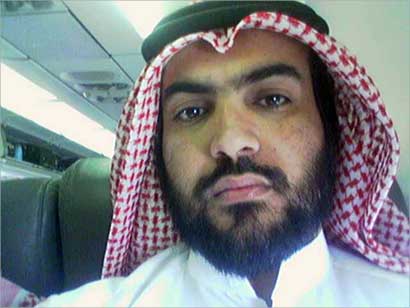
Junubi relates that the three men wen to Iraq through a coordinator, but he doesn’t say where their transit point was. It has now come to light that the men went through Syria. Indeed, one of the last photos of Harbi was taken by himself on the flight to Syria.

According to press reports, `Ajami called his family from Syria to tell them where he was headed and why. The next time they would hear news of him was when they received an anonymous call informing them that `Ajami had carried out a suicide bombing. Harbi’s family got the same call a few weeks later.

According to a Furqan video that was posted on June 21, `Ajami carried out a March 23 suicide attack on the Harmat neighborhood of Mosul. A little over a month later, Harbi carried out an April 26 attack on the Tel al-Rumman police station in Mosul. (Bill Roggio at Long War Journal has a good summary of the contents, based partially on Nibras Kazimi’s analysis).

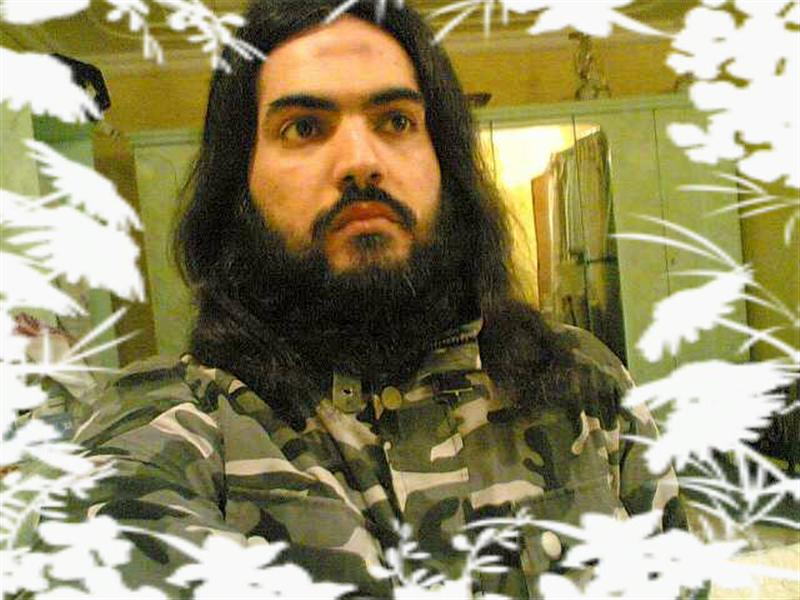
The video is over 30 minutes long and tedious in parts, but many of the useful bits can be viewed here. Harbi is the bearded, long-haired man in the center of everything (his coiffure and beard seem to be deliberately modeled on that of Khattab, a Jihadi commander in Chechnya that Harbi emulated, according to Junubi).

The first clip you see is that of Harbi talking about jihad and then chanting a nashid (hymn) with his brethren (notice the childrens’ voices in the background). The next clip is Harbi standing next to the vehicle he will use to blow himself up. After that is his attack on Tel al-Rumman, followed by `Ajami’s attack on the Harmat neighborhood. Last is Harbi again leading a group chanting a hymn.

In the full video, Harbi gives his final testament (wasiyya), summarized here. In it, he criticizes a hardline Kuwaiti Salafi scholar, Hamid al-`Ali, for badmouthing the Islamic State of Iraq. He then explains to his family that he decided to leave for Iraq because the Companions of Muhammad did not choose to sit with their families when fighting was called for.  (Harbi may have been feeling a little guilty–Junubi tells us that his mother was very ill when he left.) Harbi then chastizes other Jihadis for sitting behind their computers and doing nothing.

At the end of his testament, Harbi stands next to his car bomb. As he pats the explosive tank, he says:

I have everything: a house, a car, two wives, and eight children. But now I find happiness in my heart that I did not find in any other place.

There’s a lot to talk about here and it probably deserves a separate post, but just few closing thoughts to end the series:

  • A mixture of indignation, glory seeking, camaraderie, and promise of eternal reward motivated Harbi and `Ajami to pledge themselves to die in Iraq. Since both had been detained and likely treated harshly, they may have been motivated by a desire for personal revenge as well.
  • Syria is the transit point for our group, as it is for many other Gulfis seeking martyrdom in Iraq. But note that it is an Algerian Jihadi, not a local Kuwaiti, that informs the Kuwaiti group of the route.
  • After reading Junubi’s account, one Ekhlaas member asked 1) why Harbi went to Iraq rather than Afghanistan and 2) why he chose to be a martyrdom operative when he had enough experience to be a trainer. In other words, why didn’t a skilled Jihadi like Harbi put his talents to better use. Junubi answers that Harbi went to Iraq because it is much easier to travel there than to Afghanistan. Moreover, many go to Iraq because it is close by. On the second question, Junubi discloses that Harbi had thought about becoming a coordinator but decided he wanted to die a martyr and not fight (presumably since the latter did not guarantee martyrdom).

Document (Arabic): 6-26-08-ekhlaas-furqan-al-junubi-story-of-harbi-and-bawasil

Walking the Talk: Forum Members Travel to Afghanistan and Iraq (Pt. 3)

Today we continue our look at a Kuwaiti cell and how its members transitioned from forum fighters to foreign fighters.

When we left off, Badr al-Harbi and Bawasil had returned to Kuwait from the front in Afghanistan via Iran, entrusted with a special mission by Abu al-Layth al-Libi, a senior al-Qaeda leader. They were delayed in carrying out their task by Iranian, and then Kuwaiti, security forces. The latter, according to al-Furqan al-Junubi’s account, had tortured them and confiscated their passports.

After being released, Harbi and Bawasil stayed in Kuwait a full year to complete their special mission: gathering money, clothes, and food for the Jihadis in Afghanistan. In this, they relied on their network of friends, many of whom were already committed to the cause. Yet Harbi and Bawasil’s efforts aroused the suspicions of other Jihadis, who wrote the brothers in Afghanistan and told them that they were spies. They even made films that portrayed Harbi and Bawasil in a negative light.

Upon completing their task, Harbi and Bawasil wanted to return to the front in Afghanistan, but their passports had been confiscated. Nevertheless, they were both able to get new passports. Harbi and Bawasil then went with their families to Mecca and returned without incident.

After returning to Kuwait, Harbi and Bawasil asked the Jihadis in Afghanistan about the route to the front. The Jihadis told them that it was “broken,” but this, al-Furqan al-Junubi comments, was only because they had believed the bad rumors that had been spread about Harbi and Bawasil.

Harbi suggested the two travel to Iraq instead, but he was hesitant to go because he was not sure he would be guaranteed a martyrdom operation. Harbi and Bawasil soon met a coordinator and obtained a guarantee of safe passage from him, but they did not end up using him.

At this time, Harbi decided he wanted to marry for the second time, but wasn’t sure it was right to do so as a mujahid. Bawasil assured him it was, and so he did.

One month after Harbi’s marriage, a message came from Abu al-Layth al-Libi vouching for the integrity of Harbi and Bawasil. This meant the two could now travel to Afghanistan. But personal circumstances prevented Harbi from traveling to Afghanistan with Bawasil, who was anxious to leave because the government was pursuing him.

Bawasil first went to the United Arab Emirates with one of his close cousins (on his mother’s side). The Jihadis (it is unclear if they were in the Emirates or Afghanistan) told Bawasil that they only wanted him and not his cousin, so the latter returned to Kuwait.

Bawasil had to wait four days in the airport because of snow in Iran (indicating that Iran again served as his transit point for Afghanistan). Bawasil succeeded in finding the brothers (presumably in Iran) and soon found a coordinator, but they had stopped using the old route.

Harbi waited four months to find new way to Afghanistan, but failed. It was around this time that Harbi met a Jihadi from Algeria who told him how to go to Iraq.

(To be continued….)

Some thoughts:

  • Al-Qaeda Leadership – Abu al-Layth al-Libi personally requested Harbi and Bawasil to gather funds and supplies for the Jihadis in Afghanistan. He also personally intervened in the rumor campaign against them.
  • Support Networks – The way Harbi and Bawasil went about accomplishing their task for Libi is instructive. Like Tupperware salespeople, they relied on their personal network of friends rather than reach out to anonymous donors. But this did not protect them from allegations of spying, a consequence of their mission’s secrecy. (This is a constant problem for clandestine terrorist groups–see Jake Shapiro’s work in this regard.) On another subject, Bawasil tried to bring his close cousin to Afghanistan, reinforcing the idea that friends and family of dedicated militants are more likely than others to be involved in the Jihadi Movement.
  • Security Lapse – The Kuwaiti government was monitoring the two militants, as indicated by Bawasil’s eagerness to escape their scrutiny. So how in the world did they regain their passports?
  • Transit – As in part 2, Iran is mentioned as a transit point to Afghanistan. But this time we have the added transit point of the UAE. Moreover, travel coordinators are twice mentioned, once with regard to Afghanistan, the other with regard to Iraq.
  • Family Life – Even though Harbi knows he will die as a martyrdom operative, he still wants to marry a second wife.

As I said last post, none of this is a big revelation (with the exception of Iran). But it really adds texture to the recent abstract debates about terror networks and helps to weigh their relative merits.

Hamas Hands Over al-Qaeda Commander to Egypt

According to Usama al-Asad at Ekhlaas, when the barrier between Gaza and Egypt was destroyed, one of the commanders of al-Qaeda tried to enter Gaza and form a Jihadi group with some disaffected elements of Hamas’ military wing, the Qassam Brigades.  When Hamas found out, they captured him and turned him over to Egypt.

Usama al-Asad says his reporting is 100% accurate and claims that this commander is well known and has been fighting in a neighboring country.

Some of the respondents to Usama’s post verify his reporting, while others accuse him of blackening the good name of Hamas.

Document (Arabic): 7-3-08-ekhlaas-hamas-hands-over-aq-amir-to-egypt

Walking the Talk: Forum Members Travel to Afghanistan and Iraq (Pt. 2)

On Monday, we looked at the case of al-Miskin al-Muhajir/asdasd99, who finally made his way to Afghanistan. Miskin had hoped to go to Iraq in April with a group from Kuwait, but unnamed obstacles stood in his way. We don’t yet know the fate of Miskin, but we do know what happened to this earlier group.

The story begins with Abu `Umar Badr al-Harbi, 36, from Kuwait. According to a friend of his, al-Furqan al-Junubi, Harbi was the oldest of his brothers and very close to his mother. He became “committed to the path (of jihad)” at the age of 14.

During his military service in Kuwait, Harbi met his best friend, al-Bawasil. Bawasil was at the beginning of his commitment to jihad when 9/11 happened. Both men rejoiced at the attack and were impressed that someone had been able to strike so deep inside the U.S.

One day, Harbi came to Bawasil and convinced him of the duty to undertake jihad. By 2004, both men were encouraging others to also take up arms. Many people said they were being foolish or accused them of being spies; others said there was no permanent jihad or banner to fight under.

In 2005, Harbi and Bawasil met the followers of Shaykh `Amir Khalif, the co-leader of a militant network in Kuwait, but they didn’t get to meet him before he died.

Soon after meeting Khalif’s followers, they learned of a way to go to Afghanistan through Iran. Both men were worried that it was a trap. Bawasil went first to make sure the way was secure. After arriving safely, he spent two weeks in Afghanistan with the mujahids before returning to Kuwait.

Upon Bawasil’s return, he told Harbi of the glories that awaited him on the front.  The two then began preparing for to go to Afghanistan for a longer period of time. They trained themselves physically and psychologically, studied some Islamic legal subjects pertaining to their endeavors, and gathered money.

Together with their friend Abu Khalid al-Kuwaiti, Bawasil and Harbi went to Iran by airplane and then made their way to Afghanistian. They stayed there three months training and guarding the front line.

While there, Abu Layth al-Libi (a high-ranking, now-deceased al-Qaeda member) entrusted them with a special mission in Kuwait. The mission was so secret that not even Abu Nasir al-Qahtani, another high-ranking AQ member, knew of it and was puzzled when the men refused his request for them to stay.

Harbi and Bawasil tried to return to Kuwait via Iran, but Iranian security forces imprisoned them for several days because they had lost their passports. They were finally released and returned to Kuwait, but the Kuwaiti security forces imprisoned them for twelve days, tortured them, and took their passports.

To be continued…..

In part 3 we’ll look at Harbi and Bawasil’s special mission and their preparations for another trip to the front. Some of the details already sound familiar if you’re read up on the foreign fighter literature. What stands out to me is the role that Iran plays as a transit point between Kuwait and Afghanistan. A few days ago, I noted that the Saudis are claiming that a Jihadi in Iran is directing a large network of militants in the Kingdom. By itself, this doesn’t mean much given the source. But here we have an insider remarking that Iran is a transit point for Jihadis going to fight in Afghanistan. That’s worrying.

There’s been a lot of talk about Syria’s role as a transit point, but it’s still unclear from the open source materials if it’s ignorance, benign neglect, or something more sinister.  It looks like Iran presents the same puzzle.

Walking the Talk: Forum Members Travel to Afghanistan and Iraq (Part 1)

On the Firdaws forum yesterday, a member posted a message informing fellow Firdawsians that one of their own, asdasd99, had joined the caravan of jihad in Afghanistan.

Asdasd99, who also goes by al-Miskin al-Muhajir (The Lowly Emigrant) on the Ekhlaas forum, had tried to go to Iraq a month ago with a group from Kuwait that I’ll be profiling this week.  However, unnamed “personal circumstances” kept him from going.  Looks like he resolved them.

Document (Arabic): 6-29-08-firdaws-member-of-ekhlaas-and-firdaws-joins-jihad-in-afghanistan

Latest Jihadica
Subscribe to receive latest posts
Follow us