The Islamic State of Disobedience: al-Baghdadi Triumphant

Abu Bakr al-Baghdadi’s Islamic State of Iraq and Sham (ISIS), the leading jihadi fighting force in northern Syria, is often described as “an al-Qaeda group.” Its historical ties to Ayman al-Zawahiri’s al-Qaeda Central (AQC) notwithstanding, this characterization is unhelpful and possibly misleading. The Islamic State, in its own conception, is no ordinary jihadi group; nor is it strictly beholden to al-Qaeda as such. Describing ISIS in this way, moreover, overlooks the dramatic rupture that has set in between the Islamic State and AQC over the past several months.

Today ISIS persists in a state of outright disobedience to its supposed seniors in AQC, Zawahiri among them. The following examines both the extent of this state of disobedience and the nature of the Islamic State itself that has given rise to it.

Anguished forums

Shumukh al-Islam, al-Qaeda’s semi-official online forum, signaled alarm last week over enduring tensions between ISIS and Jabhat al-Nusra (JN), the al-Qaeda-aligned jihadi group in Syria that al-Baghdadi secretly organized in summer 2011 but now pledges allegiance (bay‘a) exclusively to Zawahiri. Evidently, ISIS and JN are engaged in a war for influence on the jihadi internet. In its very first Tweet, @shomokhalislam complained of being caught in the middle of this fight dividing the jihadi community: staunch supporters of ISIS and JN issuing demands to the forum to censor and delete rival content. Shumukh vowed to maintain a neutral stance in the dispute and, in the spirit of jihadi unity, threatened to terminate the account of any user casting aspersions on one side or the other. For more positive encouragement, it posted a doctored photo of JN and ISIS fighters standing together beside the caption, “Hand in hand…brothers in faith and religion.”
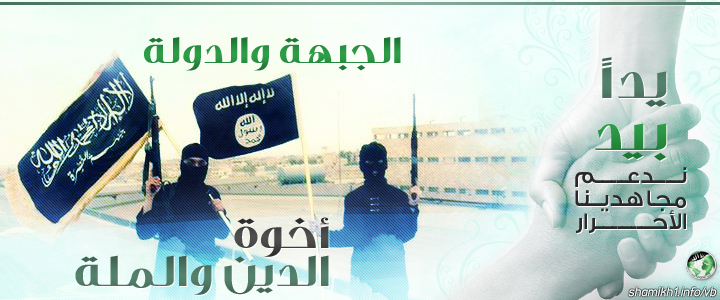
The Shumukh statement and threat owe much to the recent ascendancy in the Syrian jihad of ISIS and its much-vaunted emir, Abu Bakr al-Baghdadi. Aymenn Jawad Al-Tamimi and Joas Wagemakers recently noted the increasing level of jihadi support for al-Baghdadi, in both public displays of support worldwide and in jihadi ideological production (see here and here). All this reflects an intra-jihadi conflict opposing ISIS to both JN and AQC. While Syria’s jihadis on the ground may have achieved a modus vivendi in many areas (JN and ISIS fighters have been filmed playing tug-of-war in Aleppo), tensions in jihadi media remain pronounced.

A case decided

The Shumukh administrators are not the first jihadis to try to mediate the ISIS-JN dispute. To remind readers, this dispute broke out in April last year when al-Baghdadi, emir of the then-Islamic State of Iraq (ISI), declared JN to be a mere “extension” of ISI and henceforward dissolved. Simultaneously, he extended the Islamic State’s writ to Sham, or greater Syria, thus begetting the Islamic State of Iraq and Sham (ISIS). When JN’s leader, Abu Muhammad al-Jawlani, rejected al-Baghdadi’s instruction to disband, Ayman al-Zawahiri stepped into the fray to “decide the case.”

In late May he issued a written directive, leaked to al-Jazeera, pronouncing against al-Baghdadi. The AQC emir annulled the Islamic State’s incorporation of Syria, ordering ISI and JN to remain separate entities observing separate jurisdictions—Iraq and Syria respectively.

Zawahiri, however, had overestimated the weight of his authority. From the Islamic State’s perspective, it was he, and not al-Baghdadi, who had overstepped his bounds.

2549 days and counting

The first thing one sees on many jihadi web forums (www.shamikh1.info/vb, www.alfidaa.org/vb/, www.alplatformmedia.com/vb/, among others) is a banner marking time passed since the Islamic State’s founding in 2006. Today the banner reads: “2549 days have passed since the announcement of the Islamic State and the umma’s forthcoming hope…and it will continue to persist by the will of God.” The symbolic centrality of the Islamic State across jihadi media goes some way in explaining the current outlook of the Islamic State qua a state—not a group—and its wide appeal among jihadis.

While it began as a purely Iraqi entity—announced on October 15, 2006 by a “council” of eight jihadi groups including the infamous al-Qaeda in Mesopotamia—the Islamic State has since its very beginning entertained a vision of limitless territorial expansion. In its founding statement, the state’s anonymous spokesman claimed to draw inspiration from the model of the original Islamic State (al-dawla al-islamiyya) founded in 622 by the Prophet Muhammad in Medina, whence it became the capital of the caliphate and global Islamic empire.

This prophetic model has been a standard feature of the Islamic State’s propaganda and intellectual production. A 90-page document from 2006 explaining the state’s raison d’être, authored by a member of ISI’s Shari‘a Council, likewise portrayed ISI as “the new Islamic state”: “This state of Islam has arisen anew to strike down its roots in the region, as was the religion’s past one of strength and glory.” As to its claimed jurisdiction, the author wrote: “There exists no legal proof-text from the Qur’an or sunna stipulating a decreed limit to the territorial expanse on which the Islamic state ought to be erected.”

Zawahiri, for his part, spoke similarly of the Islamic State’s unique role as the proto-caliphate. In a 2009 question-and-answer forum he stated: “The State [i.e., ISI] is a step on the path to establishing the caliphate. It is superior to mujahid groups. These organizations [in Iraq] must give allegiance to the State, not vice versa.”

Problem child

Beyond public pronouncements, AQC and ISI do not seem to have ever enjoyed happy relations. The Abbottabad documents in fact indicate that AQC never approved of the Islamic State’s establishment and that a leadership-to-leadership relationship hardly ever existed. This is at least according to American al-Qaeda spokesman Adam Gadahn, who in 2011 recommended that al-Qaeda publicly “sever its ties with the Islamic State of Iraq.” Gadahn feared that ISI’s engagement in sectarian violence had tarnished al-Qaeda’s reputation.

While AQC leaders did not follow his advice, ties between al-Qaeda and the Islamic State were indeed to become practically severed—on the initiative, however, of the Islamic State.

Rupture

Some three weeks following Zawahiri’s leaked decree, Abu Bakr al-Baghdadi, who in mid-2010 succeeded Abu ‘Umar al-Baghdadi as emir of the Islamic State with the latter’s death in an American bombing, signaled the rupture with AQC. In a seven-minute audio statement issued June 15, al-Baghdadi decried “the document attributed to Shaykh Ayman al-Zawahiri.” He declared defiantly: “The Islamic State of Iraq and Sham shall endure, so long as we have a vein that pulses and an eye that bats.” He added, in a nod to its expansionist nature, that “[the Islamic State] shall not retreat from any spot of land to which it has expanded, and it shall not diminish after enlarging.” Zawahiri’s was a “command at variance with the command of God,” unacceptable on account of “numerous legal and methodological objections.” The decision to defy Zawahiri, he said, was made not by him alone but rather in consultation with the Islamic State’s Shura Council and in accordance with the ruling of its Shari‘a Council.

Al-Baghdadi was firm yet respectful in this rejoinder. It was left to another ISIS leader, Islamic State “official spokesman” Abu Muhammad al-‘Adnani, a Syrian, to sharpen the tone.

Ayman who?

The Syrian al-‘Adnani, in a follow-up audio message to al-Baghdadi’s, denounced Zawahiri’s edict more aggressively and systematically. “No one,” he thundered, “will stop us from aiding our brethren in Syria! No one will stop us from fighting the ‘Alawis and waging jihad in Syria! No one will stop us from remaining in Syria! Iraq and Syria will remain one theater, one front, one command!” “Car bombs,” he threatened, “will strike the shi‘a (rawafid), from Diyala to Beirut…and we will repel the ‘Alawis and Hizballah.”

Al-‘Adnani elaborated on seven “objections” to Zawahiri’s order. First, it was an order to commit a sin (ma‘siya) in the form of dividing the ranks of the mujahidin: splitting a united fighting force into an Iraqi and a Syrian force and thus weakening the community. Second, it affirmed the Sykes-Picot division of the Arab Middle East into artificial nation-states like “Iraq” and “Syria,” a division without basis in Islam. Third, it validated those “disobedient renegades” in the JN leadership who split, unlawfully, from the Islamic State by withdrawing bay’a from al-Baghdadi. Fourth, it set a precedent for other factions within the Islamic State to branch off and declare their independence. Fifth, Zawahiri’s judgment was made without properly consulting either party to the dispute, not to mention that the JN leadership’s testimony would be invalid on account of their sinning. Sixth, JN’s public rejection of al-Baghdadi’s ISIS announcement had gratified the enemies of the mujahidin and divided the community; this was not on par with the error Zawahiri attributed to the Islamic State of mistiming the announcement of its expansion to Syria. Seventh, Zawahiri was demanding that the mujahidin and their leadership withdraw from Syria at a time when all the mujahidin in the world were trying to join the fight there—a senseless demand.

The Islamic State, it would appear, does not recognize—at least for the moment—the higher authority of AQC. On July 29, the seventh anniversary of the Islamic State’s founding according to the Islamic calendar, al-‘Adnani issued yet another audio address reaffirming its expansionist doctrine in contravention of Zawahiri’s decree. “Our objective,” he averred, “is the formation of an Islamic state on the prophetic model that acknowledges no boundaries, distinguishes not between Arab and non-Arab, easterner and westerner, but on the basis of piety. Its loyalty is exclusively to God: it relies on only Him and fears Him alone.”

Bay‘a for al-Baghdadi

Apart from repudiating Zawahiri, ISIS’s recent media efforts have focused on promoting bay‘a, or the pledge of allegiance, to al-Baghdadi. In large measure this seems aimed at discrediting JN’s al-Jawlani, but it is also a more general effort to attract new Islamic State loyalists. One example of the effort is a widely publicized nashid (religiously sanctioned chant or anthem) calling on listeners to “close ranks and give allegiance to al-Baghdadi,” described as “our emir of Iraq and Sham.” Another item of interest is a short essay by a Syrian ISIS member explaining to readers “why I chose the State,” and why they should too. In short, the reason is that its leader dealt a severe blow to the Sykes-Picot division of the Middle East by expanding to Syria and that his Islamic State has the momentum to carry it to Jerusalem.

Even greater effort in promoting bay‘a for al-Baghdadi has come from beyond ISIS’s media organs in the form of lengthy treatises by big-name jihadi scholars like the Jordanian Abu Humam al-Athari. Joas Wagemakers has detailed al-Athari’s arguments, which center on al-Baghdadi’s peerless credentials as a scholar and warrior. Two other jihadi scholars worth noting here are the Tunisian Abu Ja‘far al-Hattab, a member of the Shari‘a Council of Ansar al-Shari‘a in Tunisia, and the more anonymous Abu al-Hasan al-Azdi, who appears connected to the Shumukh forum.

In his treatise, al-Hattab discusses at length the institution of bay‘a in Islamic law as a prelude to declaring invalid any bay‘a directed to JN leader al-Jawlani. The thrust of the argument is that al-Baghdadi had received bay‘a first and so al-Jawlani was outside his prerogative in receiving a competing bay’a. Moreover, because al-Jawlani had originally pledged allegiance to al-Baghdadi as a member of ISI, his retraction of that pledge constituted a betrayal and a “grave sin.” The only legitimate bay‘a can be to al-Baghdadi.

In “Obligations for Joining the Islamic State of Iraq and Sham: Objections and Responses,” al-Azdi also stresses the gravity of al-Jawlani’s withdrawal of bay’a from al-Baghdadi. He summarizes his support for al-Baghdadi in a number of points: his eminent qualifications as emir, the legal inadmissibility of giving additional bay‘as, and the Islamic State’s evident superior strength compared with mujahid groups. Finally, al-Azdi argues, even if al-Baghdadi erred in declaring the expansion of the Islamic State to Syria, that State had become a reality that must be accepted in light of the harm that multiple bay‘as in Syria would do to jihadi unity.

Al-Baghdadi triumphant

To be sure, there are jihadi ideologues who have supported JN or taken a more neutral stance on the ISIS-AQC-JN debacle. Journalist Hussein Jamo has identified some of them. The momentum, however, both material and intellectual, appears to favor the Islamic State, al-Baghdadi, and his contempt for Zawahiri’s effort to restrain him.

The sudden ascendancy of al-Baghdadi marks a signal achievement for the defiantly reborn Islamic State. Contrary to popular perceptions, this achievement is in no way a triumph for AQC but rather comes at its expense. Al-Baghdadi, the rising standard-bearer of the jihadi ideology traditionally undergirding al-Qaeda, appears for the moment the triumphant leader of something quite distinct from an “al-Qaeda group.”


Al-Qaida Advises the Arab Spring: The Case for al-Baghdadi

The once fledgling Islamic State of Iraq has appeared to be going strong again since its leader, Abu Bakr al-Baghdadi, merged it with the jihadi efforts in Syria to become the Islamic State of Iraq and al-Sham (ISIS). Although this merger was apparently rejected by Abu Muhammad al-Julani, the leader of the Syrian Jabhat al-Nusra, at first, things now seem to be going smoothly. (See here for a recent report on Syria’s military opposition, by the way.)

Since the start of the ISIS in April of this year, much support for this state and al-Baghadi has been expressed among jihadis across the world. Not everybody seems to be convinced, however, and apparently some still see the need to criticise al-Baghdadi as a proper leader of the ISIS. For this reason, Abu Hummam Bakr b. ‘Abd al-‘Aziz al-Athari, one of the scholars who used to be on the Shari’a Council of the Minbar al-Tawhid wa-l-Jihad (and in theory still is) but now just publishes random articles every now and then, has written a tract in which he makes the case for swearing fealty to al-Baghdadi. As such, it gives interesting insight into the question of leadership of an Islamic state.

The man

Al-Athari starts his case by singing the praises of al-Baghdadi’s background. First of all, he writes, Abu Bakr al-Qurashi al-Husayni al-Baghdadi is a direct descendant of the Prophet Muhammad himself. Although this does not guarantee in any way that jihadis will like you – just think of the Jordanian and Moroccan royal families, who also claim to descend from Muhammad – it does give honorary status to al-Baghadi, which al-Athari stresses by citing hadiths in which the Prophet’s family is lauded.

Apart from al-Baghdadi’s family background, he is also a scholar of Islam according to al-Athari, having obtained an MA-degree in Qur’anic studies and a PhD in Islamic jurisprudence (fiqh) and having written a book on tawhid (the unity of God). This comination of Islamic knowledge and Prophetic descent makes him a special man indeed, al-Athari claims.

The mujahid

Al-Baghdadi’s qualities cannot just be found in his person, but also in his activities as a jihad fighter. He has taught at several mosques in Iraq, where he also served as an imam and preacher, al-Athari states, and he has led several jihadi groups. He is also a member of the Majlis al-Shura (consultation council) of the mujahidun and heads the shari’a and judicial councils of the Islamic State in Iraq.

Besides mentioning the many jobs al-Baghdadi has, al-Athari stresses that his leadership of ISIS was achieved through the pledge of fealty by the state’s Majlis al-Shura and the scholars in it, who agreed that al-Baghdadi should succeed the previous two leaders, Abu ‘Umar al-Baghdadi and Abu Hamza al-Muhajir, to become the new amir.

In his various capacities, al-Baghdadi has actively resisted the American invasion of his country “against his religion and his honour” and was instrumental in setting up and organising the Islamic State of Iraq, which was ruled on the basis of the Qur’an and the Sunna, al-Athari claims.

Throughout the period that preceded his leadership, al-Athari states, al-Baghdadi tried hard to listen to people, both young and old, in order to make Islamic rule pleasant for them. As such, he met with tribal representatives, jihadi groups and militias and called on all of them to pledge fealty to his predecessor.

The amir

Despite the man’s alleged abundant qualities, al-Athari dedicates several pages to “proving” that al-Baghdadi is indeed suitable for the job of amir. He lists ten conditions for leadership: the amir should be male, free, an adult, sound of mind, just, courageous, a descendant of the Prophet Muhammad’s Quraysh tribe, knowledgeable and suitable to lead the umma and serve its interests. Suffice to say, al-Athari believes that al-Baghdadi fits all the criteria.

Al-Athari then asks whether someone can actually be a good amir if not all Muslims have pledged fealty to him. He answers in the negative, stating that only the scholars responsible for this, the ahl al-hall wa-l-‘aqd, need to swear their loyalty to him and even they needn’t necessarily all agree on this. The idea that all members of the ahl al-hall wa-l-‘aqd should give their pledge of fealty (bay’a) to the amir is a Mu’tazilite idea, al-Athari claims, and the notion of popular support is derived from the concept of democracy. It will come as no surprise that al-Athari rejects both.

The fact that scholars from areas conquered by the ISIS may not necessarily endorse al-Baghdadi’s rule is no problem, al-Athari writes. These areas were not ruled by the shari’a, so the fact that al-Baghdadi’s state controls them now is great in and of itself, but even if these areas had been under shari’a rule, the consensus of the scholars is that the new ruler should be obeyed. The idea that al-Baghdadi is unknown to people and that this may hamper his ability to rule is false, al-Athari states, since he is not unknown at all. Even if this were the case, however, this would pose no problem to his leadership because individual people obviously do not have to know the leader personally to follow his rule.

Al-Baghdadi’s incomplete rule over Iraq and his lack of agreement with scholars in Syria about ISIS do not impede his leadership abilities either, according to al-Athari. The Prophet Muhammad did not rule everywhere on the Arabian Peninsula either and his leadership was certainly not in doubt. As for the scholars in Syria, al-Athari claims that the amir does not necessarily have to consult them to be allowed to incorporate this area into his state.

The caliph?

Al-Baghdadi’s descent of the Prophet Muhammad, his scholarly credentials and his actions as a mujahid who clearly builds his activities on the consensus of scholars and tries to work with others are the reasons why al-Athari believes he is such a great leader. He refutes all arguments that one may have against al-Baghdadi’s leadership and calls on Muslims in both Iraq and Syria to follow his lead and unite. In fact, al-Athari states that “we ask God that the time will come in which we will see our shaykh sitting on the thrown of the caliph”.

Much of this praise seems rooted in the idea that is also found in the work of Abu Muhammad al-Maqdisi and the Shari’a Council he started – of which, as mentioned, al-Athari is nominally still a member – namely that jihad should be legitimate, effective and fruitful. In other words, it should consist of exactly the type of scholarly sanctioned, thoroughly considered and widely consolidated actions that al-Baghdadi apparently engages in. Al-Baghdadi seems to combine the qualities of a thinker with those of a fighter and, in a nutshell, therefore seems to be precisely the type of “philosopher jihadi”, to use Nelly Lahoud’s phrase, that scholars like al-Maqdisi and al-Athari are searching for.

Memo about Syria: Jihadis are people too

Perhaps the most important reason mentioned by a lot of people why the United States should not bomb targets in Syria is that the possible downfall of President Bashar al-Asad’s regime may lead to a situation in which jihadis come to power, who may be even worse than the country’s current leader. Such fears are certainly justified. Yet we should also be careful not to exaggerate the threat that these men supposedly represent.  In this post, I look at a specific series of fatwas from the Shari’a Council of the Minbar al-Tawhid wa-l-Jihad that deals with the problems and questions that potential jihadis have (these, these, these, these and these), which shows that jihadis – their sometimes radical views notwithstanding – can be quite human too.

Refusing parents

Many of the questions that Abu l-Mundhir al-Shinqiti, the shaykh who has long been the sole scholar on the Shari’a Council, has to answer deal with questions related to the classical jurisprudence (fiqh) of jihad that go back centuries: “Am I allowed to wage jihad if I am in debt?”, “I am able to do jihad. Does that mean I have to?” etc. One of the questions that also falls into this category is that of parental permission. Quite a few budding jihadis ask whether it is allowed to go to Syria if their parents refuse to let them go. According to the classical laws of Islam, parental permission is needed for someone to wage offensive jihad.

It is obviously easy to make fun of such questions (“I want to kill Nusayris but my mum won’t let me. What should I do?”). I believe this misses the point of why these jihadis ask such questions, however. They seem to be motivated primarily by a great concern for what is going on in Syria – and aren’t we all? – and want to take armed action to stop it, but are afraid they will violate Islamic law at the same time.

Some youngsters admit to lying to their parents about their true intentions when going abroad and wonder whether this is allowed. Others clearly don’t want to go to Syria and mention that their parents won’t permit them either, but apparently feel compelled to ask the shaykh anyway, perhaps hoping that he will excuse them from their jihadi duty. For similar reasons, several questioners ask if it is okay if they just donate money to the jihad, without actually going to Syria themselves. One potential fighter even asks al-Shinqiti to tell him what legitimate excuses exist that allow him to refrain from waging jihad.

Unfortunately for some of these hesitant youngsters, shaykh Abu l-Mundhir points out to them that the jihad against the al-Asad regime is a defensive one, meaning that it is an individual duty (fard ‘ala l-‘ayn) for every able-bodied male Muslim. This, in turn, means that parental permission is not needed and that lying to them about this is permitted as well.

Family problems

Although al-Shinqiti comes across as someone whom one would perhaps not easily qualify as “a good family man”, he does take into account that problems at home may excuse one from waging jihad. Several questioners indicate that if they went to Syria, their parents would not be able to cope without them for financial reasons. Others state that their parents are old and need to be cared for, which these men will not be able to do from abroad. Still another questioner tells the shaykh that if he leaves for Syria to wage jihad, he fears his mother will die of grief and pain.

As mentioned, al-Shinqiti is somewhat more understanding of such problems. He encourages people to find others to take care of their parents and their (financial) needs, but also states that if this does not work the jihadis are allowed to stay home. He is less compromising with regard to marital problems – in the broadest sense of the word. One person wants to know if it is a sin to go off to Syria if it means leaving behind a sick child and a wife who is five months pregnant, a question that is posed several times in various forms. Another wants to wage jihad, but also wants to get married. Realising that he desires both, he asks al-Shinqiti what to do. There is even a person complaining that his family in his homeland have abandoned him financially, that he has no education and no job and that he wants to wage jihad, but that his wife starts crying every time the subject comes up.

Al-Shinqiti does not prove particularly helpful with regard to recalcitrant wives (“Try to go to the jihad together with your wife.”), but he does understand that spouses cannot simply be left to their own devices and therefore encourages the questioners to let them stay with their families if possible. He is much more accommodating, however, when it comes to the somewhat related problem of potential fighters wanting to finish their education. Some men point out that they study something that is useful to the jihad and that they themselves will also be of greater use if they are allowed to graduate. Abu l-Mundhir is quite forthcoming in this respect, allowing such youngsters to finish their studies, even if it means putting jihad on hold for the moment.

Attachment

Such expressions of doubt, hesitation and concern by jihadis obviously do not mean that we should dismiss fears about their goals and behaviour. The ideas of some of the men going to Syria are clearly problematic and there is indeed reason to fear sectarian strife and even all-out war between some of the various sects if the al-Asad regime should fall. The ideas about ‘Alawites expressed by some Jihadi-Salafi groups and scholars are quite explicit in this respect and do not bode well for the future.

At the same time, however, the fatwas mentioned above do show that those men wanting to join Jabhat al-Nusra and similar groups have plenty of other things on their mind besides jihad. In fact, quite a few fatwas betray their attachment to earthly things such as their families, their wives and children and even their careers. This, in turn – and without wanting to negate the real threat that some of these men may pose, means that they are  perhaps not the wide-eyed extremists hell-bent on world-wide jihad that some believe they are. In fact, they look surprisingly human in these fatwas and none more so than one questioner who asks:

“Is a mujahid who is killed fighting also considered a martyr if he is afraid to die?”

Who let the Dog out? A note on the German side of “jihadism”

Recently two videos emerged on Twitter of Denis Cuspert aka Dego Dogg aka Abu Maleeq aka Abu Talha al-Almani who is allegedly shown in Syria as part of a group called Junud al-Sham. Both videos are “trailers” with the promise of full versions to be released soon.

The first video, published on August 14th, is entitled “Abu Talha al-Almani Dokumentation Teaser”. The short clip was published by ShamCenter on YouTube and also disseminated via Twitter. It has been viewed about 180,000 times by August 25. As of August 28 it has over 190,000 views. It was also published with the Turkish title “Deso Dogg Suriye’de muhaliflerin safında Esed’e karşı savaşıyor” (“Deso Dogg fighting on the side of the opposition against al-Assad in Syria”). This had an additional 50,000 views as of August 25th and is up to over 90,000 views as of August 28.

The second video only has about 4,000 views as of 25 August and was also published by ShamCenter via YouTube and Twitter on August 20. This video is entitled “Abu Talha al-Almani Vortrag Trailer”, a preview of a forthcoming sermon for his fellow Mujahideen of the Junud al-Sham. In the description, the audience is reminded that this will be a “brief admonishment by your brother Abu Talha al-Almani.”

Twitter member @almnther posted a picture of Denis Cuspert, showing him before his reversion to Islam and transition as a “Salafist” now turned “jihadist”. The picture on the right shows the former rapper with limited fame after his migration to Syria.

The caption reads:

“He was one of the most famous rap singer in Germany, known as Deso Dogg. He embraced Islam and his name became Abu Malik with his nickname “Abu Talha al-Almani”. He left Germany for today he is [among] the rows of the Mujahideen in Syria.”

The picture on the left is taken from his album “all eyes on me” (sound bite here).

“Malik” was transliterated as “Maleeq”. When searching for “Abu Maleeq” on YouTube within the related SalafiMedia channels, the vast number of his appearances provides interesting insight into the progress of Cuspert’s reversion to Islam and his embrace of radicalism (see here, for example). It should be noted that the jihad music videos are sometimes enriched by pop-cultural aspects, or electronic game elements, such as the latest Call of Duty main theme which had been popular in jihadist circles (see here, other examples: Assassins Creed, Counter Strike, Facebook/CoD). His most recent Jihadi hit, al-Jannah al-Jannah, was published as usual by the Global Islamic Media Front and received some coverage in the German media. According to the article, German authorities warn that Cuspert has previously been involved in burglary, blackmail, armed robbery, assault, and manslaughter. “And today he doesn’t seem to be taking the rigid Islamic lifestyle too serious: investigators grade him as a “consumer of narcotics”, according to an internal LKA document.” As mostly the case, the “al-Jannah al-Jannah” nashid was advertised for on the Arabic and non-Arabic jihadist forums.

In the tweet, @almnther further states:

“to whoever looking at my tweets ((now)); repent to God; go forth to the land of jihad; await the extraordinary; embrace Islam, then go forth [to jihad], then fight. What will you do?”

Sham Center maintains a multilingual website of most likely German dominance where videos and news in general are posted, both from jihadi as well as mainstream media sources. Naturally, Twitter (note the German car sticker in the picture), Facebook, Google+, Skype (shamcenterinfo), email and other contact information is available.

The Twitter account has a mere 90 followers, with the majority consisting of mainly academics, journalists and CT analysts. The tweets replicate a typical jihadi style of content and rhetoric.

The Twitter activity consists of mostly provocative messages directed to German authorities (here) and some basic information on the conquest of parts of the area of the Jabal Akrad and Jabal Durin, as promoted in one of their videos in German, Russian, and Arabic. The claim to be soon advancing on the city of Latakia is repeated (visiting the German Mujahideen, Chechen fighters). The Chechen commander Abu al-Walid Muslim is prominently advertised by ShamCenter and is seen in a video explaining the territorial gains made in Russian (Arabic dubbed version here). Al-Walid has previously been one of the key leaders of the “Liwa’ al-Mujahideen bi ard al-Sham” (Latikia) and received some social media fame for his eulogy of a fellow Chechen explosives expert.

A German and Arabic language video of the attack and conquest of the Jabal Akrad and Durin was published by the Center and most tweets are related to the film (here, here, here).

The two videos

Let’s have a look at the first video, the “documentary about Abu Talha al-Almani”. The clip starts by visualizing his reversion to Islam, smiling into the camera with his “Thug Life” shirt and his movie styled crew before committing – what seems like – some kind of robbery. The title “A Documentary about Abu Talha al-Almani” flashes into the screen, summarized by the statement, “from the darkness, into the light.” This scene is concluded by Cuspert in his make-shift combat fatigue, sitting at a natural water spring splashing with water.

The teaser starts with an Arabic nashid which is then carried on in German by Cuspert smiling and claiming to now reside in the “land of honor” (Boden der Ehre), calling to Jihad in Syria. This is a reference to two German jihad videos of the same title by the Chouka brothers from the Islamic Movement of Uzbekistan.

The second video with far lesser views is of a more serious nature with Abu Talha being presented as both a real-deal mujahid and an ideologue who will give a lengthier sermon in the forthcoming film. Cuspert allegedly joined up with an unkown group called Junud al-Sham (“The Soldiers of al-Sham”, in short a reference to greater Syria). The video starts with a masked man hushing the audience to be silent, switching to perhaps the same water spring in the first video. It states “in cooperation with Junud ash-Sham, a talk by Abu Talha al-Almani: Holiday Greetings (Urlaubsgrüße)”. The following scene shows Cuspert in a military outfit, armed with a commando version of the AK47 marching in a forest area with an armed troop detail following in line. Most of the men are masked with last guy carrying a small AQ / ISI (or ISIS) flag. The “trailer” concludes with Cuspert sitting and apparently lecturing these Mujahideen who he has just, according to the video, led to this meeting point.

A very brief note on Denis Cuspert, aka Abu Talha al-Almani

Denis Cuspert, born 1975, (Deso Dogg) renounced his former rap-star career in an emotional video some time ago before he then started to rise as a new German-language nashid singer. He chose the name Abu Maleeq and is now known as Abu Talha al-Almani. At least in his hometown Berlin he was a known rapper and has become “somewhat as the first Jihad-Pop Star of Germany” (Schmidt, 2012).

He seemed to have been ideologically guided by his companion and leader, the Austro-Egyptian Mohammed Mahmoud (Steinberg, 2012), who took advantage of Deso Dogg’s musical skills to convey specific ideological notions and sentiments by nashid. A nashid is an a cappella styled Jihad-rhyme that in the meantime is an essential genre on- and offline to convey the content of jihadist ideology (for example here). Such battle-songs became popular during the 1980s but have since gained broader popularity thanks to online dissemination. German nashid, freely available on YouTube, are easy to comprehend, rhythmical, and contain religious Arabic code words. The effect of the ideological content is strengthened and emphasized by pictures or short video sequences. The ambition of Deso Dogg certainly is and had been to be one of the most important German nashid singers. The perhaps most impressive German hymn is “mother remain steadfast” (Mutter bleibe standhaft), recorded by Mounir Chouka, originally from Bonn, who is one of the key German media activists for the Islamic Movement of Uzbekistan. He and his brother Yassin produce lots of videos and nashid from their base in the Pakistani Tribal areas (Prucha, 2012).

Deso Doggs appearance in two trailers, claiming to have travelled to Syria and joined the Junud al-Sham is intended to portray him as a mujahid who acts on his words and who now finally has the chance to engage in combat. The question remains for now to what extent he will fight, or even if he will fight at all, and go beyond acting merely as a media-mujahid / singer and preacher for the cameras, splashing around in waterfalls.


Jabhat al-Nusra: A Self-Professed AQ Affiliate

[Jihadica is pleased to welcome a guest post from Charles Lister (Charles_Lister), a London-based terrorism and insurgency analyst. The views expressed below are entirely his own and do not represent those of his employer.]

An article recently released by EA Worldview claims to refute the widespread belief that Jabhat al-Nusra (JN) is an al-Qaeda affiliate; rather, it is a “local faction” in the Syrian insurgency that respects al-Qaeda but maintains its autonomy. According to EA Worldview, when JN’s leader, al-Golani, recently renewed his oath of allegiance (bay`a) to al-Qaeda leader Ayman al-Zawahiri on April 10th, it was merely a formal nod of respect without significance for command and control.

EA Worldview’s interpretation of Golani’s oath of allegiance is wrong & here’s why:

(more…)

Al-Qaradawi and the Help of the Unbelievers


Yusuf al-Qaradawi, the famous Egyptian Muslim scholar who’s often described as the most influential Sunni scholar alive, is well known for his comments on politics, society and other practical issues that believers have to deal with. Yesterday, I read in an article that he has added a new comment of that type to an already long list: he has called upon the United States to “hit” Syria. This may not come as a surprise to some, but it is nevertheless a position that is worth taking a closer look at.

“Please sir, I want some more”

In a recent Friday sermon delivered in the Qatari capital Doha, al-Qaradawi thanked the United States for giving 60 million dollars’ worth of weapons to the Syrian rebels fighting the regime of President Bashar al-Asad. This is remarkable enough in itself, but al-Qaradawi even added to that by asking for more help from the US.

Interestingly, after claiming that the US fears Israel and dreads the idea that Syrian rebels will cross the border into that country, he makes his request for more American aid to Syria quite explicit and asks: “Why hasn’t America acted [in Syria] the way it acted in Libya? America must defend the Syrians and adopt a position of masculinity (waqafat rujula), a position for God, what is good and what is just.”

Libya

As mentioned, it may not come as a surprise that al-Qaradawi takes this position. After all, the article states, al-Qaradawi had more or less the same view about Libya when that country’s leader, Mu’ammar al-Qadhafi, was still in power and faced revolts against his rule: “Whoever can kill Mu’ammar al-Qadhafi”, al-Qaradawi is quoted from an earlier speech or sermon, “let him kill him. Whoever can shoot him, let him do it, so that the people and the umma are rid of the evil of this madman.”

Necessity

Like al-Qaradawi supported the call for (the “un-Islamic”) NATO to help the Muslims in Libya, so he now supports asking the Americans for aid in Syria. Apart from the Libyan case, such calls for non-Muslim help in conflict or even jihad are not without precedent. The most famous contemporary example of this is probably the Saudi King Fahd’s 1990 plea for American protection against a possible attack from Iraq, which had just invaded Kuwait at the time.

This decision to invite 500,000 US troops in 1990 was not only highly controversial in Saudi political circles, among the Saudi public and in the Middle East in general, but it was also a fiercely debated religious issue. The major Saudi scholars at the time legitimised their decision to allow the US troops to come by pointing to the necessity of keeping the country secure.

Asking unbelievers for help

Not everyone agreed with the decision of the major Saudi scholars, however. In fact, as I pointed out in an article published in the International Journal of Middle East Studies last year, this decision sparked a debate over whether it was allowed in general to ask unbelievers for help (al-isti’ana bi-l-kuffar) in conflicts, particularly when this help was directed against other Muslims.

The famous Salafi scholar Muhammad Nasir al-Din al-Albani (1914-1999), argued that such calls for non-Muslim help were not allowed against other Muslims. Scholars stating that former Iraqi President Saddam Husayn was no longer a Muslim because he was a member of the socialist Ba’th Party were dismissed by al-Albani since the Iraqi army, which was going to do the actual fighting, did consist of mostly Muslim soldiers, he said.

The example of the Prophet

According to some Muslims, there are indications in the main sources of Islam – the Qur’an and the Sunna – that asking non-Muslims for help during conflicts is, in fact, not permissible. Q. 5: 51, for instance, says: “O believers, take not Jews and Christians as friends; they are friends of each other. Whoso of you makes them his friends is one of them.” Similar words are expressed in Q. 60: 1, although the statement there is more specific and clearly refers to a particular episode in Islamic history.

Perhaps more clearly military in nature are some sayings of the Prophet Muhammad, in which he rejected seeking assistance from unbelievers in certain battles. At the same time, however, one hadith does state that the Prophet sought help from the Jews of the Medinan tribe Banu Qaynuqa’ against another Jewish tribe, namely the Banu Qurayza.

Fighting against whom?

The above suggests that the sources may not be entirely clear on asking unbelievers for help against others, despite assertations by some Muslims to the contrary. The last example given above, however, deals with asking unbelievers for help in fighting against other unbelievers, not against fellow Muslims. This is obviously an important distinction and one that could explain why al-Qaradawi made his statement.

Bashar al-Asad, important parts of his regime and parts of his elite troops are ‘Alawi Muslims, who are often seen by Sunnis as being so heterodox that they are really not considered Muslims anymore. If al-Qaradawi agrees with this, asking American unbelievers for help against the Syrian regime is then, in his view at least, not directed against Muslims, but simply at other unbelievers. This, in turn, would justify making a theological distinction between asking the Americans for help in fighting, say, Iraqi soldiers and ‘Alawi special forces from Syria.

Of course, it has to be borne in mind that all of this theological reasoning may well act as nothing more than a religious justification ex post facto, rather than an actual reason for al-Qaradawi to make his call for American help in the first place. Al-Qaradawi may well have been inspired to call on the US to help by the killing which the Syrian regime is responsible for and nothing more. Still, his statements did provide me with an opportunity to expound on an important ideological issue among jihadis, which is never a bad thing I suppose.


Al-Qaeda Advises the Syrian Revolution: Shumukh al-Islam’s “Comprehensive Strategy” for Syria

Three weeks ago members of Shumukh al-Islam, al-Qaeda’s premier online forum, began collaboration on a “comprehensive strategy” for the ongoing Syrian jihad. In a thread started by a certain “Handasat al-Qaeda,” several dozen members of the access-restricted site set down a plethora of observations and recommendations.

A week later, on February 9, the same member to initiate the thread condensed these contributions into a single strategic document, intended to represent the forum membership’s thinking as a whole. The author identified the document as sensitive and not to be shared except via email with jihadis lacking access to Shumukh. (The Shumukh forum, which has direct ties to al-Qaeda, is password-protected and does not readily register new users.) In the spirit of transparency, I have taken the liberty of translating the document in its entirety (see below).

In all likelihood, Shumuk’s so-called “comprehensive strategy” for Syria has less value for jihadis on the battlefield as actionable strategy than it does for researchers as a window into how important jihadi thinkers are processing the unending Syrian civil war. In this regard, the document is particularly revealing in two respects.

First, contrary to the triumphalist tone of much Syrian jihadi media, the Shumukh members are not upbeat in their description of ongoing and anticipated events. For the present, there is hope mixed with desperation and fear; for the future, a strong sense that the jihadis will suffer strangulation from all sides. In their worldview, some form of Western intervention to stymie jihadi success is all but assured; the West, with its Israeli and Iranian allies, will seal Syria’s borders and proceed to eliminate the jihadi threat, carving up Syria and elevating the “Islamists” to power.

Second, Shumukh’s recommendations presuppose a very long war in Syria. These include such things as rapidly increasing the number of recruits before the borders are sealed, making sure to take control of the regime’s heavy and unconventional weapons, establishing a unified media organization for more effective propaganda, and refraining, at all costs, from allying with “Islamists” such as the Muslim Brotherhood, no matter how attractive this might seem.

Read in full, Shumukh’s “comprehensive strategy” for Syria presents an unmistakably grim prognostication for jihadism’s future in Syria—indeed a grim prognostication for Syria’s future in general. It is an attempt to think realistically about the challenges to true jihadi success in Syria in the coming months and years.

Translation of Shumukh al-Islam’s “comprehensive strategy” for Syria:

As you know, brothers, the intention of this thread is to bring together the greatest possible number of strategic ideas and proposals from which our mujahidin brothers and their supporters, especially those on the fighting front in Syria and its surrounding areas, may benefit. We would like here for our forums, in addition to their traditional role of support, publication, mobilization, and exhortation, to be centers for research and sophisticated studies that issue reports and advisory recommendations by which we may progress, by firm and well-studied steps on our path toward the virtuous caliphate, and arrive by God’s help and support at the desired objective in the quickest time possible and at the lowest possible cost. This is just as our enemies have centers for research and advisory studies, directed by contemptuous experts and thinkers, constantly issuing recommendations and reports which their countries’ governments act upon.

Here we will combine what we managed to summarize of previous and other entries, reducing them to a number of important and all-inclusive strategic points. These will give us, and our brothers in Syria and its environs, a clear picture of what our enemies are planning for us and what we must do to resist them, nay what we must do to take charge of our present and future activities and to compel our enemies to respond to what we—not they—are planning.

First, there are two points which constitute red lines and on which there can be no debate with anyone, whether in Syria or elsewhere. The first is ruling on the basis of the Islamic Shari‘ah, that is, striving to establish an Islamic state that rules according to the book of God and the normative practice of His Prophet, peace and prayers be upon him, in accordance with the understanding of the pious forefathers of this [Islamic] community and the interpretation of their pious successors. The second is non-recognition of any Sykes-Picot boundaries between our Islamic countries, near or distant, except insofar as Islamic activity may require harmless formalities, like the requirements of travel and logistical cooperation, on account of what this serves us in gathering soldiers and support and the like.

In light of the foregoing points, here we will set down certain recommendations, as well as [describe] certain events anticipated—by God’s will—to transpire.

Events anticipated and ongoing:

First, most of our thinkers expect the struggle in Syria to endure for a long time, and it is necessary therefore to make the needed provisions for this.

Second, there is currently an ongoing race, and there will be Crusader-Israeli-Iranian efforts, to wrest control of or destroy the chemical weapons facilities within Syria before they come under the control of those whom this criminal alliance believes are a danger to it: namely, the jihadis or Hezbollah[i] from the perspective of the Jews and the Crusaders, and the jihadis from the perspective of the Iranian Zoroastrians and the Crusaders.[ii]

Third, a Crusader power will, inevitably, arrive on Syrian territory, using multiple pretexts such as “preserving peace” or “protecting the Jews” or “protecting the poor and innocent Alawite community!!!!”

Fourth, there will be efforts to partition Syrian territory—or partition will be imposed upon it—with a view to protecting the Alawite sect so that the latter may serve as a Crusader-Jewish-Zoroastrian nail in the throat of the Sunnis in greater Syria. This is an outcome which must be guarded against no matter how many Islamists engage in the conspiracy, either as clients cognizant of the conspiracy, or as fools ignorant of it.

Fifth, the revolution and the mujahidin are currently being besieged in an effort to prevent their acquiring arms, while at the same time military, logistical, and financial support are being provided to the Alawite regime. There are, of course, a number of reasons for this, all of them being interests of the alliance mentioned above:

  • prolonging the war until the desired arrangement of cards and puppets can emerge;
  • bleeding the financial reserves of the regime and sucking dry everything in this foolish Alawite’s possession;
  • transforming those financial reserves into arms and weapons stocks for the regime, that it might use them against its people in bombarding and destroying them, or that they might fall as booty into the hands of the revolution’s fighting units;
  • exploiting the revolutionaries’ seizure of the regime’s weapons in order to destroy what remains of it [the regime].

With time, everyone will be exhausted, all weapons in Syria will be destroyed, and all signs of civilization will be obliterated and cast back to what existed before the Stone Age. Thus will the path be paved for direct and indirect military intervention in Syria, and for redrawing the map in accordance with the wishes of the Zionist-Crusader-Zoroastrian alliance.

Sixth, different forms of intervention will multiply in Syria, which will become filled with contradictory ideas leading to major disagreements among opposition forces, as well as among the independent fighting units of foreign origin fighting on the battlefield in league with these forces.

Seventh, and with the transformation of the revolution’s course into an “Islamist” one, “drawing on the support of God and intending to establish His rule on the ground,” it is the “secular Islamists” who will be brought to power, power being their main objective. In this they will be encouraged by the forces of the international conspiracy, but on the condition that they [the Islamists] oppose with all their might this jihadi Islamic tide aspiring to the virtuous caliphate. What will happen, in other words, is that pseudo-Muslims will be attacking Muslims, thus sparing the infidel powers the evil of fighting themselves. Of course, this group (i.e., the secularist pseudo-Muslims) is that which will be provisioned with weapons from now on, so that instead of against the Alawites they [the weapons] may be used against the [conspiracy’s] real enemy, which is those who wish to implement the rule of the Islamic Shari‘ah.

Eighth, after the exhaustion or downfall of the regime, the Zionist-Crusader-Zoroastrian alliance and its allies in Syria will, if possible, reorient its compass in a new direction, sealing off all borders to forestall an influx of jihadi recruits and any kind of logistical support for them. This will be with a view to besieging them [the jihadis] and beginning a confrontation with those of them present inside the country.

Ninth, the shared interests [in besieging the jihadis] mentioned in point eight will expand to encompass the Brotherhood government in Turkey, the client Son of the Crusaders in Jordan and his Brotherhood friends, Lebanese Hezbollah, the Safavid government in Iraq, the hypocrite government in the Hijaz, the Muslim Brotherhood government in Egypt, and others who are clearly with them.

Tenth, in sum, perhaps it will be that our brothers in Syria are exposed to extraordinary pressure, assault, forced retreat, ignominy, and many, many other things. But all of this, God permitting, will be of a piece with the greatness of the trial and the test, and the greatness of the responsibility assumed for pushing the community of one and a half billion Muslims toward salvation. And few are those, unfortunately, deserving of such credit.

As for the recommendations that are advised:

First, patience…and more patience, and trust in God alone in all things, and dependence upon Him, be He praised and exalted. For He is the Bringer of success and the All-Knowing about His servants.

Second, keeping in our eyes the principal objective at all times no matter what the challenges. This is: the annihilation of the Alawites, then the establishment of God’s law in the land of Syria—in preparation for erecting the larger virtuous caliphate on all of the earth—and removing all obstacles standing in the way.

Third, making the necessary provisions and taking the necessary measures for what will follow the fall or toppling of the regime. In fact, these are of greater concern to us than the ongoing war, be one a mujahid inside Syria or a supporter somewhere around the world.

Fourth, collecting the greatest possible amount of heavy and unconventional weapons and guarding them in full security, as there will be great need for them in the future.

Fifth, increasing recruitment [of mujahidin] extensively and securely—securely meaning the possibility of recruiting large fighting units for service with Jabhat al-Nusrah while instructing individuals in the correct [Islamic] creed and path, periodically polishing them [in this way], and selecting those whose credibility has been established for dependable battalions…and things such as this—as well as establishing links and alliances, insofar as these do not contravene God’s law, with the many influential forces in Syria, such as other Islamic organizations, tribal shaykhs, and others.

Sixth, working to increase greatly the inflow of recruits to Syria, both because of what need the brothers have there and because the openness of these borders will not persist; rather the borders will soon be closed. But this inflow need not require emptying other [jihad] fronts of the fighters and young men who are needed there; rather [the latter should spare only] what they have above and beyond their local need and in proportion to the need of our brothers in Syria if it be greater.

Seventh, all forces of Ansar al-Shari‘ah throughout the world (in Tunisia, Egypt, Libya, Lebanon, Jordan, Yemen, and even in Europe) must take concerted action in two ways:

  • First, work to increase the number of lectures and activities relating to preaching, consciousness raising, and communications—with regard to the media, there is today a concerted media war against the brothers in Syria and especially from the channel “al-Jazeera,” for recently this lying channel has attributed all the various operations and activities in Syria to the “Free Syrian Army”; this is a criminal and programmatic effort to brainwash the viewers and render the past and future of the revolution empty of any activity or space for Islamic fighters—and work to inform the Islamic community of the truth of the struggle [in Syria], of its nature as global and not merely limited to Syria, or as merely opposing oppressive regimes, but rather as opposing the murderous Alawites, those of the Zoroastrians standing in the background holding imperial Persian dreams, and a Crusader-Jewish alliance that provides unlimited support to anyone wishing to destroy the community of Islam.
  • Second, work to gather contributions and support for our brothers in Syria and ensure that they reach them, as well as working via the proper mechanism to sustain necessary recruitment activity and engaging in demonstrations highlighting the extent of the interconnectedness of our interests around the world. For we are a single community, not divided by geographical or other boundaries. All must know that the issue of Syria is a pivotal issue for us, and that no participant in a conspiracy against the brothers there will ever be spared, no matter how far away he may be.

Eighth, the military and civilian units of global jihad supporters in Jordan, Iraq, Lebanon, and Palestine must be fully prepared for mobilization if that is required. What this means is that there first be peaceful activities, as we have indicated [in point seven], but that they be accompanied by the threat of plunging the entire region into a vast war if our brothers in Syria are besieged or conspired against whether [by elements] from beyond Syria or by the brothers of the revolution itself. The interests of anyone participating in such a conspiracy would be targeted. Fingers should be on the trigger. Indeed, this point is most important for establishing a balance of fear that allows the brothers in Syria the support necessary to be able to concentrate on their activities within the country.

In this vein, the brothers from the Islamic State of Iraq, may god strengthen them, who are the true strategic depth for the brothers in Syria, must work to prevent the Safavids from having any presence on the eastern Syrian border. They must ensure sustained logistical support and prevent the Safavids from partaking in any effort to besiege the brothers in Syria in the future, as well as stop overland support and other things that would diminish pressure on the Alawites in the west of Syria.

Ninth, the fighting units of Jabhat al-Nusrah, may God grant them victory, and their allies should turn their fire and missiles in the direction of Alawite cities with great intensity. For such will work to upset their security and encourage them to flee, particularly those possessing wealth, thus leading to the collapse of the regime’s bases of support. The latter consist of the finances provided by Alawite businessmen, and which is necessary for funding the different groups of the shabiha.

Tenth, the fighting units of Jabhat al-Nusrah and their allies should work to establish a broad and unified shura council and to create an executive committee for carrying out the work of governance, in order to fill the void and manage people’s affairs in the areas under our control. In this way services and other forms of aid may be rendered, people may be educated and enlightened about the creed and Islam, and they may be informed about the international conspiracy against them.

Eleventh, establishing an office or large media organization that would work around the clock for Jabhat al-Nusrah and the fighting units in Syria allied with it, providing the people with the necessary facts. For the media in this generation are equivalent to half the army, and sometimes international wars are led by means of the media alone. This [proposed] office can produce local broadcasts, ensuring that these reach every home in Syria and thus allowing the true, undistorted voice of the mujahidin access to the ears of the people.

Twelfth, it is incumbent upon all preachers and religious scholars to bear their legal responsibilities to guide and enlighten the [Islamic] community. For your brothers in Syria, in the coming days, will be in the utmost need of what you can do [for them].

Thirteenth, establishing a professional intelligence apparatus to carry out special operations: that is, to clean up anything dirtying the path to the creation of an Islamic state.

Fourteenth, urging our brothers in Jabhat al-Nusrah to seize control of geographically strategic areas; also urging them to seize barracks containing heavy weaponry so as to increase the conventional weapons stocks that will be of the greatest importance in the future.

[Finally,] a notice: Personally, I do not at the present time advise striking what is referred to as “Israel.” Doing so would widen the circle of enemies and [war] fronts around our brothers while they are in an inflexible state of full exertion. [I would only advise it] in the event [“Israel”] immediately join the battles alongside the Alawites against the mujahidin, or if we were responding to Israeli tests of our determination, which they will carry out once the mujahidin have or are nearing complete control of Syria.

This is what was possible for us to bring together of points and recommendations. We ask God Almighty to grant us success by means of them, to grant our brothers in Syria success by means of them, to grant them victory, and to establish for them the virtuous caliphate, by the permission of Him—be He exalted.


[i] In a typical play on words, Hezbollah is rendered in this document Ḥizb al-Lāt, meaning the “party” not of God but rather of a well-known pre-Islamic pagan deity.

[ii] The author has a very confused understanding of Middle Eastern alliance politics, a common feature of jihadi writings.

Jihadism’s Widening Internal Divide: Intellectual Infighting Heats Up

Last year witnessed the outbreak of a major feud between two of the most prominent and active ideologues in the jihadi movement: the Syrian Abu Basir al-Tartusi and the Mauritanian Abu al-Mundhir al-Shinqiti. As Joas Wagemakers wrote in June and July of last year, the quarrel emerged in May 2012 following two perceived provocations by Abu Basir. First came the Syrian’s statements praising the generally secular Free Syrian Army (FSA) and criticizing the radical jihadi group Jabhat al-Nusrah; second was his critical letter to the Yemeni jihadi group Ansar al-Shari‘ah. Al-Shinqiti followed with a furious—and ceaseless—campaign of repudiation.

Since last May the context of this dispute has changed significantly. Abu Basir has abandoned his London refuge, where he had lived for more than a decade, for the battlefields of northern Syria. Meanwhile, Jabhat al-Nusrah no longer enjoys a monopoly on Syrian Islamic militancy, as a large number of groups has emerged fighting under an “Islamic banner.”

Yet the war of words between the two jihadi ideologues has intensified over the past months, becoming the most significant bout of intellectual jihadi infighting since the 2005 quarrel between Abu Muhammad al-Maqdisi and Abu Mus‘ab al-Zarqawi. The tension in jihadi media has been palpable. Two days ago, al-Bunyan al-Marsus, a jihadi outfit promoting unity among Syrian Islamists, issued a plea for reconciliation between the two shaykhs. As the following explains, this is not likely to ease tensions. The intellectual divide separating these opponents is vast, and the battle lines have been boldly drawn—with possible implications for the unfolding Syrian jihad.

Dramatis personæ

Little is known about Abu al-Mundhir al-Shinqiti besides his presumed Mauritanian nationality. His anonymity, however, has not hindered his rising stature, which derives from affiliation with the website Minbar al-Tawhid wa-l-Jihad. This is the site founded by the now jailed Abu Muhammad al-Maqdisi of Jordan. In 2009 al-Maqdisi organized a Shari‘ah Council of some dozen like-minded scholars to handle queries on his website, among whom was al-Shinqiti. For the past several months, al-Shinqiti has been the Council’s sole acting representative. The Minbar also publishes his many books and essays, all written within the last few years.

A great deal more is known about the 53-year-old Abu Basir al-Tartusi (real name, ‘Abd al-Mun‘im Mustafa Halimah), who fled his native Syria in 1980 after fighting against the previous Asad regime. Abu Basir made a name for himself in the 1990s in Jordan with books calling for jihad against the impious rulers of the Arab world. Around the millennium he took refuge in London and started a website hosting his books and commentaries. (For more information, see here and here.)

Abu Basir has long posed as an internal critic of the jihadi movement. For example, he categorically opposes suicide (or martyrdom) operations on theological and strategic grounds and holds that non-Muslims in Western and Muslim countries are entitled to protection from attack. He accordingly denounced the 2005 London bombings as “disgraceful.” He has argued, in a pragmatic vein, that jihad focus on the near enemy—as opposed to the far enemy strategy of al-Qaeda—and eschew needless violence.

When protests against the Asad regime broke out in March 2011 Abu Basir started a Facebook page called “The Islamic Opposition to the Syrian Regime,” urging jihad against the government, and in May 2012 he arrived in Syria himself. Although he is often pictured armed, he defines his role in the Syrian jihad as “simply a servant and an adviser to all the heroic rebels.” He has been seen among various rebel groups with Islamic names (see here and here, for example), but certainly not with the al-Qaeda group Jabhat al-Nusrah.

Al-Shinqiti attacks

Despite his contrarian stances, Abu Basir has long been a welcome member of the jihadi community. Even al-Qaeda’s Ayman al-Zawahiri underscored his “respect and appreciation” for Abu Basir’s “support for jihad and the mujahidin.” Al-Shinqiti, however, has made it his personal objective to write Abu Basir completely out of the jihadi fold.

The Mauritanian fired his opening salvo in May 2012 with the publication of “The Disgusting Deviations of the Critic of Ansar al-Shari‘ah: A Refutation of Shaykh Abu Basir.” (For further coverage of this, see here.) This monograph, a line-by-line critique of Abu Basir’s letter to the Yemeni AQAP-linked group Ansar al-Shari‘ah criticizing it for unnecessary violence in post-revolutionary Yemen, accused Abu Basir of obstructing jihad on the pretext of offering advice. Whereas the Syrian believed it wrong to target Yemeni soldiers following the deposition of the Yemeni president, the Mauritanian held that jihad ought to continue. Al-Shinqiti called one of Abu Basir’s arguments “the ugliest thing I have ever heard in my life in terms of obstruction.” Revolution, he claimed, had become for Abu Basir “an end in itself,” more important than implementation of the shari‘ah.

The following day al-Shinqiti attacked again, this time in a fatwa castigating Abu Basir for his stances toward the FSA and Jabhat al-Nusrah. (For more on this, see here and here). These remarks were indicative of a “large methodological shortcoming.”

In September 2012 al-Shinqiti released yet two more monographs chiding Abu Basir—and this time also his followers—in equally harsh terms. The first of these, called “The Enlightenment of Some Warnings in the Book Jihad and Shari‘ah Politics,” attacked Abu Basir’s forenamed book that called on jihadi groups to reform and reassess their strategies. The second, called “The Illumination of the Truth of Abu Basir’s Method,” comprised fourteen enumerated points of criticism and an extended plea to his followers to desist from supporting him.

Continuing his line of criticism, al-Shinqiti writes in these monographs that the chief aim of Abu Basir’s “advice” literature is to put out the fires of jihadis’ passion and instill in them fear of activity. “He considers himself a theoretician of jihad, and yet at the same time he supports not one action of the mujahidin’s actions.” Some of his fatwas, al Shinqiti believes, even played a role in decreasing the number of jihadi attacks in the United States and Europe. ‘Abd al-Bari ‘Atwan, the editor of the London-based daily al-Quds al-‘Arabi, he says, is a bigger supporter of al-Qaeda than Abu Basir.

Addressing himself to the Syrian’s supporters, al-Shinqiti says that it is time they recognize that their shaykh has defected from “the jihadi methodology,” much like other erstwhile jihadis, including Salman al-‘Awdah, have before him. “Know,” he continues, “that Abu Basir’s dispute with the mujahidin is not a dispute over one or two issues but rather one between two methodologies (manhajayn).” Therefore his opinions and judgments are to be read with great caution.

Abu Basir fires back

Abu Basir has issued two responses to al-Shinqiti, the first in November 2012 and the second in early January of this year. They are both short—about two to three pages each—in comparison with the Mauritanian’s more than 100 pages, and betray a certain reluctance. Abu Basir states that while he preferred to stay silent on the matter of al-Shinqiti’s accusations, he finally relented in view of the many solicitations for a response. But for all his reluctance, he does not mince words.

Al-Shinqiti, says Abu Basir, is a delusional “extremist” and “khariji” whose critiques amount to implicit takfir (excommunication). “He sees no farther than his nose” and writes as if he held “the keys to paradise in his hand.” In his lying screeds, “he interprets your advice to some of the mujahidin brothers as if it were an expression of enmity toward God, his Prophet, and the believers.” And he piles up scriptural evidence like firewood. Abu Basir states that while he, Abu Basir, is busy supporting jihad against the Asad regime, al-Shinqiti spends his time drumming up opposition not to Asad but to Abu Basir.

Al-Shinqiti ought not to be praised as brave and bold, Abu Basir warns, for he is in fact a coward, “too scared even to identify himself.” This “unknown jurist of his age,” he says mockingly, does not even deserve a proper refutation. Those who truly deserve one are “the brothers in charge of Minbar al-Tawhid wa-l-Jihad. How do they allow such dishonesty, extremism, and vileness to be published on their site?” (Ironically, the site also hosts a large number of Abu Basir’s writings.)

Most important for this discussion is that Abu Basir finds al-Shinqiti a serious threat to opposition unity in Syria. He is worried by the spreading influence there of his “takfiri words,” for certain Syrians are paying them notice. The result, he claims, is that some in the Syrian opposition are preparing for a confrontation with their fellow Muslims on the pretext of fighting the FSA.

Reconciliation?

Clearly the temperature of this exchange does not bode well for any hoped-for reconciliation between the two shaykhs. It may even portend confrontation between two kinds of Syrian jihadi groups somewhere down the road: those concerned with immediately seizing power and establishing God’s law by whatever means necessary, and those more willing to cooperate with the less Islamist elements of the opposition.

Recently, Abu Basir endorsed a new conglomerate of Islamic militant units called the Syrian Islamic Front, which represents—at least probably to his mind—the latter kind of group. The group’s charter mentions “gradualism” with respect to political objectives and “coexistence” with Syrian minorities. While Abu Basir criticized some parts of the charter, these were mere quibbles which the group kindly noted and brought to the attention of its leadership.

Abu Basir remains critical of Jabhat al-Nusrah, which he did not defend after its designation by the U.S. State Department as a terrorist organization. He did recently affirm his “affection for all the mujahidin” in Syria notwithstanding “reservations about some of their strategies and policies.” But the very next day he criticized Jabhat al-Nusrah for its excessive secrecy.

One might anticipate that this rather intellectual dispute between Abu Basir and al-Shinqiti will have practical implications for the ongoing Syrian jihad. It may be some time before the full extent of these implications is borne out—or perhaps the mujahidin will allow all this to pass over their heads. But it is clear from Abu Basir’s writing that he, at least, sees confrontation between Syrian jihadis as a looming threat and possibility.

Al-Maqdisi and the Jordanian Jihadi-Salafi Movement

As most readers of Jihadica will know, the famous Jordanian radical scholar Abu Muhammad al-Maqdisi was arrested in September 2010 on suspicion of aiding terrorists and was sentenced to five years’ imprisonment in July 2011. Since then, however, we have rarely heard anything from the man often described as the most important radical Islamic scholar alive. As my current research focuses on quietist Salafis and the Muslim Brotherhood in Jordan, I regularly read Jordanian newspapers, which not only give us some idea of what is happening with al-Maqdisi, but also report on the Jihadi-Salafi community that he has left behind.

Hunger strike

For those who know something about al-Maqdisi’s earlier stays in prison, it is clear that these periods have often been some of the most productive ones in his entire life. He once even referred to the period 1994-1999 as the “blessed days”, as they allowed him to write many books, articles and fatwas. Since his earlier re-arrest in 2005 (released in 2008), however, very few of his writings have reached a wider audience while he was in prison. This is not to say that he was not engaged in putting his thoughts on paper, but just that he was apparently less successful in getting them out to the rest of the world.

His most recent stay in prison is also characterised by an almost complete black-out to the media and others. Almost, that is, since the Jordanian Islamist Al-Sabil newspaper reported on 9 November that al-Maqdisi sent them a letter from behind bars in which he told them of his threat to go on a hunger strike. Al-Sabil had reported this before and al-Maqdisi also sometimes took the same action during his previous stays in prison. The reason this time, according to al-Maqdisi’s letter, is that he wants to be transferred from the current prison in which he is staying in al-Mafraq (in the north of Jordan) to one closer to al-Rusayfa, where his family live, but the prison authorities are apparently not forthcoming in granting his request.

In his letter to Al-Sabil, al-Maqdisi also writes that life in prison has not been easy for him. On top of his assertion that he is innocent and therefore wrongly imprisoned and is withheld the support of a lawyer, he claims to suffer from back pains and also has a knee that hurts. The latter, al-Maqdisi states, was caused by an intelligence officer (described by him as the son of the current Jordanian Minister of Justice) who beat him there with the butt of his rifle. Meanwhile, the prison authorities refuse to give him the treatment he needs, al-Maqdisi claims, and – to his frustration – also offer him fruit on which the words “Produced in Israel” are written.

Al-Maqdisi’s Jordanian heirs

With al-Maqdisi apparently languishing in prison, it is interesting to see what the Jihadi-Salafi community he left behind is now doing. First of all, there is the question of leadership. While al-Maqdisi was clearly a scholar with a wide and international following, none of the remaining Jihadi-Salafi leaders seem able to fill his shoes in this respect. The movement’s current leaders include men such as Abu ‘Abdallah Luqman al-Riyalat, Nur al-Din Bayram and Abu Muhammad al-Tahawi. Although all three enjoy the respect of their local base in the cities of al-Salt, al-Zarqa’ and Irbid, respectively, none of them have the same scholarly credentials as al-Maqdisi and they are virtually unknown outside Jordan.

If the amount of media exposure is any guide to indicating who al-Maqdisi’s Jordanian temporary heirs are – until he is released from prison again, that is – the movement’s undisputed leaders are Muhammad al-Shalabi (better known as Abu Sayyaf) from Ma’an, in the south of Jordan, and especially the aforementioned Abu Muhammad al-Tahawi from the northern city of Irbid. The latter is obvious, since he was a prominent figure even when al-Maqdisi was still a free man and was on good terms with him. Abu Sayyaf is a different matter, however, since he was considered little more than a firebrand several years ago, but is now often called upon to comment on issues related to radical Islam.

Al-Maqdisi’s jihad

The Jihadi-Salafi movement led by the men mentioned above may have few scholars and even fewer high-profile activists, but al-Maqdisi left them some very clear ideas on why, when and how to wage jihad. As I point out in detail in my recently published book on al-Maqdisi, the most important reason to wage jihad according to the latter is to overthrow “apostate” rulers in the Muslim world, rather than defending Muslim land against non-Muslim invaders, although he certainly considers this legitimate too.

Even a legitimate jihad, however, should not be engaged in hastily and recklessly, but only if there is a real chance of succeeding. There is little use in jihadis simply acting as cannon fodder for their enemies, as al-Maqdisi once explained in the context of his opposition to youngsters going off to Iraq to fight the Americans there. Moreover, even if someone decides to join a jihad, this needs to be waged in a way that is legitimate from the point of view of the shari’a, meaning that the ends (victory over the enemy) do not always justify the means (beheadings, killing innocent civilians, etc.).

In short, it is necessary for all jihadis, al-Maqdisi believes, to think twice before they to run off to some war front; even in legitimate jihads, he wants them to join a proper organisation that fights under the banner of Islam so that their fighting efforts will be organised, effective and legitimate. Now that al-Maqdisi is not available to guide and correct his followers, however, how are they faring?

Fighting on two fronts?

The Jordanian Jihadi-Salafi movement seems to have been engaged in at least one jihad this year, namely the fight to overthrow the regime of President Bashar al-Asad in Syria. According to al-Tahawi, some 250 Jordanians are fighting the regime in Syria at the moment. Several of these were reported to have been killed, including – incidentally – al-Tahawi’s own son-in-law, and some of them have also been arrested after returning from Syria in increasing efforts by the Jordanian regime to crack down on border-crossing jihadis.

The second front – if there is one – is less clear. Although al-Tahawi proclaimed in late October that his movement “is determined to do a martyrdom operation in Israel”, little has come of such efforts in the past and the fact that such threats are published in the media seems to suggest that they are little more than empty rhetoric. More interesting is the arrest of eleven Jihadi-Salafis suspected of wanting to attack shopping centres and Western diplomatic targets in Amman in October. While much of the Jordanian press praised the security services for nabbing these men before they could do any damage, some took the trouble of asking Abu Muhammad al-Tahawi about his thoughts on the case. The latter rejected the regime’s accusations and stated that he believed they were innocent since his movement condemned killing other Muslims.

What would al-Maqdisi do?

It is unclear whether al-Tahawi’s claims should be taken at face value. Do the actions that we can be sure about (i.e., the Jordanians fighting in Syria) conform to al-Maqdisi’s jihadi preferences? Although it remains difficult to assess, al-Maqdisi’s focus on fighting “apostate rulers” most probably means that he agrees with a jihad against al-Asad, especially since the jihadis actually have a (long) shot at succeeding, particularly as no Western armies have entered the fray yet.

Al-Maqdisi would also look favourably on the Jihadi-Salafi groups set up in Syria itself, such as Jabhat al-Nusra li-Ahl al-Sham, which at least some Jordanians are said to have joined and which ensure that the jihad being waged is better organised and fought under a legitimate banner. Although he would definitely lament the fact that no true scholar has temporarily succeeded him to provide religious guidance to Jordanian jihadis, al-Maqdisi may well be quite satisfied with what his followers are doing.


Al-Qaida Advises the Arab Spring: Abu Basir’s Scrapbook

In my previous posts on al-Qaida scholars advising the Arab Spring (here, here, here and here), we have frequently come across the Syrian-British Abu Basir al-Tartusi. His advice to the people of the Arab world trying to overthrow their dictators has often been at odds with that of his fellow radical ideologues, as we have seen, since Abu Basir frequently encourages fighters to be lenient with others or even scolds them for using violent methods too recklessly. As we saw in my previous post on Yemen, other scholars have criticised Abu Basir for this. Similarly, when Abu Basir published a fatwa on his website in February in which he expressed support for the (non-Islamist) Free Syrian Army fighting against the regime of Syrian President Bashar al-Asad and not for the much more overtly Islamic Jabhat Nusrat al-Sham, he was criticised for this by Abu l-Mundhir al-Shinqiti on the Shari’a Forum of the Minbar al-Tawhid wa-l-Jihad. In a fatwa of his own, al-Shinqiti states that Abu Basir’s endorsement of the Free Syrian Army, with its “democratic method” and his simultaneous criticism of a group that strives for “the implementation of the Islamic shari’a” shows that Abu Basir “has a major methodological shortcoming”. (For more on this issue, see this article).

Commitment

Despite Abu Basir’s tendency to state things differently from his colleagues, nobody seems to question his commitment to the cause of the Arab Spring, particularly in his native Syria. He has written numerous articles and fatwas about the revolts in the Arab world and has even gone to Syria himself to support the people there, as others have pointed out (see here, for example). Moreover, Abu Basir’s nephew is said to “have achieved martyrdom” in Syria earlier this month and al-Tartusi himself has long been involved with the Facebook page “The Islamic Opposition to the Syrian Regime”, which shows some photographs of him, including one in which he is holding a gun, suggesting that he’s actually out there fighting the regime.

Perhaps Abu Basir’s most extensive sign of his commitment to the Arab Spring is his almost 500-pages long scrapbook on everything related to the revolutions in the Middle East. Entitled “The Scrapbook of the Revolution and the Revolutionaries: Words Written for the Arab Revolutions and Particularly the Syrian Revolution”, it contains Abu Basir’s daily (?) musings on what goes on in Egypt, Libya, Tunisia and, as the title suggests, particularly Syria. Although many journalists may do similar things, Abu Basir is the only radical Islamic ideologue that I know of who does this.

Conspiracies

Even in posts focussed on countries other than Syria, Abu Basir often finds a way to make a connection with the country of his birth. In his criticism of the former Libyan leader Mu’ammar al-Qadhafi, for example, he apologises to his readers for the support the Syrian regime gave to its Libyan counterpart (contribution no. 6). He does state, however, that “al-Asad is more criminal than the criminal al-Qadhafi” since the latter “only started using weapons against his people after a week of demonstrations”, while the Syrian president did so “from day one” (contribution no. 53).

Abu Basir’s scrapbook abounds in conspiracy theories. In one contribution (no. 46), he claims that the reason the United States does not invade Syria to overthrow the regime there is that the country – unlike Libya – lacks oil on the one hand and, on the other, because Syria “has played the role of watchdog” for Israel for more than forty years. He also states that Syria is a “servant” of “its master”, the US and the international community (contribution no. 304).

Readers may wonder if such thoughts aren’t rather odd considering, among several other things, Syria’s long-time support for Hizbullah’s attacks on the Israel. They might be, if Hizbullah wasn’t part of another conspiracy, namely the “coalition between the Syrian sectarian regime, Iran and Hizbullah in Lebanon” (contribution 35). He accuses the latter of contributing to the killing of Syrian demonstrators (contribution 231) and sees them as part of a Shiite plot, which has supposedly succeeded “through the Syrian secret service and the media” to brand all demonstrators as “Salafis”, which many see as a synonym for “terrorists” (contribution 226). According to Abu Basir’s logic, which he leaves largely unexpressed, such conspirators must apparently work hand in glove with those other countries allegedly pulling all the strings (i.e., the US and Israel).

Shallow

Some of the contributions that appear in Abu Basir’s scrapbook are also available as individual articles. Still, there is a clear contrast between this book and his other writings on the Arab Spring. Whereas the latter are relatively careful and considered, the collection of short contributions to his scrapbook are often rather crude and shallow. This does not just apply to his accusations of conspiratorial plots and his cheap shots at Shiites – which, to be honest, can also be found in his longer writings – but also in his downright celebration of the death of al-Qadhafi: “God is great… God is great and praise be to God… Today the tyrant al-Qadhafi has been killed… The father of ignorance of this age has been killed… Musaylima [an early-Islamic false prophet] of this age has been killed” (contribution 688).

Perhaps such tendencies can be expected in a scrapbook, in which deep thoughts usually have no place. Abu Basir is also less likely to be criticised for saying such things, since some of these “arguments” go down particularly well with his fellow radicals. Still, Abu Basir might do the Arab Spring more good if he stuck to his genuine efforts – no matter how unpalatable these may still be to most – to help the revolutionaries find solutions to their problems rather than egging them on with hollow rhetoric that doesn’t do anybody any good.


Latest Jihadica
Subscribe to receive latest posts
Follow us