Pakistani Taliban Videos Posted On Mainstream News Site

[Chipotle Mystery] One of the difficulties in studying militant groups in Pakistan is that there aren’t a lot, if any, forums dedicated to these groups that are affiliated with the Taliban. Most Taliban-related information that is available in forums comes through Al-Qaeda clearinghouses like Al-Sahab, though smaller studios occasionally have videos that make it to the Internet (these were more common in the past). News about the activities of the Pakistani Taliban generally comes from the media and we have very few “primary sources” from such groups.  Although it is well known that they do produce and distribute tapes in Pakistan, I must admit from personal experience that I was unable to locate any when I was in Pakistan a few months ago.

Asia Times Online has posted two videos from the Pakistani Taliban today. Syed Saleem Shahzad has alluded to these in his recent posts. They’re both interesting videos and even though one they lack the polish seen in Al-Qaeda video, they are clearly influenced by these productions; the latter video even includes Arabic-language hymns. The first video (“Recruiting”) is a recruitment video with English subtitles in the first portion. It appears to have been produced in late 2007 and takes aim at the Pakistani government and military, portraying them as apostates and slaves of the United States while lauding the piety of militants. Such propaganda has been effective as demonstrated by reports of low morale among the largely Pashtun soldiers sent to fight Pashtun militants and continued opposition to attacks against militants among elements of the Pakistani populace.

The second video (“Battlefield”) is especially interesting to long-time observers of such groups as it is published by Ummat Studios. Ummat appeared to have stopped publishing videos in 2005 after Nek Muhammad Wazir, a pro-Taliban militant from Waziristan, was killed following an insurgency in that region. The studio was thought to have been affiliated with him, and his death appeared to have ended its run. In the past, I have only seen two Urdu-language videos put out by this studio on the Internet, and I believe it published a number of Pashto-language videos.

Upon viewing the video, one might think it is old.  But during the second segment, the Urdu narrator (who sounds exactly like the narrator from older Ummat videos) mentions Baitullah Mehsud and the Tehreek-e-Taliban Pakistan (TTP). The TTP was not officially formed until late 2007, and Mehsud did not become prominent until sometime in 2006. Mehsud also belongs to a tribe that rivals Nek Muhammad’s (despite the stated universal Islamic character of the Taliban, it remains a distinctly Pashtun entity, and internal Pashtun tribal differences remain an exploitable weakness).  In fact, Muhammad’s tribe appears to be now led by Hafiz Gul Bahadur, a pro-Taliban militant from North Waziristan, who has not joined the TTP and appears to have a personal rivalry with Mehsud).

The end of the video confirms its recent vintage and is dated to February 2008. Unlike the first video it has no English subtitles and most of the dialog is in Pashto, but it has some violent scenes of battles against Pakistani forces, apparently in early 2008 in various locales in Waziristan. The use of the Ummat Studio brand in the latter video means that it either never went out of business (perhaps it only stopped posting videos to the Internet) or it has been brought back to life by Mehsud.  Either way, it shows a growing media awareness among the Pakistani Taliban.
Pakistan Preparing All-Out Confrontation of Militants?

[Chipotle Mystery] Since late July a number of suicide attacks have struck Pakistan, reminiscent of the spate of violence that ringed in the New Year and witnessed the assassination of Benazir Bhutto. The rise in violence comes as the Pakistani military appears to be engaging in a large-scale offensive in Bajaur, one of the seven agencies that make up the semi-autonomous Federally Administered Tribal Areas (FATA), and also follow the visit of Yusuf Raza Gillani to Washington in July (It appears that the U.S. Government gave its approval for the removal of Musharraf during this meeting – but this is just speculation).

Quick background: The FATA serves as a sanctuary for various Taliban-affiliated groups, notably the “Pakistani Taliban” led by Baitullah Mehsud who has been blamed for Ms. Bhutto’s assassination. The FATA may also house Al-Qaeda leaders, and Bajaur in particular has often been speculated as serving as a hiding place for Ayman al-Zawahiri, who has been the target of a number of air strikes in the area in recent years.

With this “raising of the temperature” by the Pakistani military, lead by Ashfaq Pervez Kiyani since late 2007, the Pakistani Taliban and its cohorts appear to be returning to their time-tested tactic of spreading terror in order to persuade the government to return to the status quo: reduced Pakistani military interference in the FATA in exchange for a termination of terrorist attacks. This dance has played out regularly in the past, seeing the army launching offensives, only to sign peace deals and retreat, allowing militants a relatively free-hand along the Afghan border. Understandably, such maneuvers by Pakistan have been criticized by Afghanistan and NATO for allowing militants to increasingly target forces in Afghanistan.

Amidst this apparent repetition of history is an interesting report from a Pakistani journalist, Syed Saleem Shahzad, claiming that the Pakistan has decided to pursue an all-out offensive against militants. Before delving into the report, I should point out that Shahzad’s own background is murky: He often reports exclusives on the Taliban and appears to have an unprecedented amount of access and information about militant activities in the frontier regions. He has been alleged to be everything from an Indian intelligence agent (by some Pakistani extremist groups) to an affiliate of Pakistani intelligence. I would bet the later is true to some degree as some of his previous reports have come true, while others haven’t panned out (maybe he serves to spread disinformation for intelligence?). The fact that he has had so much apparent access to militants along the Pak-Afghan border indicates that he has some sort of protection, as journalists sniffing around in the area have regularly died on the job.

Shahzad’s claims are notable as he claims that Pakistan will not just confront Mehsud, who poses a real threat to Pakistan, but members of other Taliban and pro-Taliban groups. This includes the leadership of the Afghan Taliban, led by the faceless Mullah Omar, and militants under the command of Jalaluddin Haqqani, a famed Afghan warrior who made his name fighting the Soviets. Both of these factions have not pursuing attacks against Pakistan or its military, and in fact have historic links with Pakistani intelligence. A number of reports in the Pakistani media earlier in the year, claimed that Omar had removed Mehsud from his position of power due to the latter’s willingness to pursue confrontation with Pakistan. It is very difficult to know if such reports are true, but it makes sense if Omar is really hiding in Quetta as has been alleged. At the same time, as if often the case when discussing the Taliban, it could be a ruse to separate Omar from being blamed for Mehsud’s actions (the degree of coordination between the Afghan and Pakistani Taliban remains unknown, but they surely maintain some level of links). Omar and other Afghan Taliban leaders may also be loathe to provoke Pakistan due to the possible continued existence of links between Pakistani intelligence and the Afghan Taliban, maintained due in part to Pakistani strategic concerns, an allegation that has been forth in the media after last month’s attack in Kabul on the Indian Embassy.

With that said if Shahzad is correct, this indicates a major paradigm shift by the Pakistani government. It means that the government has either decided to attempt to eradicate militancy, which is unlikely if only due to the nature of militancy; or the government has been received some major incentives or pressure to take such action by an outside power. It could also be that the military (Pakistani intelligence is part of the military structure) has decided to clamp down on militants in the interests of its own preservation, or no longer finds them useful for its strategic objectives.

Ultimately, whether or not Shahzad’s report is prophetic; the changing situation in Pakistan bears watching as it will have an effect on both Pakistan and Afghanistan, and South Asia at large, especially in light of worsening tensions between Pakistan and India. The removal of Musharraf, infighting in the government, increased international scrutiny and a renewed terrorist campaign could make things very hot in the coming weeks. This may also be portended by Zawahiri’s recent video focused exclusively on addressing Pakistanis, where he spoke English for the first time, perhaps serving as a warning before the launch of an Al-Qaeda campaign to coincide with the upcoming holy Islamic month of Ramadan.

Abu al-Yazid Alive

That’s the claim of Zamjari, which Ekhlaas ranks as “a major author” on the forum.  He writes:

We proclaim to the supporters of the mujahids everywhere that our beloved shaykh is alive, prosperous, fighting, moving about freely, and leading battalions of mujahids.  Martyrdom has not yet been decreed for him.

That’s quite a claim for a major forum member to make given that al-Qaeda could release a statement that would prove him wrong.   Since there’s been no such statement, I’m inclined to give this unofficial proclamation some weight.

Document (Arabic): 8-16-08-ekhlaas-major-forum-member-says-mustafa-abu-al-yazid-still-alive

Sahab Releases Full Zawahiri Message in English

A few days ago, ARY (a Pakistani network) ran an extremely truncated version of a lengthy audio tape of Zawahiri addressing Pakistanis in English.  Yesterday, Sahab (the media production arm of al-Qaeda) released the full audio recording online (open the .pdf below for links).  Here are the interesting bits:

  • Zawahiri says at the beginning that he wants to address Pakistanis in Urdu, but he can’t speak the language.  He is speaking English to communicate with them, even though it is the language of the enemy.
  • Zawahiri’s attachment to Pakistan began in his childhood.  His grandfather was the first to translate the poetry of Muhammad Iqbal into Arabic.
  • Musharraf is a tool of the U.S.
  • Pakistan made a “strategic blunder’ when it allowed the U.S. to install Hamid Karzai in Afghanistan since Karzai is friendly to India.  Now, Pakistan has no “strategic depth” in the mountains of Afghanistan, which would be useful in a war with India.
  • How can military officers and soldiers not be bothered by Musharraf’s strategic blunders?  How can they not be bothered by killing fellow Muslims and Pakistanis?  How can they not be troubled by their defeats at the hands of the mujahids?
  • Until the mujahids in Kashmir free themselves of ISI influence, they won’t be able to liberate it.
  • The new head of the Pakistani army, Kiyani, is also an enemy of Islam like his predecessor.
  • Officers and soldiers in the Pakistani army are apostates if they fight against fellow mujahids.  Zawahiri belabors this point a great deal.
  • There are historical examples of Muslim resistance to British rule in the region, such as `Abd al-`Aziz, Ahmad Shahid, Isma`il Shahid, Shah `Abd al-Hayy, Shaykh al-Hind Mahmud al-Hasan, and his student Sayyid Husayn Ahmad Madani.
  • Zawahiri invites Pakistanis to join the jihad.  If they don’t rise up, Pakistan will become part of Greater Hindustan.

It may not come across in the summary, but Zawahiri directs a lot of his remarks to Pakistani military personnel to explain why they will have to be killed if they don’t disobey orders.  Perhaps this is a prelude to an increase of violence in Pakistan against military installations and personnel outside the tribal regions.   I better understand now why ARY cut most of the video.

If you’re interested in watching it, open the .pdf below and download it from one of the first two sections of links (the links below these are for an Urdu translation).  The password is the long string of letters and numbers above the links.

Document (Arabic): 8-16-08-ekhlaas-complete-zawahiri-english-message-to-pakistan

Map of Recent Strikes on al-Qaeda Leadership in Pakistan

Reuters reports, on the authority of a Pakistani security official, that an “Abu Saeed al-Masri” was killed.  The official said Masri is “among the top leadership of al Qaeda.”  The identity of Masri is unknown, but the news media is claiming that it’s Mustafa Abu al-Yazid, a close Egyptian friend of Zawahiri’s from the Sadat assassination days (Long War and CT Blog have good summaries of the news).

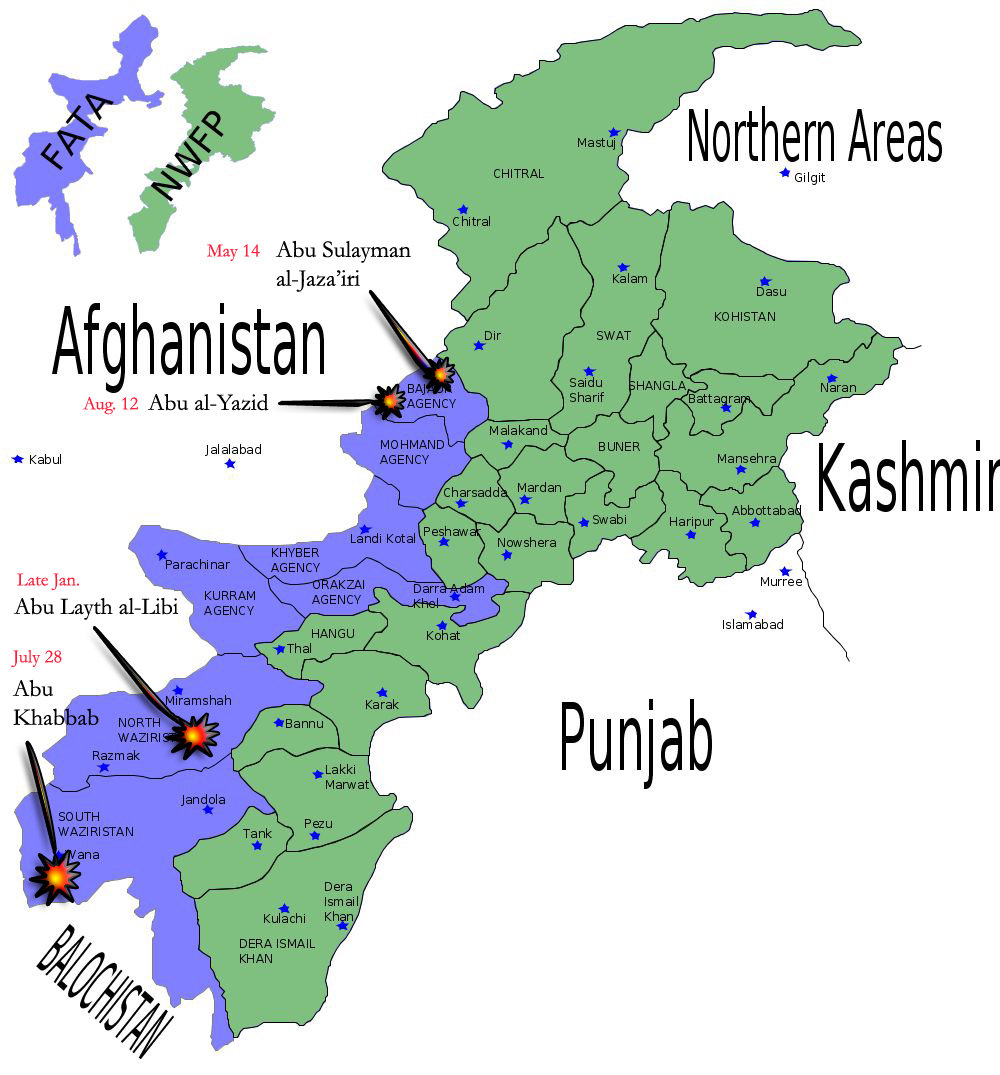
If true, it is horrible news for al-Qaeda.  Abu al-Yazid is the head of al-Qaeda in Afghanistan and one of the few public faces of the organization (he sometimes gets the job of announcing the death of AQ operatives killed in Afghanistan).  Moreover, it comes after a string of successful strikes on high-profile al-Qaeda leaders this year: Abu Layth al-Libi, Abu Sulayman al-Jaza’iri, and Abu Khabab.  Of course, there are other capable leaders waiting in the wings, but don’t underestimate the damage these deaths cause.  It is sending AQ Central back to 2003.

To get a spatial and chronological sense of what is happening, I’ve put together a map of the 2008 killings based on Bill Roggio’s nice summary of the information.  The marks for al-Jaza’iri and Abu Khabab are accurate since we know where they died; for Libi and Abu al-Yazid (if dead), all we know is the province.

Al-Qaeda Cleric Linked to Chinese Terrorist Group

In the past week, there have been a spate of terrorist attacks in Xinjiang, the Muslim-majority province in China. On Aug. 4, militants killed 16 police in Kashgar, Xinjiang Province, which is near the border of Afghanistan and Pakistan. On Sunday, bombers attacked 17 sites in Kuqa, west-central Xianjiang. Although I haven’t seen any claim of responsibility for the attacks, a good candidate is the Islamic Party of Turkistan (IPT), which in recent weeks has been threatening terrorist attacks in China during the Olympic Games.  They have also claimed other recent attacks.

Although little is known about the IPT, Aaron Weisburd has done some amazing cyber sleuthing and discovered that the IPT hosted the website of `Abd al-Hakim Hassan. Aaron did not know who Hassan was and neither did the Jihadi ideologues on the elite Hesbah forum. But he knew that Hassan was someone important because al-Qaeda’s media distribution organization, al-Fajr, announced the establishment of his website.

As I wrote in June, Hassan is the alias for al-Qaeda cleric Shaykh `Isa. `Isa has a lot of sway over the Pakistani Taliban and has provided the doctrinal justification for its campaign against the Pakistani government. He is a near-enemy ideologue that would rather Jihadis in Afghanistan and Pakistan decrease attacks against the U.S. in foreign countries and focus on achieving power locally (see my analysis of one of his articles here).

I don’t know if Hassan/`Isa’s internet connection with the IPT gives us any hints about the group’s strategy, but tells us something about its ideological orientation. It is also further proof that the group has direct links with al-Qaeda Central.

Zawahiri Dead?

A Pashtu television station reported on July 29 that Zawahiri was killed in the same attack that killed Abu Khabab in South Waziristan. The news broke in the U.S. this afternoon via Stratfor.  CBS reported this evening that Zawahiri was badly wounded in the attack.  (See the news summary here.)

Bill Riggio is right to urge that the report of Zawahiri’s death be treated with extreme caution since it is based on the word of an anonymous Pakistani official.  Pakistani intel previously lied about the death of Abu Khabab and Zawahiri.

I did a thorough search of Ekhlaas and turned up nothing.  I’ll check other forums tomorrow.  By way of comparison, the news of Abu Khabab’s death surfaced on Ekhlaas only a few days after the U.S. missile strike in South Waziristan.

Abu Khabab Killed in Missile Strike

This morning Reuters reported that U.S. missiles had struck a madrasa in Wana, South Waziristan and killed six people. At that time, the reporters did not know who had been killed.

On the forums this afternoon, there were several rumors that Abu Khabab, a senior al-Qaeda bomb maker and chemical weapons expert, had died in the strike. Now Taliban officials have confirmed it.

Abu Khabab was supposedly killed in 2006, but he survived. If you’ve read Omar Nasiri’s Inside the Jihad, you’ll remember Abu Khabab’s ominous appearance at a training camp in Afghanistan (hat tip: AC).

The fact that the U.S. has killed so many high-profile al-Qaeda members recently suggests greater penetration of the militant network in Pakistan or greater cooperation of some tribes in the region.

Smackdown! Sageman vs. Hoffman

That’s how the New York Times sets up the Sageman/Hoffman argument today: Two powerful academics are feuding over whether al-Qaeda is a leaderless movement (Sageman) or a hierarchical terrorist organization (Hoffman). There are billions in federal dollars hanging in the balance. And best yet, the two guys can’t stand each other.

There’s a lot more agreement between Sageman and Hoffman than the Times piece portrays. Both men accept that there are grassroots Jihadi groups popping up without any operational connection to AQ and both men believe that AQ Central (Bin Laden, Zawahiri, et al) is alive and well in the FATA region of Pakistan. The main difference is over how strong AQ Central is and what relationship it has to those who fight in its name. In his latest book, Sageman says AQ Central is not that strong outside of Pakistan/Afghanistan and that it doesn’t have any operational links with groups or individuals outside the region. Hoffman disagrees, arguing that AQ Central does have these links and that it is planning and financing global operations again. My money is on Hoffman’s thesis; Abu Ubayda’s shenanigans should be proof enough.

The problem with Sageman’s thesis is that it is four years too late. It works very well in 2004 when AQ Central was on the run and grassroots groups were popping up. But it is incomplete today when we have both grassroots activism and a powerful AQ Central. What makes things difficult now is that the grassroots groups are reaching out to the mother ship.

As for Sageman’s why-me? posture in the Times article, puh-lease. In his books, Sageman dismisses entire fields of study with a flick of the pen, excoriating colleagues for their lack of scientific rigor. His fulminations would be tolerable if his own scientific practice were rigorous, but it’s not–his datasets are not easy to obtain, his coding of the data is idiosyncratic, and some of his strongest conclusions rest on weak evidence. This is what Hoffman is reacting to in his review of Sageman’s latest book and it is long overdue.

Sageman has a lot of very useful ideas, but they are hard to talk about when he is standing in the way:

Maybe he’s mad that I’m the go-to guy now.

Blech.

Important al-Qaeda Scholar Identified

In the Tabri’a (Exoneration), released a few months ago, Zawahiri mentions several clerics he admires and who continue to support al-Qaeda. One of them is an Egyptian named Abu `Amr `Abd al-Hakim Hassan, whom he describes this way:

He has a long history in hijra, ribat, and jihad. He was arrested and tortured in Egypt, which he endured patiently. He graduated from the College of Commerce and then from al-Azhar’s College of Theology. His scholarly and scientific efforts are copious. Among the works he produced were the books Elucidation of the Importance of Issues Surrounding Unbelief and Faith (التبيان في أهم مسائل الكفر والإيمان) in three parts, Jihad in the Path of God: Etiquette and Rules (الجهاد في سبيل الله- آداب وأحكام) in two parts, and Guiding the Mujhadis to the Commission of the Trustworthy Prophet (هداية المجاهدين إلى وصية النبي الأمين), which is a book explaining the Prophet’s (peace and blessings be upon him) commission to listen and obey those in authority. He emigrated to Afghanistan two times–the first during the jihad against the Russians, the second during the time of the Islamic Emirate [the Taliban]. He was the supervisor of the journal Signposts of Jihad (معالم الجهاد), which was a quarterly scholarly journal that used to be published by the al-Jihad group. He established the The Salah al-Din Center for Proselytizing ( مركز صلاح الدين للدعوة), and taught lessons, which were not suspended (even) along the frontiers and battlefronts. When America launched its Crusader invasion on Afghanistan, he lined up with the mujahids, educating them, issuing them fatwas, and adjudicating between them. The shaykh has a website on the Internet that contains his valuable publications and fatwas. We beseech God to bless his righteous work, his health, and his life and to provide for us, for him, and for (all) Muslims constancy upon the truth and a good end.

Hassan’s website–kanzhassan.net–was working when when Zawahiri’s book first came out, but it is now defunct. I’ve attached archived copies of earlier versions.

Tawhed.ws, the main library of learned Jihadi-Salafism, carries a number of Hassan’s works and also has a bio. According to the site, Hassan was born in 1959 or 1960 (1379 AH) and adopted the Salafi creed in the seventies. He first studied with several shaykhs, including Azhari professors. He “participated” with the brothers in Egypt in their jihad against Sadat and was imprisoned in 1980 following Sadat’s assassination. After Hassan was released from prison, he formally studied at al-Azhar. Afterwards, he studied management at the College of Commerce. Hassan then traveled to the Arabian Peninsula and Yemen, where he studied with a number of scholars. But eventually he had to leave the Peninsula because he was not able to stay (doesn’t say why). Hassan decided to go to Afghanistan to participate in the jihad there in 1985 or 1986. While there, he published a lot on issues associated with jihad, particularly on issues associated with faith and unbelief. He also rubbed shoulders with `Abd Allah `Azzam and Sayyid Imam (aka Dr. Fadl or `Abd al-Qadir b. `Abd al-`Aziz). In 1992 or 1993 Hassan went to Yemen to teach in religious schools after fighting broke out among the mujahids in Afghanistan. After traveling to several countries, he returned to Afghanistan in 1995 or 1996 when the Taliban came to power. When the U.S. attacked Afghanistan after 9/11, Hassan fled with the mujahids to the mountains of Afghanistan, where he remains today.

So, who is `Abd al-Hakim Hassan? According to journalist Syed Saleem Shahzad, he is none other than Shaykh `Isa (or Sheikh Essa), who is supposed to be a high-level member of al-Qaeda and one of its main links to the Pakistani tribal insurgents. Shahzad claims that `Isa has been instrumental in pushing takfirism in the tribal regions of Pakistan. He also claims that `Isa was nearly killed by a U.S. Predator drone a day after Bhutto’s assassination, but managed to survive.

If Shahzad is right, a brief study of some of Hassan/`Isa’s writings online might shed some light on recent ideological trends in the FATA and al-Qaeda’s intent in the region.  One work, on the near enemy/far enemy question, looks particularly interesting. I’ll post more in a few days once I’ve had a chance to look at it in detail.

Document (Arabic): 6-1-2008-tawhed-bio-and-works-of-abd-al-hakim-hassan

Document (Arabic): 11-9-06-kanzhassan-dot-com

Document (Arabic): 8-9-2007-kanzhassan-dot-net

Latest Jihadica
Subscribe to receive latest posts
Follow us