Are the Uzbeks Going Global?

[Editor’s note: I am thrilled to introduce Einar Wigen, author of the recent FFI report on the IJU, as a guest contributor. Einar interned at FFI last summer and is currently a a student fellow at the Norwegian Institute for International Affairs (NUPI). A fluent Turkish speaker, Einar specialises in jihadism among the Turkics. Not many people produce world-class research as summer interns, so this guy is really someone to look out for in the future.]


The Turkic peoples have until now played a fairly peripheral role in global jihadism. They have not attracted much academic attention, and apart from the 2003 Istanbul bombings and the 2008 American Consulate attacks, operations carried out by Turkics have gained little attention. The Waziristan-based group Islamic Jihad Union (IJU) seems to be trying to change this (as Jihadica has suggested before).

The IJU broke off from the Islamic Movement of Uzbekistan in 2001, and went for a while under the name Islamic Jihad Group. When the name changed in 2005, the group also assumed a new strategy, one that looked beyond Uzbekistan and focused more on global issues. This may also have involved a merger with other groups, as indicated in the “Union”. What binds the group together appears to be language, and it is primarily made up of Turkic-speaking members.

The number of IJU fighters has been estimated at between 100 and 200, the bulk of which comprises Uzbeks, who remain relatively anonymous compared to the Turks and Germans arriving in the camps. This makes it much smaller than the Islamic Movement of Uzbekistan, which operates in nearby Southern Waziristan and is hosted by Baitullah Mahsud.

Although smaller than the IMU, the IJU maintains a higher profile through its use of the website Şehadet Zamanı. It is unclear whether this website is run by the IJU itself, or by a sympathiser with privileged access to the group. The website is in Turkish and presents news on the group’s operations and on other issues relating to Jihad. It is the most important of the Turkish jihadi websites, and is frequently referred to on other forums and jihadi websites.

The IJU is based in Mir Ali in North Waziristan, where it is hosted by the influential tribal leader Jalaluddin Haqqani. Until the latter was killed in an American drone attack in January 2008, the group was in contact with the centrally placed Libyan al-Qaida member Abu Laith al-Libi. Abu Laith seems to have exerted considerable influence over the group, seemingly pushing it to take its struggle beyond Uzbekistan and Afghanistan.

The group’s best known plot was the Sauerland Cell’s planned attack in September 2007. The group was led by a German convert called Fritz Gelowicz and consisted of at least one more German and two German Turks. The plan was to attack the Uzbek and the American Consulates and the Rammstein Airbase in Germany with hydrogen peroxide bombs, each equivalent of about 250kg of dynamite. The trial against the cell is still going on, and the four main suspects have pleaded guilty.

The Sauerland Cell was trained by the IJU in Waziristan, and while in Germany it was in contact with the IJU via email. Since the attack became known, more German recruits have turned up in the IJU’s camps. In March 2008, Germany got its first suicide bomber when the Bavarian Turk, Cüneyt Çiftçi, blew himself up at an American base in Afghanistan. Another German in the IJU is the convert Eric Breininger, who has become something of a celebrity on the IJU’s webpages. He has made several appearances in videos. In his rhetoric, Germany should expect attacks because of its close cooperation with Uzbekistan and for its involvement in Afghanistan. Breininger’s picture now hangs at every point of entry to the EU, and publicly at all German airports. It was long speculated that he may become a suicide bomber, but that has not happened so far.

Through its use of the Şehadet Zamanı website the IJU is becoming a hub in the Turkic network of jihadists. The spokes go to Germany, Turkey and obviously also to Uzbekistan. Such a development would seem to give al-Qaida a foothold among radicals of the Turkic peoples.
Virtual safe havens and the war of ideas

Abu Muqawama has a great piece in the New Republic today. Given his very kind words for Will and myself, I am biased, but the article makes an extremely important point about the importance of virtual safe havens. Although I just posted and don’t really have the time to blog, I felt compelled to add a few thoughts.

There are at least two more reasons why there ought to be a virtual dimension to the new AfPak strategy. First, the Pashto and Urdu-language part of the jihadi cyberspace is growing rapidly, and very few people are keeping track of it. Those who do rarely know the Arabic sites and vice-versa. No analyst I know has enough Arabic and Pashto to connect the dots (except Mustafa Abu al-Yazid).

Second, the Internet infrastructure in Afghanistan and Pakistan is relatively poorly developed compared to the Arab world. This is very worrying, because it means that there is a huge untapped propaganda resource which will be exploited as the local infrastructure inevitably develops. This is unlike in much of the Arab world, where the Internet’s potential has been largely taken out by the local jihadi groups. We are seeing the signs of this trend in the spread, on the ground, of semi-virtual propaganda such as DVDs etc – see this brilliant ICG report for details.

Having said this, in the overall “war of ideas” we must realise the limits of the Internet and other media, because at the end of the day they are just that: media. In the debate about Abu Muqawama’s article, “MK” is spot on when he asks: “What exactly are we going to use for the substance of our digital message if we don’t actually try to deal with some of the real-world problems that render the jihadist narrative plausible or appealing?”

I couldn’t agree more. For several years people in Washington have been discussing public diplomacy in the misguided belief that it is somehow enough to tinker with the form and distribution techniques of “our message” to win the war of ideas. The elephant in the room (or in the Beltway) is that the war of ideas has to be waged on substance.

It is very simple: 1) Say and do things on Palestine, Chechnya and Kashmir that make Muslims feel less geopolitically deprived and humiliated. 2) Be nice to the locals in Iraq, Afghanistan and Pakistan and broadcast your good deeds, 3) Point out where the jihadis are wrong on substance, and 4) Let mainstream Muslim clerics take care of the theology.

In the meantime we can and should do things to limit the Internet’s effectiveness as a propaganda tool, but at the end of the day the Internet is just the messenger.

Update: Tim Stevens has an excellent in-depth post on this topic and Abu Muqawama has added further remarks.

Update 2: Tim reposted an extremely interesting DoD-sponsored study of safe havens relevant to the discussion. I should of course also mention Mike Innes’ book on safe havens – the only one on the subject as far as I know. His take on Abu Muqawama’s article is here (sorry for the delay).

Back

I have been busy the past two weeks, but the jihadis have been busier. Bin Ladin has issued two audio statements, one proposing practical steps to liberate Palestine and the other about the treacherous government in Somalia. Al-Zawahiri warned against the forthcoming Crusader attack on Sudan, while Mustafa Abu al-Yazid has addressed the people of Pakistan. Abu Umar al-Baghdadi has spoken about the US plan to withdraw from Iraq, but he does not seem to get the same attention from the online community as his colleagues in Afghanistan. Abu Qatada has issued a statement from prison about the decision to extradite him to Jordan. Fatah al-Islam sharia officer Abu Abdallah al-Maqdisi has been taking questions since Monday, but nobody is allowed to ask about Shakir al-Absi or Asad al-Jihad2 (hmm).

On the magazine front, Sumud 33  has been out for a little while. Fortunately Sada al-Malahim 8 came out on Sunday so now Greg can sleep again. Turkestan al-Islamiyya 3 came out earlier this week, adding to the past month’s increasing flow of Uighur jihadi propaganda.

We have also seen the publication of a couple of unusual videos featuring Abu Muhammad al-Maqdisi, one with him delivering a funeral sermon in front of a crowd of several hundred people, and another showing him at a large wedding alongside half the jihadi community in Zarqa.  I suspect these videos are part of an attempt to bolster al-Maqdisi’s legitimacy by showing that he is enjoying freedom of movement and expression. By the way I highly recommend the 2-hour wedding video. It offers a fascinating inside look into the sociology of Islamism. It serves as a great illustration of a point I made in a recent article about Zarqa, namely that you cannot deradicalise entire communities. The film may depress you, but you might enjoy the songs.

I will be back soon with a report from the jihadi roundtable in Oslo.

Update (27 March): The Christian Science Monitor became the first Western newspaper to report on the Maqdisi controversy today – and Jihadica is mentioned.

Document (Arabic): 03-26-09-shouraa-mustafa-abu-al-yazid
Document (Arabic):
03-19-09-shouraa-abu-qatada-statement
Document (Arabic):
03-23-09-shamikh-abu-abdallah-al-maqdisi-qa
Document (Arabic): 03-22-09-shouraa-sada-al-malahim-8
Document (Arabic): 03-25-09-shouraa-turkestan-al-islamiyya-3
Document (Arabic): 03-12-09-faloja-maqdisi-fima-kuntum
Document (Arabic): 03-12-09-ansar-maqdisi-wedding-video

Child Martyrs

[Editor’s note: I am very proud to introduce a new contributor, FFI researcher Qandeel Siddique, who will be covering Urdu-language jihadi websites for Jihadica].

The Pakistani militant group Jaish-e-Mohammad, led by the famous Masood Azhar, has a strong presence on the Urdu-language wing of the jihadi internet. Among its less savory operations is an online jihadi magazine tailored especially for children, entitled Musalman Bachay [Muslim Children]. In the magazine, Masood Azhar and others regale their young readers with anecdotes from personal battles, as well as fictional pieces, centering on the importance of Islam and being a “good Muslim”, and convincing them of the bravery and honor in pursuing the path of jihad.

The aim of this magazine is quite evident: to lure young minds into Jaish-e-Mohammad’s ideological fold. This arguably gives meat to JeM’s broader strategy of harnessing support for jihadi missions.

The magazine contains articles on religion and combat written in simple style, supplemented by child-friendly features such as “cartoon of the day,” riddles, jokes, and so on. Articles cater to both boys and girls, and a section is dedicated to posting various entries scribed by the readers – presumably to encourage their engagement with the magazine.

In this month’s issue (March 2009), Masood Azhar shares the story of “Commander Sajjad Khan’s exemplary sacrifice;” portraying Sajjad Afghani, a Harakat ul Mujahideen leader who was captured in Srinagar in 1994 and imprisoned in India until his death in an attempted 1999 jailbreak. In the article, Masood Azhar tells stories from his time in prison with Sajjad Khan, including an account of how the latter, on 11 February 1994, risked his own life to save Masood Azhar.  “Until doomsday [Sajjad Khan’s] sacrifice shall serve as a glorious guide for all mujahideen,” writes Masood.

By revealing intimate stories like this, and using emotional language, Masood Azhar makes his young readers feel like privileged confidants, thus strengthening their emotional ties to the Maulana.

Sajjad’s sacrifice for Masood Azhar is portrayed as an Islamic ideal to be emulated; “to take the noose from around the neck of your Muslim brothers in distress, and put it around yourself.”

Another article entitled “I will be a mujahid” relates the tale of Nauman, a student who, when asked by his 5th grade Urdu teacher what he aspired to be when he grew up, replied “Master sahib! I will be a mujahid.” The narrator reveals that upon hearing this answer, the teacher became overwhelmed with great affection for the child and secretly lauded the parental upbringing he had received.

Once home, Nauman would recount the classroom incident to his mother and reiterate: “Mother, as you already know I want to be a mujahid like brother Usman and kill the enemies of Islam.” These words joyfully echoed in the mother’s ears.

Five years later, after Nauman completed his secondary school, he set off for a “three month training course.” He would go on to attend college for two years, all the while excelling at his studies. Armed with parental permission and prayers, as well as blessings from his master sahib, he then left for jihad. For one year he “sent Hindus to hell” whilst providing “protection to his mothers and sisters.” Eventually, Nauman, the “seeker of martyrdom” would find eternal peace in killing 20 infidels.

The story ends with the news of Nauman´s martyrdom reaching his parents and former Urdu teacher; the parents react by “giving thanks to Allah” for their son had “paved their way to paradise.” Meanwhile the teacher’s eyes welled up with happy tears and fond memories of the little boy with the “innocent countenance” who had once declared “Master sahib! I will be a mujahid.”

Several points can be raised from this article: it is cleverly geared at young Pakistani boys for whom parental consent and a teacher’s approval are socially important factors. The aspiration to be a mujahid, and then subsequently setting off on that path, is met with positive encouragement in this story.  For an impressionable 5th grade student reading this magazine, being a “mujahid” assumes a higher status than that of “doctor” or “engineer” (which a few other students in the story claimed to aspire to, leaving no impression on the teacher).

In Musalman Bachay you will also find a section containing letters from the readers. One such letter presented some “good news” – that is, “Kosar Shah, a friend of mine who was also a JeM soldier… was martyred on January 21.”

Targeting young children appears to be an important Jaish strategy. About a year ago, in April 2008, JeM held a conference in the city of Bahawalpur in Pakistan’s Punjab province where amongst the star-studded speakers was a young madrassa student  named Muhammad Umar (incidentally also the nephew of Masood Azhar).  In an impassioned, but discernibly rote-learned speech, the boy advocated am immediate revival of Islam’s historic jazbah jihad or “passion for jihad” and declared Masood Azhar’s latest book to be instrumental in achieving this goal. Once jazbah jihad has been perched back to its rightful place, “it will strike such a blow that the infidel powers will be ruined forever, inshAllah.”

As a prelude to Muhammad Umar’s speech, the convener of the conference proudly stated: “…like women, children, too, have been fighting.” Among other examples, he cites the Badr raid as proof of this.  (The identity of the presenter is not known at this stage; however he has introduced Jamia Masjid Usman-o-Ali as his madrassa and Mohammad Umar as one of his students).

The very presence of a madrassa student at a jihadi conference highlights the importance of children to Jaish-e-Mohammad. The aim of using a madrassa student to promote jihad at a gathering such as this, and of creating magazines such as Muslaman Bachay, would be to inspire and manufacture a line of child martyrs willing to die for JeM’s militant causes.

Document (Urdu): 03-09-musulman-bachay-sajjad-khan-story
Document (Urdu): 03-09-musalman-bachay-i-want-to-be-a-mujahid
Document (Urdu): 03-09-musulman-bachay-letters-from-the-readers

New Jihadi Mags Analyze Mumbai, Somali Pirates

Issue 31 of Sada al-Jihad is out, as well as issue 4 of Qadaya Jihadiyya.  In Sada, Ta Ha al-Miqdad argues that the Mumbai attacks demonstrated that Jihadis have a “strategic awareness” because:

  • They hit the commercial center of India at a time of great global economic instability.
  • All of the attacks were from Pakistan, which demonstrated solidarity with the Muslims in India.
  • They sent a message to the chief Crusader allies by taking citizens of those countries hostage and executing them.
  • The attacks widened the scope of the confrontation in Afghanistan to include countries allied with the Crusaders against Muslims (i.e. India).
  • Most important, the attacks were a message to Obama, who wants to pull out of Iraq and concentrate on Af/Pak.  Obama knows he needs peace between Pakistan and India for his strategy to work and the Jihadis have shown they can destroy this peace.

In Qadaya Jihadiyya, Abu `Ammar al-Khusti observes that the allied powers have not cracked down on the Somali pirates and have agreed to pay their outrageous ransom demands.  The reason for this, he postulates, is that the allied powers are happy to pay the ransoms if it means the pirates will grow strong and thwart the designs of the Shabaab movement to conquer Somalia.  This is the Somali version of the Sawha movement in Iraq.

Document (Arabic): 12-17-08-faloja-issue-31-of-sada-al-jihad

Document (Arabic): 12-18-08-shamikh-qadaya-jihadiyya-issue-4

The Connection Between Sayyid Imam And The Mumbai Attacks

Khalil al-Anani wrote an article two days ago about the ideological connection between Sayyid Imam and the Mumbai attackers.  There are bits I disagree with, but he’s right to highlight the contribution of Sayyid Imam’s earlier works to the attackers and the contribution of his current revision to our understanding of those attacks.  A paraphrastic summary follows:

(more…)

The Denudation Of The Exoneration: Part 8

In part 8, Sayyid Imam continues to hammer al-Qaeda for bringing disaster to the Middle East and for the hypocrisy of its leaders.  He

  • puts forward the odd claim that AQ lied to the U.S. about WMD in Iraq and about AQ ties with Iraq to push the U.S. to invade
  • observes that Iran and Syria have been the primary beneficiaries of AQ’s antics in Iraq
  • notes what any observer of the region already knows but rarely says: bashing the U.S. and Israel and talking about the Palestinian issue is great PR
  • offers an excellent explanation as to why AQ will not get a foothold in the Palestinian territories
  • claims that Bin Laden gave Saudi donations for jihad to Nawaz Sharif in support of his candidacy against Benazir Bhutto

Continuing…

Z claims that only the mujahids have thrawted the plans of the U.S.  That’s like Gamal Abdel Nasser’s slogan after the ’67 defeat that “no voice rises above the voice of battle” in order to silence his critics.

AQ brought the U.S. into the region and caused it to occupy Iraq and Afghanistan.  It gave the U.S. false information about WMD in Iraq and tying Iraq to al-Qaeda to give the U.S. the excuse to invade Iraq.  They did this to lure the U.S. into a battlefield where it could be destroyed.  But AQ killed far more Iraqis than it killed Americans.  It brought the U.S. in and excommunicated the people of Iraq solely to fulfill its desire to fight America.

Z claims that AQ thwarted the plans of the U.S. but the truth is the opposite.  Wherever AQ goes, it brings destruction to Muslims.

Those who have benefitted from the killing in Iraq are first Iran, then Syria.  Is Syria facilitating those who seek to fight in Iraq out its love for jihad, for the Iraqis, or for its own self interest?  Aren’t some of the leaders of AQ who are encouraging others to fight in Iraq located in Iran, particularly the son of UBL?  Is fighting for the interests of Syria and Iran a jihad?  Hasn’t Z previously paid his brothers to fight in Egypt in service of Sudanese intel?  Isn’t killing the Iraqis and demolishing their homes exactly what Jews are doing to Palestinians?  Is this jihad or even thwarting the plans of America?  Wasn’t Iraq part of the Abode of Islam under Saddam before the American occupation?  Didn’t al-Qaeda, at the hands of Zarqawi, trigger a sectarian civil war in Iraq by killing the Shia en masse?  Haven’t the Sunnis paid the ultimate price for this?  Killing the Iraqi Shia only strengthened their ties to Iran and facilitated Iranian involvement in Iraq, whereas it did nothing but weaken the Sunni position in Iraq.

Does the mentality that lost an actual Islamic state in Afghanistan really believe that an Islamic state will be established in Iraq and not just on the Internet?  Are the Islamic peoples to be test animals for Bin Laden’s and Zawahiri’s experiment?

No one is more pleased with al-Qaeda today than Iran and Syria.  All they have to do is turn a blind eye to the fighters who travel through their countries to blow themselves up, which serves Iranian and Syrian interests.

8) One of Z’s ignorant beliefs is that he proves the truth of what he says by pointing to the number of his followers.

Z says I heaped abuse on Bin Laden, but then he asks which of us has better understood reality and affected more of Muslim youth and masses? (Exoneration, p. 10)

The truth is known by its agreement with the Sharia, not by the number of its followers.

I have not called on anyone to follow me.  I am only relaying what I think is right according to the Sharia. 

Aren’t those who extol Bin Laden the same people that previously extolled Saddam Hussein?

Z’s words [ie the truth of what you say is proven by the number of your followers] indicate a fundamental aspect of his character: he has always been looking for fame and he is willing to get it by killing the innocent.

* One of the deceptions of Z is his trading on the Palestinian question

It is well-known that the fastest way to gain popularity among the Arab and Muslim masses is to bash the United States and Israel and talk a great deal about the Palestinian issue.  Nasser did it, Saddam did it, Ahmadinejad does it, as do others.  However, these people have actually done something for Palestinians, particularly Nasser, whereas Bin Laden and Z just talk.  Z even says in his Exoneration that “the slogan which the masses of the Muslim umma have understood and responded to well for 50 years is the slogan of calling for jihad against Israel.  Moreover, in this decade the umma is mobilized by the American presence in the heart of the Islamic world.” [I think this quote is from Knights but haven’t checked it yet]

Z and Bin Laden talk about Palestinian children being hurt but not about the death they bring to the children of Afghanistan.

* Why doesn’t al-Qaeda undertake operations in Palestine?

If Al-Qaeda is so interested in the Palestinian question, why hasn’t it undertaken operations against the Jews there?  There are two reasons.  First, killing Jews is not one of Bin Laden’s priorities.  Second, al-Qaeda is an organization without a state; wherever it is, it is a stranger.  One can’t carry out operations in a country without the help of some of the people in that country. 

Al-Qaeda has failed to ally with any of the Palestinian organizations for four reasons:

1) Palestinian organizations don’t trust Bin Laden.  There’s no room to explain here, but it is an old matter from the days of the Afghan jihad.

2) Al-Qaeda has nothing to offer Palestinian groups militarily since the latter are far more advanced.  Indeed, Al-Qaeda relied on the cadres of the Egyptian Islamic Jihad trained by the Palestinian groups in Lebanon from 1990 to 1992.

3) Different tactics with respect to the use of force.  Bin Laden uses blind force to kill as many people as possible, even if it leads to the destruction of his organization–“organizational suicide.”  Palestinian organizations, on the other hand, use limited force to make gains against the enemy while ensuring the survival of their organization.  They follow the traditional principles of guerrilla war, the “war of the flea and the dog.”  Bin Laden’s new way is the war of the elephant, which makes mass killing the goal.

4) Palestinian organizations don’t need Bin Laden’s money since they have their own resources, just as they are more politically sophisticated than Bin Laden.

This is why Al-Qaeda has failed to ally with Palestinian groups and failed to gain a foothold in Palestine.  That’s why Z in his recent statement called for the Bedouin of Sinai to engage in jihad in Palestine.  It’s just propaganda.

When the Palestinian organizations rebuffed al-Qaeda, Z started criticizing them. Z accused Hamas of killing Jewish children with their missiles.  Is this a rational person?  What about the innocents al-Qaeda has killed in Afghanistan, Iraq, Algeria, and elsewhere?  Is what is permitted for Al-Qaeda forbidden for Hamas?  Z is sad for Jewish children but kills Muslim children.

Z accuses Hamas of participating in elections on the basis of a secular constitution.  Why does Z criticize Hamas only?  Why not also criticize his shaykh Bin Laden?  Bin Laden paid a lot of money in support of Nawaz Sharif in parliamentary elections in Pakistan against Benazir Bhutto.  This was money for jihad that Saudis had give Bin Laden.  When I found out about this in 1992, I said to Abu Hafs al-Masri, who was the one who gave the money to Nawaz Sharif, “Abu Hafs! By God, Bin Laden is leading you to Hell!”

Document (Arabic): 11-27-08-al-masry-al-youm-denudation-part-8

The Denudation Of The Exoneration: Part 3

As with Wednesday’s installment, Sayyid Imam saves the good stuff for last.  He obliquely chides Mullah Omar for not turning over Bin Laden to the U.S.  Imam also discloses that Bin Laden was plotting with Pakistani intelligence before 9/11 without the permission of Mullah Omar and alleges that he worked with ISI head Gen. Mahmud Ahmed.  Finally, Imam reveals that Zawahiri did not know of the 9/11 attacks until after they happened.  In all, the picture he paints of Zawahiri is of a man very peripheral to al-Qaeda operations until after 9/11.  

At the beginning of today’s installment, Sayyid Imam rebuts several of the principles underpinning the “school of al-Qaeda” and reprises the argument of his last book that even though jihad is a duty, there are conditions that must be met before it can be undertaken.  My paraphrastic translation follows:

Muslims are the cause of their own problems, not Americans as Zawahiri and Bin Laden say.  The reform of Muslims has to begin with themselves.

UBL and Z. abandoned the umma, leaving it to pay the price by losing two nations, Afghanistan and Iraq, and by coping with the death of hundreds of thousands of people and widespread destruction.  

* Zawahiri rejects my argument that jihad is not the only option Muslims can use to confront their enemies.  He also rejects the idea that there are conditions and barriers to jihad.

  • But there is a difference between the necessity of an Islamic duty and the ability of a Muslim to carry it out [eg you don’t have to pray if you are unable to].
  • Z. says, “This corrupt reality…will only change through force” (Exoneration, p. 193).  Any other option, he says, is “the poisons of weakness and paralysis” (p. 74).  These words are kufr [unbelief] because God clearly mentioned other options in the Qur’an, and the Prophet and his Companions did not always use violence.  Z. is like an ignorant doctor who only knows how to treat a patient one way and believes every other way is wrong.
  • UBL and Z. exploit the Islamic sentiments of the youth along with their ignorance of the Sharia sciences.  Z. hates to speak about conditions and barriers for Islamic duties, even though they are the pillars of Sharia wisdom.  He doesn’t want the youth to know this way of reasoning so they will be more receptive to fiery rhetoric.  Weighing conditions and barriers is the difference between a scholar and an ignorant person, a jurist and a reckless person.  
  • My experience with Z. is that he is the most reckless of those who don’t think about consequences.  But he is an unusual reckless person.  A normal reckless person risks something he owns.  But Z. risks what he doesn’t own.  In Egypt, he risked the lives of hundreds of his brethren and then he fled and did not die with them in Egypt as he had promised.  He then risked the Taliban state, the Afghan people, and then the Iraqi people.  He always risks what he doesn’t own, flees, and then leaves others to pay the price.  All of this has led to no real achievement on the ground but rather wholesale losses.  Thus, he doesn’t want Muslim youth to know there are conditions and barriers for jihad that lead to minimal loses, in contrast to the outcome of recklessness–heavy losses without benefit.  Think about why the Islamic movements have failed to establish Islamic states or suffered severe losses; it is because these conditions have been ignored.

* Localization of Leadership

  • UBL violated the command of his amir, Mullah Omar, to not attack the U.S.  He developed the heretical notion that he only had to obey him in matters internal to Afghanistan.
  • Islamic scripture does not limit obedience to one’s amir to a location.  You have to obey your amir no matter where you are.  Moreover, medieval scholars say there can be no raid beyond the borders your amir controls without his permission.
  • UBL betrayed Mullah Omar but this doesn’t excuse Omar’s responsibility for the loss of Afghanistan.  He could have prevented it if he had acted wisely at the first sign of trouble without violating Islamic law.  But he failed to act.
  • During its reign, the Taliban punished women for leaving their homes without covering their faces.  Today they kill Afghan soldiers who collaborate with the American occupation.  But the Taliban still will not bring UBL and Z. to an accounting, even though they were directly responsible for the loss of the Taliban state.
  • UBL never respected the Taliban government.  He wanted to use it as a means to attack the U.S.  He also cut deals with outsiders as if he were a state within a state.  For example, he struck agreements with his old ally, Pakistani intelligence, in particular with Gen. Mahmud Ahmed.  UBL also did interviews with the foreign press even though Mullah Omar forbade it.
  • Z. also had contempt for the Taliban state, even though he said in his book Knights that the mujahid states of Afghanistan and Chechnya had to have Jihadis’ total support and that the battle had to be transferred to the heart of the Islamic world.  He further said that because these states are weak, the Jihadis had to solve the problem [overthrowing Islamic regimes elsewhere] themselves without exposing these states to retaliation.  But his subsequent actions contradicted his earlier words.

* The heresy of fighting the far enemy before the near enemy

  •  Z. invented this principle to support UBL’s plan to attack the U.S.  By this, they wanted to focus the disparate actions of the Islamic groups on a single far enemy.  This is completely contrary to Islamic scripture and to the classical understanding of scholars [gives quotes].
  • For 30 years, Z. preached fighting against the near enemy, the Egyptian government, until he decided in 1998 that it was more important to fight the far enemy.  That was after the failure of Egyptian Islamic Jihad in Egypt and its financial bankruptcy.  So he joined UBL’s Global Islamic Front for Jihad in 1998, even though the U.S. had done nothing to EIJ before that.  That’s when he concocted this principle and put it in UBL’s mind.
  • Z.’s agent in Europe, Hani Siba`i, said in a book that Z.’s decision brought great harm to EIJ, even though the change in strategy was not the collective decision of the group.
  • Even though Z.’s group incurred heavy losses for the sake of UBL, UBL did not used to trust Z. for reasons I won’t go into here.  Thus, he did not inform him of the 9/11 plot before it happened, even though Z. had joined AQ and given allegiance to UBL in June of 2001.  UBL then had him justify the attack after the fact.

Document (Arabic): 11-21-08-al-masry-al-youm-denudation-part-3

New Issue of Urdu-Language Jihadi Journal

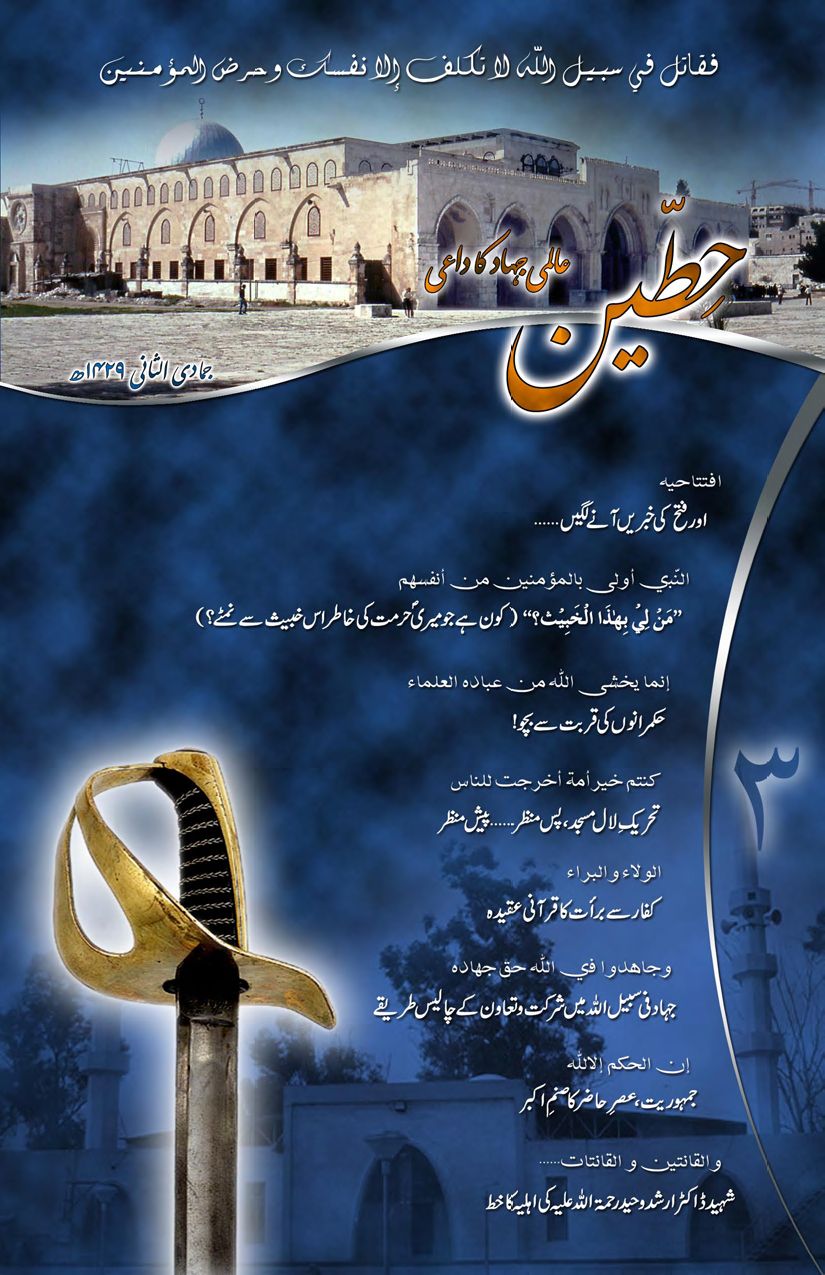
[by Chipotle Mystery]    Issue 3 of Hittin, an Urdu-language Jihadi journal, has been released.  The issue includes:

  • short reports on the Islamic State of Iraq and the Islamic Emirate of Afghanistan
  • a eulogy of Mullah Dadullah, a major Taliban commander who was killed in May of 2007
  • several articles that refer to the Red Mosque incident
  • a collection of quotes from notable jihadi figures (e.g. Mullah Omar, Usama bin Laden, and Zawahiri) that is presented as inspirational advice for leaders
  • an article on “methods” for engaging in jihad by the “Center for the Islamic Studies”  

It’s telling that although this issue was published recently, it focuses on events that occurred in the middle of 2007.  There is also older material.  For example, this issue has a fatwa issued by Mufti Nizamuddin Shamzai in 2001 that justifies attacks on American soldiers in Afghanistan (he had issued a similar fatwa against the Soviets following their invasion of Afghanistan in 1979).  Shamzai was a Pashtun cleric from Karachi who has been lionized in Al-Qaeda videos and who was assassinated by unknown assailants in 2004.  He issued this fatwa just prior to the collapse of the Taliban government.  

Going back even further, there is also an “article” by Jalaluddin Al-Suyuti, a 15th century Egyptian polymath who wrote on a variety of subjects ranging from theology to history (he wrote an interesting history of the caliphs).  The article attributed to him warns against getting entangled with governments, likely meant to warn readers against assisting the Pakistani government in its anti-militant clampdown.   

The publication of Hittin has been sporadic, with the first two issues being published in 2007 (March 2007 and then May-July 2007 after the Red Mosque siege).  Although the length of the magazine has increased over time, it remains an eclectic collection of material, much of it recycled from elsewhere.  This fact, coupled with the magazine’s dated material, indicates that either  Jihadi Urdu-language e-journals are still in their infancy or that there is limited personnel for preparing such journals.  The fact that it had to be distributed on Arabic-language forums also tells us that Urdu jihadi forums (if there are any) don’t yet have the infrastructure or following to disseminate it.  As for the breadth of the magazine’s distribution in hard copy, that remains a mystery.

Document (Arabic): 10-31-8-faloja-issue-3-of-hittin

The Strategic Effects of 9/11, Part 5: The Jihadi Domino Theory

Continuing…

  • Why did al-Qaeda attack the U.S.?  Was it to drive the U.S. out of the Middle East?  Or was it to strike the far enemy for the sake of destroying the near enemy (i.e. regimes in the Arab and Islamic world)?
  • Regardless of the intent of al-Qaeda’s leaders, the sequence of events gives weight to the second possibility, which could also be termed the Domino Scenario.
  • According to a 2007 article by George Friedman, Bin Laden saw a rare opportunity after the fall of the USSR to begin re-establishing the worldwide caliphate.  But, says Friedman, armed groups can’t establish empires.  They can, however, seize a state and use it to begin to establish an empire.  UBL realized that Afghanistan wasn’t the ideal place for this because of its geographical position and its weakness.
  • Based on Zawahiri’s pre-9/11 writings, Friedman believes that UBL wanted to topple local regimes and replace them with Islamic ones.  He was looking to do this in Egypt because it leads the Islamic world.
  • Friedman says the two goals of the attacks were 1) to prove to Muslims that the US could be attacked and suffer great harm, and 2) to provoke a U.S. response.  Whatever the U.S. chose to do in response, Muslims would win.  If the U.S. failed to respond, it would look weak.  If it attacked, it would be engaged in a crusade.
  • The authors of a report from Decision Supports Systems, Inc. written two months after 9/11 understood al-Qaeda’s intent.  The study says that before 9/11, AQ attacked three targets without sufficiently provoking the US: civil, diplomatic, and military.
  • Based on al-Qaeda’s statements before 9/11, DSSI wrote that al-Qaeda was trying to provoke the U.S. into a conflict with it.  After the 9/11 strikes, the U.S. responded in the manner planned by al-Qaeda.
  • According to DSSI, AQ wanted to provoke the U.S. into a large military invasion of the Middle East so AQ could destroy its military and upset the geopolitical balance of power.
  • The DSSI report argues that the greatest indicator that this was AQ’s strategy is the fact that its operatives assassinated Ahmad Shah Massoud, the commander of the Northern Alliance.  AQ knew that when the US retaliated for 9/11, it would work through tribal proxies because the U.S. does not like to get its hands dirty.  Thus, AQ had to kill the most effective leader of those trbies.
  • As the DSSI study concludes, as long as the U.S. continues to behave in predicable ways, al-Qaeda can anticipate its responses and plan accordingly.
  • According to the DSSI study, there are three possibilities after 9/11.  1) The U.S. intervention in the Middle East provokes uncontrolable violence in the Middle East which will make it ungovernable in the long term.  2) The U.S. sends more troops to stabalize the situation but its presence polarizes Muslims and puts strain on its allies in the region, particularly the Gulf states and Pakistan.  The government of Pakistan could become unstable and AQ or its allies could get control of its nukes by infiltrating the security apparatus or overthrowing the government.   The collapse of these states will create security vaccuums that AQ or its allies will fill, giving them control of oil and nukes.  3) AQ could choose to destroy oil production in the MIddle East, forcing the U.S. to look elsewhere to meet its energy needs.

[Update: All of DSSI’s publications can be found here.]

Latest Jihadica
Subscribe to receive latest posts
Follow us