The Propaganda of Jihadist Groups in the Era of Covid-19

Since the very beginning of the pandemic, jihadist groups have been addressing and discussing the issue of Covid-19 in their propaganda, seeking to interpret it for their constituencies and exploit it for their cause. As we shall see in detail below, these groups have sought to use the pandemic as an opportunity to denigrate their enemies, spur recruitment, and inspire attacks. They have also tried to cast the pandemic as a warning from Allah to mankind, including Muslims, and in many cases have detailed strategies for preventing the virus’s spread.

Jihadist messaging regarding the pandemic has not been uniform, however, as the following survey of the different groups’ propaganda will show.[1] The main difference is seen between those groups focused more on stopping the spread (e.g., the Taliban, Hay’at Tahrir al-Sham) and those focused more on exploiting the pandemic to stoke violence and amplify their message (e.g., the Islamic State, al-Qaida). All of these groups, however, have benefited from one of the main effects of the pandemic, which is the considerable increase in time spent on the internet and social media as people were forced to isolate themselves at home. To that extent, the pandemic has created fertile ground for jihadist propaganda and proselytising campaigns.

The Turkestan Islamic Party (TIP)

Among the first groups to speak publicly on the issue of Covid-19 was the Turkestan Islamic Party (TIP), a Uyghur jihadist organisation with links to al-Qaida.[2] In a video published in February 2020 on the Islam Awazi media channel, titled “The Perspective of the Mujahedeen Regarding the Corona Outbreak in China,” the TIP states that the outbreak in China is a “punishment from Allah” for the Chinese oppression of the Uighur minority in Xinjiang: “They destroyed mosques and turned them into  places of dancing, vice and insolence, they trampled on the Koran and burned them, transgressed honour and raped women […] God’s vengeance came against these criminals and sent them the deadly coronavirus […] the whole world knows that what happened in China, is simply part of God’s punishment.” In the video, the group gives an overview of the pandemic and rebukes the Chinese state for allowing the consumption of “meat forbidden by the Quran.” The TIP video ends with the spokesman’s hopeful statement that the pandemic will lead to the destruction of the atheistic Chinese state.
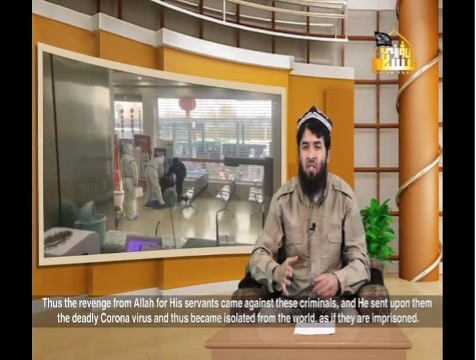
Figure 1 – A snapshot of the TIP video (Source: Islam Awazi Telegram channel)

The Islamic State

The Islamic State has addressed the issue of Covid-19 in several statements, not explicitly naming the Coronavirus or the term Covid but rather speaking about pandemics in general.

The first statement, an infographic titled Sharia Guidance for Managing Pandemics,” was published in the second week of March 2020 in issue 225 of the weekly newsletter al-Naba’. The infographic cites various hadith to emphasize hygiene and other precautionary measures regarding contagious diseases. The advice for militants includes instructions to “cover your mouth when yawning and sneezing” and to “wash your hands.” The infographic also warns healthy militants not to go to countries affected by the pandemic and those who are sick not to travel. At the same time, it reminds the militants that the pandemic is ultimately under the control of God, stating that “it is necessary to believe that diseases are not infectious on their own but are by Allah’s command and decree,” and it further emphasizes the necessity of “relying upon God and seeking refuge in him to be spared from disease.” Soon after, during the same month, the Islamic State published a 2-minute-and-13-second video reiterating the same guidance as the infographic. In both the infographic and the video, the lettering and banners are either purple or green, purple indicating a hadith of the Prophet and green indicating advice of a hygienic nature.
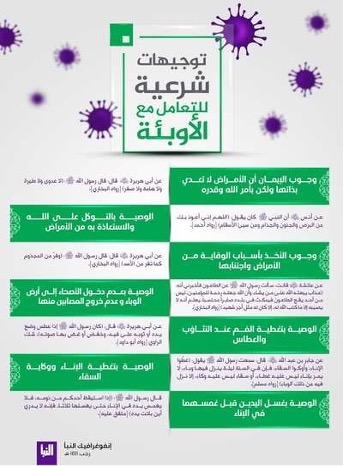
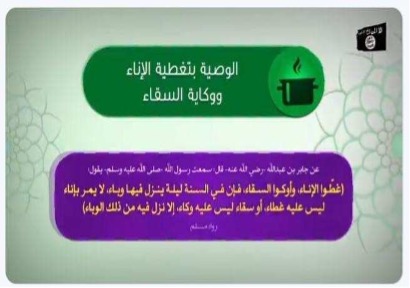
Figure 2 – The infographic of the 225th issue of al-Naba’ (Source: Telegram and Rocket.Chat channels)
Figure 3 – A snapshot of the IS video (Source: Telegram and Rocket.Chat channels)

The Islamic State would return to the subject of the pandemic in issue 226 of the al-Naba’ newsletter, which was published on March 19, 2020. The issue included a lengthy editorial on the spread of the contagion showing how the organisation was seeking to exploit the pandemic in service of its strategy. The editorial makes a number of points about the nature and implications of the pandemic and how the mujahideen ought to go about exploiting it:

  • The pandemic is an example of Allah’s torment, which strikes especially at idolatrous nations and unbelievers.
  • The Crusader (i.e., Western) nations are concerned about the current and potential consequences for the economy, including the prices of goods and services.
  • The Crusaders face pressure on their military deployments abroad at a time when they have been trying to bring their troops home. There is also the fear that with the pandemic come terrorist attacks in their own countries.
  • The Crusaders hope that the mujahideen will not carry out attacks even as they feign ignorance of their own crimes against Muslims; the latter should feel no sympathy for unbelievers and apostates but should seize the opportunity to free Muslim prisoners from the prison camps in which they suffer terribly.
  • Muslims should also remember that obedience to Allah allays His torment and wrath, so performing jihad and striking enemies is the best way to protect oneself from the pandemic.
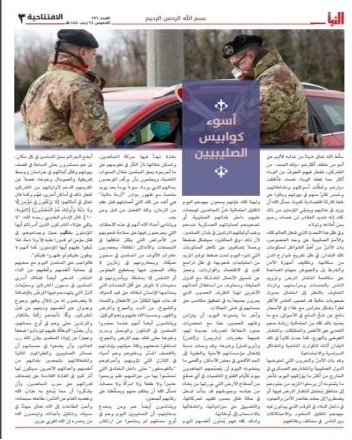
Figure 4 – The editorial of the 226th issue of al-Naba’ (Source: Telegram and Rocket.Chat channels)

The following week, the Islamic State’s propaganda again took up the matter of Covid-19, this time with a twist. In the editorial of al-Naba’ issue 227, the group talked almost exclusively about the United States, casting doubt on the United States’ ability to deal with global events, to contain the pandemic, and otherwise to anticipate risks and protect itself. Also in February, the English-language magazine The Voice of Hind, associated with the Islamic State’s Wilayat al-Hind, or Hind Province, devoted a page to the pandemic. The brief editorial, titled “Verily, it is a Punishment sent by Allah on whom he wished, and Allah made it Mercy for the believers,” echoes many of the Islamic State’s earlier points, including the idea that the pandemic has had a disproportionate impact on non-Muslim countries and the importance of seizing the opportunity to attack enemies. “The ever-increasing rate of COVID-19 that we are witnessing,” reads the editorial,

is a torment for the disbelievers and has brought the glad tidings for the believers. O Muwahideen, prepare with whatever you have and Rise up! and make it worse for the Kuffar […] Allah has made this disease a source of chaos among the nations of disbelief, and so their military and police have been deployed in their streets and alleys making them an easy target. So use this opportunity to strike them with a sword or a knife or just a rope to stop their breathing, fill the streets with their blood.

For the Islamic State, then, Covid-19 was at this stage a welcome development since it was seen as mainly affecting unbelieving nations and possibly providing additional incentive to wage jihad. There was some concern about the spread of the virus among Muslims, as the first Islamic State publications on the subject stressed mitigating measures drawn from prophetic guidance. But for the most part the group’s tone was one of optimism and schadenfreude.
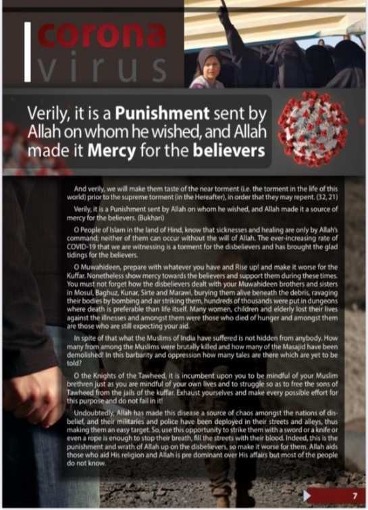
Figure 5: The editorial of issue 2 of the magazine The Voice of Hind (Source: Sawt al-Hind. Channel present on Telegram, Hoop, Tam Tam and Rocket.Chat).

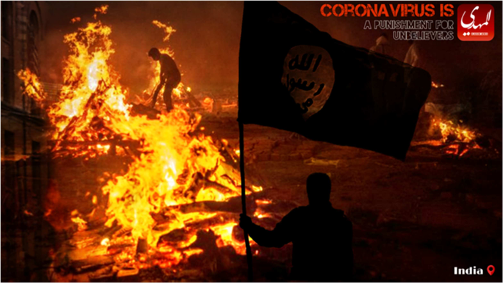
In the same period, several unofficial pro-Islamic State media channels published posters and messages on various platforms recalling and reiterating the information previously spread by the organisation on its official channels, including the theme of divine punishment of the unbelievers and the idea of the virus as being the will of Allah. Among the most active of these channels were “Coronavirus: A Soldier of Allah” and “GreenBirds” on the Rocket.Chat platform.
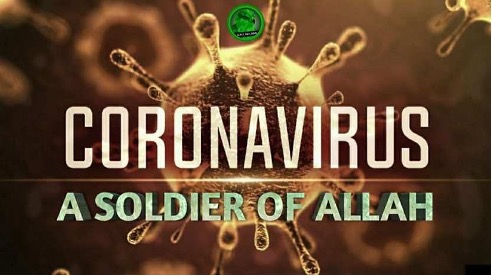
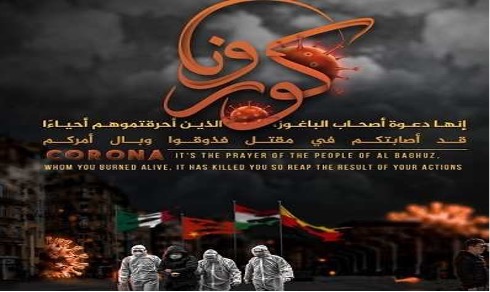
Figures 6, 7, 8: Posters published by pro-IS channels

The Taliban

The Taliban’s approach to the pandemic has been quite different from the Islamic State’s, the group’s leadership being concerned above all with stopping the spread of the contagion in Afghanistan, particularly in government prisons where thousands of Taliban militants were being held. In a statement issued on 3 March 2020, Taliban spokesman Zabihullah Mujahid expressed dismay at the rapid spread of the virus, stating that the blame for infections and deaths “will be the responsibility of the Kabul government and its foreign supporters.” The group has since repeatedly issued security guidelines to counter the spread of the virus and has asked all Afghans returning to the country from abroad to have themselves tested.

On March 18, 2020, the Taliban’s official website, “Voice of Jihad,” published a “Statement concerning the fight against coronavirus” in which the group mixed religious observations about the nature of the virus with practical recommendations about how to fight it and protect people from it. “The Coronavirus is a disease ordered by Almighty Allah because of disobedience and sins of mankind or other reasons,” the statement read. “According to the directives of the scholars, people should recite effective prayers frequently and increase the reading of the Holy Quran, give alms and charity and turn to Allah in repentance for their past sins. […] In addition, safety guidelines issued by health organisations, doctors and other health experts should be adhered to and all safety precautions should be followed to the best of their ability.” Since the end of March 2020, the Taliban have refrained from offering such religious assessments of the pandemic, rather issuing rules and regulations to help counteract it.
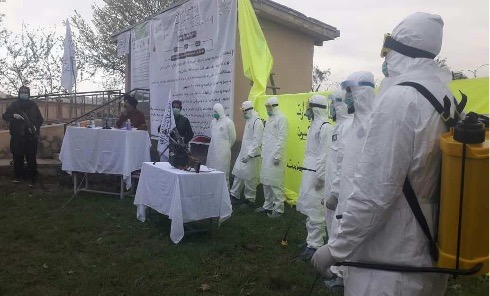
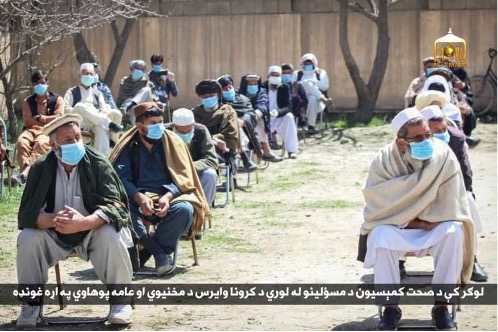
Figures 9, 10: Meetings organized by the Taliban to provide instruction in anti-Covid measures (Source: official website of the Islamic Emirate of Afghanistan, al-Emara).

Meanwhile, the Pakistani Taliban, or Tehreek-e-Taliban Pakistan (TTP), which presents itself as a subsidiary of the Afghan Taliban, has promoted the theory that the Jews and their allies were secretly behind the pandemic. The eighth issue of the Urdu-language magazine Mujalla Tehreek-e-Taliban Pakistan, published in December 2020, includes an article by mufti Abu Misbah titled “The Coronavirus and the Background Realities,” in which “the Jews and their puppets” are blamed for releasing the coronavirus in order to harm Muslims. According to this conspiracy theory, the virus was developed in the 1960s by a Scottish virologist, and afterwards “the COVID-19 virus was kept in a safe place and properly concealed so that it could be used as an atomic bomb, especially against Muslims.” It was released as part of “the work of those dreaming of establishing […] a Jewish superpower government.”
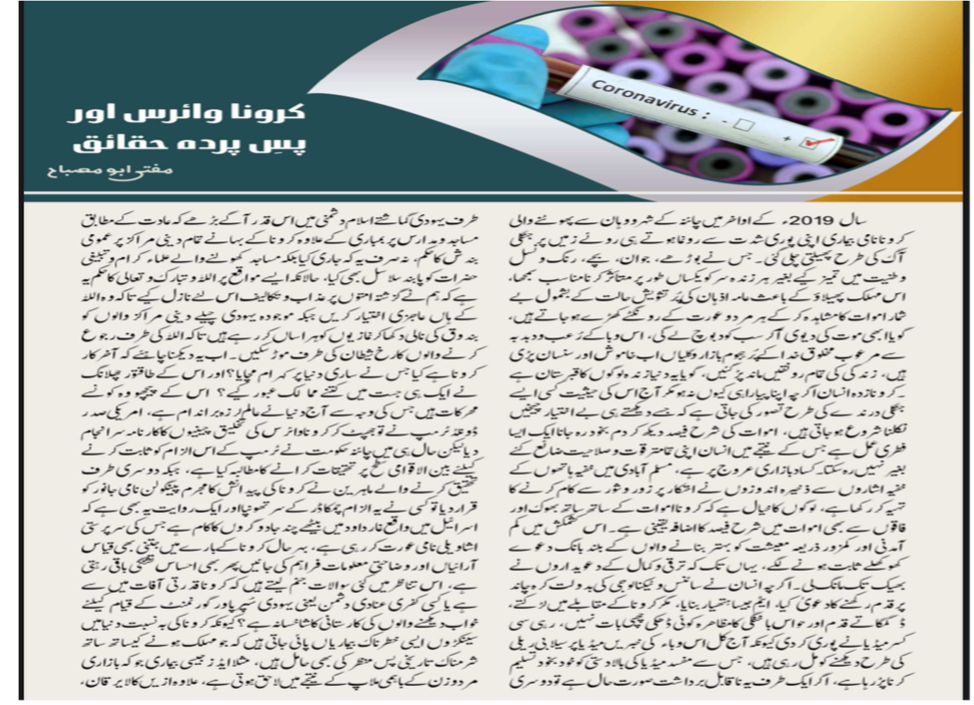
Figure 11: TTP magazine editorial on Covid-19 (Source: Umar Media Telegram channels and official UmarMedia.co website)

Al-Qaida

As for al-Qaida, which, like the TTP, bills itself as a jihadist entity subordinate to the Afghan Taliban, the group’s propaganda has focused on several themes, from the importance of hygiene and cleanliness to the idea of the pandemic as being the just rewards of the unbelievers.

The first remarks by al-Qaida on the subject, published in March 2020, took the form of a six-page statement by al-Qaida Central’s al-Sahab Media titled “The Way Forward: A Word of Advice on the Coronavirus Pandemic.” In the statement, both the Islamic world and humanity at large are described as having invited the pandemic by means of their wicked behavior. “It must be said,” the statement reads, “that the arrival of this pandemic to the Muslim world is only a consequence of our own sins and our distance from the Divine methodology.” Several pages later it affirms that “this pandemic is a punishment from the Lord of the Worlds for the injustice and oppression committed against Muslims specifically and mankind generally.” The statement also takes the opportunity to invite Westerners to embrace Islam in light of the evident failure of their societies to stop the pandemic, a failure that is attributed to “your usury-based economy.” As the pandemic has revealed, “Your governments and armies are helpless, utterly confused in the face of this weak creature. Allah (swt), the Creator, has revealed the fragility and vulnerability of your material strength.” From there the al-Qaida statement turns to the issue of hygiene, noting how “Islam places great emphasis on the principles of prevention to protect against all forms of disease. This is implemented through a system of personal hygiene that takes the form of a regular routine that is repeated several times throughout the day.” The statement concludes on an optimistic note, addressing the Crusaders, Zionists, and apostates by saying, “The fear and panic that has befallen you bodes well for us, and we ask Allah to hasten your fate.”
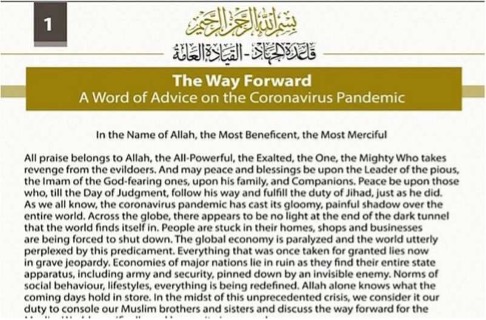
Figure 12: Al-Qaida Central statement (Source: As-Sahab Media)

Subsequent statements by al-Qaida and affiliated groups have tended to focus on the devastating effects of the pandemic on the West and the opportunities created for terrorist attacks. In April 2021, al-Qaida Central’s flagship magazine, One Ummah, devoted an issue to the subject of “America Burns.” The opening article exulted in the economic, political, and social hardships facing the United States due to Covid-19, noting that the number of deaths in America from the pandemic has crossed the half million mark. Joe Biden is quoted calling the distribution of the vaccine under the Trump administration “a catastrophic failure.” Several months later, in August 2021, Iyad Ag Ghali, the leader of the Sahelian al-Qaida affiliate Jama‘at Nusrat al-Islam wa’l-Muslimin, appeared in a video that touched on the pandemic and its effects on the United States. In the video, Ag Ghali states that “what is happening to its [France’s] master, America, scourged by the Corona plague era […] this is because of their continuous attrition for their war on jihad.”
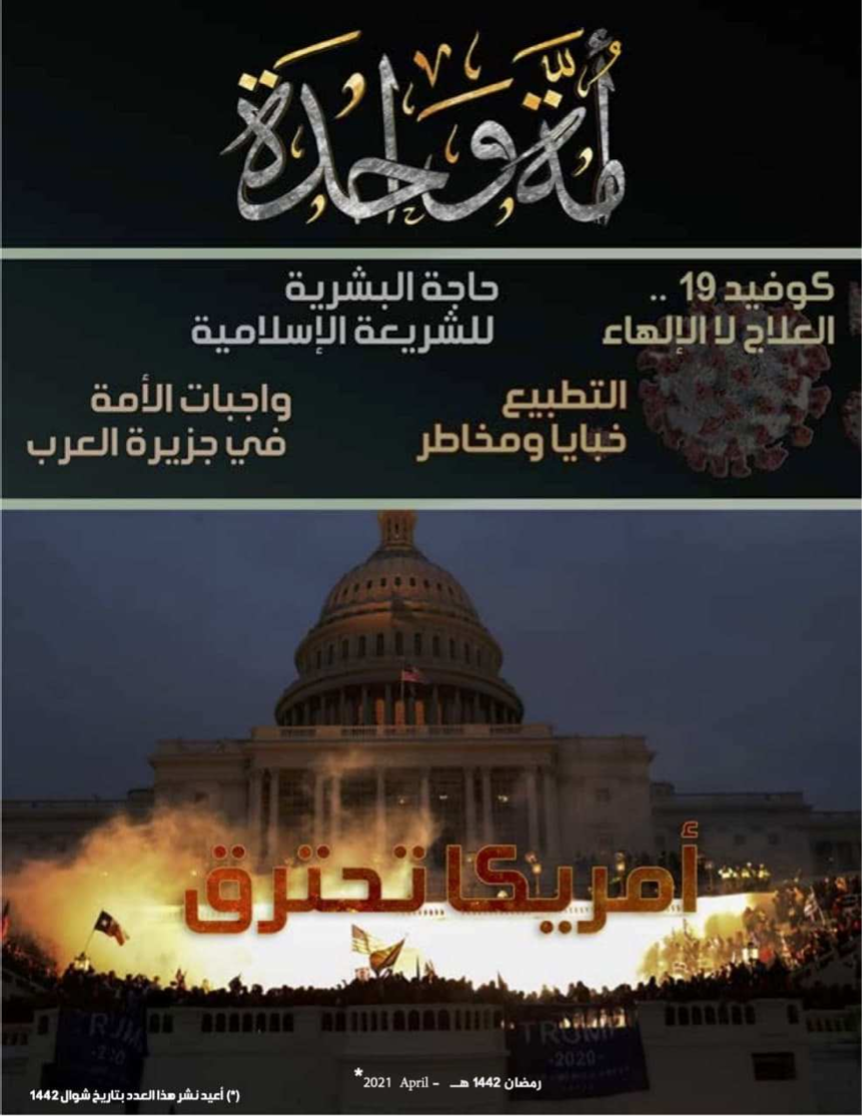
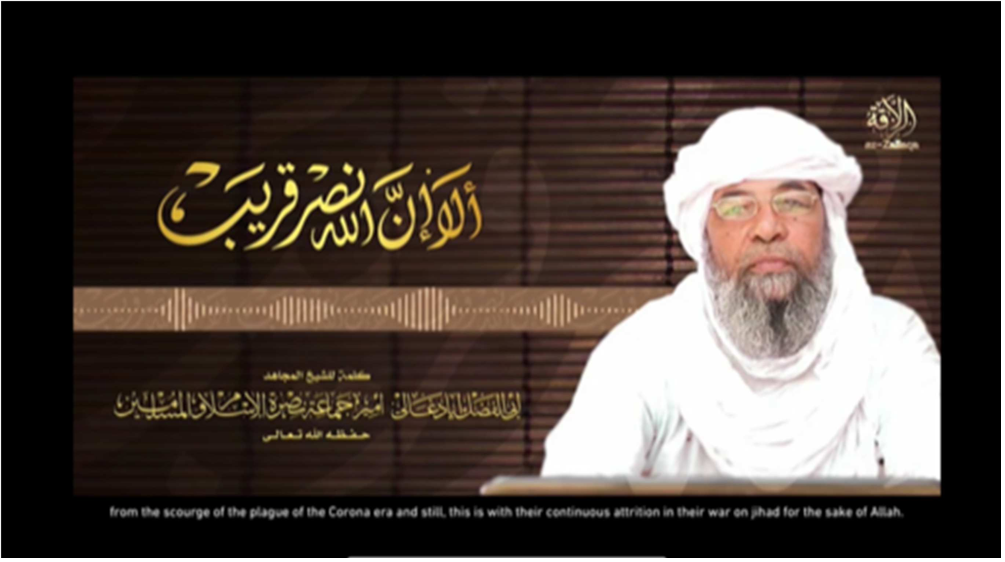
Figure 13: Issue 5 of One Ummah magazine (Source: As-Sahab Media)
Figure 14: Screenshot of Ag Ghali’s video message (Source: Az-Zallaqa Media’s channel on Rocket.Chat and Chirpwire)

The previous year, in November 2020, the pro-al-Qaida media group al-Malahem Cyber Army published the first issue of its new Wolves of Manhattan Magazine, calling for attacks to exploit the complex security situation created by the pandemic. Lone attackers were encouraged to disguise themselves with masks (so as not to be identified) and to kill and injure enemies by poisoning the stocks of face masks. The following year, in August 2021, al-Malahem Cyber Army again sought to promote attacks in the new Covid environment, publishing a statement on anti-lockdown demonstrations in the West. The demonstrations, according to the statement, were a “golden opportunity” for the Muslims to attack “the enemies of God,” particularly the police. Those unable to kill a policeman, it added, can at least destroy their vehicles.
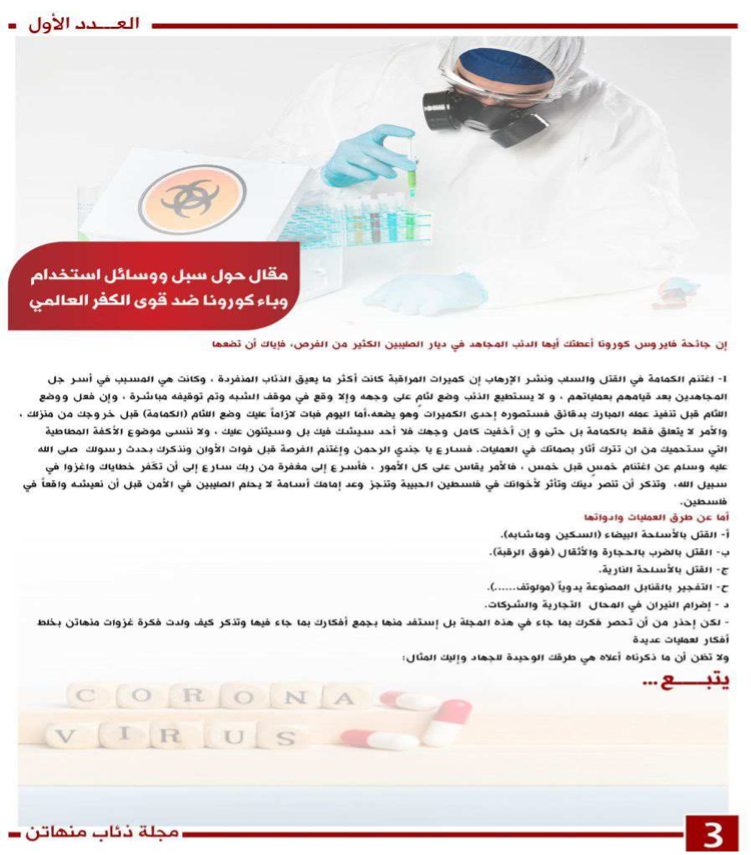
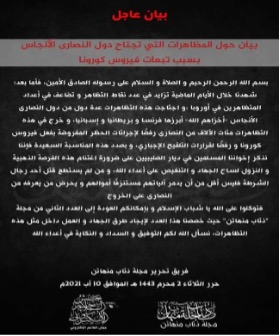
Figure 15: Page 3 of Wolves of Manhattan Magazine (Source: Telegram channels al-Malahem Cyber Army,  Sawt al-Qaida).
Figure 16: Statement by al-Malahem Cyber Army (Source: Telegram channels Al-Malahem Cyber Army, Sawt al-Qaeda and Jaish al-Malahem).

Al-Shabaab, al-Qaida’s affiliate in Somalia, has issued statements both exulting in the damage done by the pandemic to the West and providing guidance on how militants and those under al-Shabaab’s authority can protect themselves. In May 2020, the group announced the creation of a special committee of doctors, scientists, and local officials to manage the response to Covid-19 in the territories under its control. In March 2021, al-Shabaab warned in a statement against the Astrazeneca vaccine, the vaccine that was being distributed by “the apostate Somali regime.” The warning came not because of anti-vax sentiment but rather because of the alleged “ineffectiveness and adverse side effects” that had led a number of European countries to suspend the administration of the vaccine. “Do not allow your children and family members to be used as guinea pigs in the race to develop a potent vaccine for the coronavirus pandemic,” the statement advised, suggesting instead that Muslims “adhere to the medications prescribed in the Qur’an and Sunnah of the Prophet (peace be upon him), such as black seed and honey […] Until a safe and effective vaccination becomes available, the Office of Politics and Wilaayaat urges the Muslims of Somalia to repent and supplicate to Allaah in order to alleviate their suffering and uplift them from the disease.”
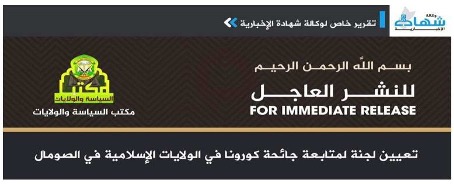
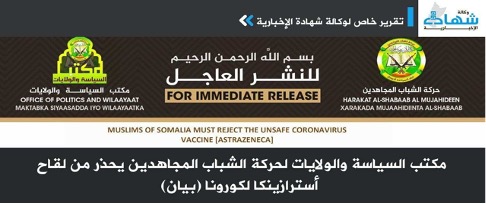
Figure 17: Al-Shabaab statement on the formation of the anti-Covid committee (Source: al-Kataib Media and Telegram channel Shahaada).
Figure 18: Al-Shabaab statement warning against the AstraZeneca vaccine (Source al-Kataib Media and Telegram channel Shahaada).

Hay’at Tahrir al-Sham

Like al-Shabaab, the Syrian jihadist group Hay’at Tahrir al-Sham (HTS), which was once affiliated with al-Qaida but has since become independent and now holds territory in north-west Syria, has been focused on preventing the spread of Covid-19 in its propaganda. While boasting in one statement that the virus has killed some of those who have “killed and shed the blood of the Muslims all over the world,” most of HTS’s attention has been devoted to emphasizing anti-Covid measures. In one poster released by HTS’s media outlet, al-Ebaa, Syrians in HTS-controlled territory are instructed to wear masks, wash their hands, and refrain from touching their faces, among other measures.
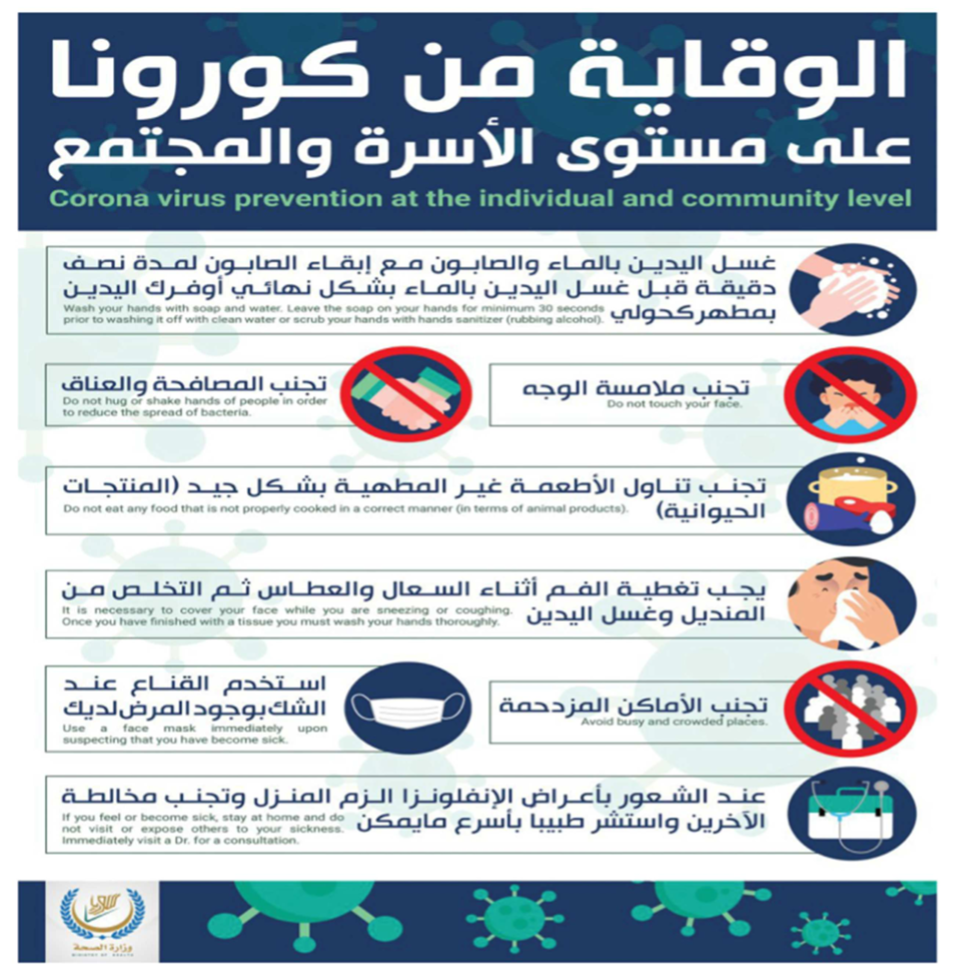
Figure 19: Poster released by HTS (Source: Ebaa news)

Conclusion

Jihadist organisations have devoted a great deal of attention to the Covid-19 pandemic in their propaganda. For the most part, however, this has had little favourable impact on the operations of jihadist groups. Jihadist activity has not significantly declined in the era of Covid-19, but neither has it increased dramatically either. The most that can be said is probably that increased time spent on the internet and social media has been conducive to greater radicalisation and recruitment. Jihadist organisations have sought to use the pandemic as an opportunity to strengthen themselves but do not seem to have achieved the desired result. Strategically, perhaps, only the Taliban and HTS have been able to exploit the pandemic operationally, providing governance services, medical aid, and infrastructure improvements in the territories they control, thus improving their credibility and popularity and demonstrating that they are more capable and prepared to meet the challenges of Covid-19 than the governments in Kabul and Damascus. In this way, jihadist organisations have sought to present themselves as a viable alternative to established governments, again showing that their aims are not limited to perpetrating violence alone.


[1] The images and statements included in the analysis were retrieved directly by the author while monitoring jihadist media channels. Where possible, links to sources are provided for researchers who wish to view or further investigate the material.

[2] The TIP has mainly been operating in Syria in recent years. See more at https://www.longwarjournal.org/archives/2018/07/analysis-the-turkistan-islamic-partys-jihad-in-syria.php.The Syrian branch of the TIP has collaborated with HTS and Abu Muhammad al-Jolani. In recent months there seems to be a split within the Syrian branch of the TIP (due to the choice of a part of the militants and leaders to participate in the fight of HTS against the other jihadist groups operating in the Syrian theatre). Many leaders and militants who disagree with the line adopted by HTS seem intent on moving towards the TIP strongholds in Afghanistan.


Jihadi Schadenfreude Over al-Nahdah in Tunisia

On July 25, President Qays Sa‘id of Tunisia dismissed Prime Minister Hisham al-Mishishi and suspended the activities of the Assembly of the Representatives of the People by invoking emergency powers under Article 80 of the Tunisian Constitution. The rationale was an out-of-control Covid crisis, continuing economic problems, and political dysfunction within the al-Nahdah-led parliament. Some analysts in the West have called Sa‘id’s maneuver an autogolpe, while many Tunisians locally, according to polling data, have backed Sa‘id’s move. It would not be a crisis, however, if the jihadi talking heads did not weigh in.

It is important to note that jihadi activity in Tunisia has been on a decline in recent years due to counterterrorism and military efforts locally against al-Qaeda (AQ) and the Islamic State (IS), as well as the waning fortunes of foreign fighting endeavors in Iraq, Libya, and Syria as IS lost territory. Nevertheless, it is worth considering the issue given the large-scale mobilization seen in Tunisia over the past decade, and since any form of instability is seen as an opportunity by the jihadi movement. Plus, what initially might appear as rhetoric, as was the case with jihadis speaking on the 2011 Tunisia uprising and having no part in it, could lead to a re-energized mobilization, in the same way that Ansar al-Sharia in Tunisia (AST) was able to take advantage of new conditions following the overthrow of former president Bin ‘Ali.

How Jihadis Have Framed the Crisis

Much of the messaging from jihadi thinkers surrounding the latest political events in Tunisia boils down to gloating over the embarrassment that al-Nahdah has suffered as a consequence of the freezing of parliament. In their telling, this is another example of democracy failing Islamist parties and further evidence that fighting jihad and instituting sharia are the only way to push back against local deep states and perceived anti-Islamic authoritarian forces. The Hay’at Tahrir al-Sham (HTS)-affiliated cleric Shaykh ‘Abd al-Razzaq al-Mahdi also views what happened through the prism of a conspiracy from outside forces, in this seeing similarities with what happened in Egypt with ‘Abd al-Fatah al-Sisi and the Muslim Brotherhood: “[Sa‘id] is leading a coup with the support of France, Sisi, and [the Crown Prince of the UAE] Ibn Zayed… if the lunatic is able to he will do as Sisi of Egypt.”

Meanwhile, the Syrian-based Tansiqiyyat al-Jihad’s Abu al-‘Abd Ashida, seeking to undermine democracy as a legitimate form of governance, rhetorically and cynically states and then asks the following: “Bloody red democracy. Coup in Tunisia. Coup in Egypt. Coup of [Libyan strongman Khalifah] Haftar. So this is considered democracy?” Abu Mahmud al-Filastini, a London-based ideologue and acolyte of Abu Qatada al-Filastini, argues that “no change will come without an effective force that loosens the joints of the deep state and undermines its pillars. The path of democracy cannot lead to the rule of sharia and the building of an Islamic state.” His mentor, Abu Qatada, gets to the point and bluntly states: “Jihad is a necessity. Almost all Muslims commenting today, from all walks of life, in their comments on what happened in Tunisia agree that jihad has become a necessity… They have no other choice.”

Alluding to what has become of al-Nahdah, the leader of Jaysh al-Ummah in Gaza, Abu Hafs al-Maqdisi, quotes a saying of the second caliph ʿUmar Ibn al-Khattab: “We are a people whom God has honored with Islam, so whenever we seek honor through anything else, God will humiliate us.” Adding onto the critiques of al-Nahdah is the London-based ideologue Abu Basir al-Tartusi, who addresses the party saying, “You will not find anyone crying for you … this is the reward of those who raise the slogan ‘separating da‘wa from politics’ and the slogan ‘freedom before Islam, and before applying the teachings and laws of Islam.’ You have neither achieved freedom nor supported the religion!” Al-Tartusi goes on to call al-Nahdah out for having tried to build relations with France while the latter is, in his view, domestically attacking Islam. Therefore, “[al-Nahdah] paid the price of this stance of vacillation and dilution … and this is the fate of every movement or group that follows this false and vacillating approach of theirs!”

As for the Tunisian ideologue in HTS who goes by the name al-Idrisi, his approach is more localized since he is originally from Tunisia: “The Tunisian revolution is paying the price of not purging the country of the remnants of the former regime, from the security [services], the army, influential businessmen, and the media. The parties are paying the price of living in an illusion and wishful thinking.” Of course, since al-Idrisi is with HTS and based in Syria now, he heavily criticizes on a regional level al-Nahdah’s and the Muslim Brotherhood’s role in failing the revolution: “Peoples’ relying on the Brotherhood in leading the Arab Spring revolutions is like relying on a mirage.” This leads to a key point in buttressing his own position on leaving Tunisia, which is that the best model today is that of HTS in Syria and the Taliban in Afghanistan. “The success of Hay’at Tahrir al-Sham and the Taliban,” he says, “calls for the umma’s reconsideration of the moderate jihadist movements that have proven their political and military sophistication in managing conflict, establishing existence, and seizing freedom from the clutches of evildoers.”

Beyond specific ideologues, the pro-AQ news agency Thabat and the official IS newsletter al-Naba’ also commented on the events in Tunisia. The Thabat article was penned by an Abu al-Bara’ al-Libi, who portrays the recent experience of al-Nahdah as part of a long history of Muslim Brotherhood organizations being used and betrayed by local regimes they had engaged with. He points in particular to what happened to the Muslim Brotherhood in Egypt under Gamal ‘Abd al-Nasir and more recently in the coup of ‘Abd al-Fatah al-Sisi. Sudan and Turkey are mentioned as cases too. Whereas Brotherhood organizations, including al-Nahdah, do not not heed the lessons of the past, he claims, the jihadis are never fooled since they have “a firm and unchanging stance regarding every tyrant (taghut) who substitutes God’s law and accepts democracy.”

Tracking with the rest of the aforementioned critiques, IS’s editorial in al-Naba’ directly attacks al-Nahdah’s embrace of democracy:

And among those who have most opposed God and His Messenger in this time are the seekers, advocates, and followers of democracy, who have believed in it and taken it as a path and course, and thus have contravened the Sunna and the precepts. God has imposed on them humiliation, destitution, and becoming lost, and that has become appended to them in all of their circumstances like a collar around their necks. This is the very thing that has happened today to the apostate Ikhwan in Tunisia after they contravened the path of the believers, followed democracy, sought help in it, glorified it, and made it a judge among them and a guide for them to the path of Hellfire. The result resembled what happened to them before, when the one they were content with as a taghut for themselves turned on them.

The IS editorial also uses the downfall of al-Nahdah as an opportunity to win points with AQ and its supporters, since in the past Abu Qatada al-Filistini, whom IS sees as a pro-AQ ideologue, had commended Qays Sa‘id when he won the 2019 Tunisian presidential election. Recalling the former praise of “some of the theoreticians of al-Qaeda” for Sa‘id, the editorial notes: “Indeed the stance of the dimwits of al-Qaeda regarding the Tunisian taghut is no less than the stance of the apostate Ikhwan in its naivete.” It is possible that Abu Qatada and others favored Sa‘id because of the latter’s traditional views on the death penalty, criminalization of homosexuality, and opposing equal inheritance between men and women.

Will These Words Amount to Anything?

It is hard to believe that Sa‘id would follow the mistakes that were made in the aftermath of the revolution as it relates to the jihadi movement. There have been too many hard-fought lessons learned by the state. It will not repeat the mistake of doing a prisoner amnesty like the transitional government did in February 2011 or having a light touch policy vis-à-vis AST as al-Nahdah did following its coming to power in the October 2011 Constituent Assembly election. That said, it would not be surprising if either AQ or IS attempted to prod the capabilities of the Tunisian state if these groups foresee some opening for themselves in the medium term. If Sa‘id goes full authoritarian, however, it is likely that dynamics will play out as they did under former Tunisian dictator Bin ‘Ali: suppression of local mobilization, with much of Tunisian jihadi activity occurring outside its borders in Europe or the latest foreign fighter destination—potentially Afghanistan again in light of the Taliban’s methodical takeover of Afghan territory.

Hamas and the Jihadis

The Palestinian terrorist group Hamas has long been a source of controversy in the world of Sunni jihadism. Especially since it participated in and won the elections of the Palestinian Legislative Council in 2006, going on to form a unity government with Fatah, the dominant faction of the Palestinian Liberation Organization, the following year, the group has generally been shunned by jihadis. Hamas’s roots in the Muslim Brotherhood, its embrace of the “polytheistic” religion of democracy, its perceived failure to rule by Islamic law in Gaza, its unholy alliance with Shiite Iran—all of this has made it unpalatable, if not anathema, to the adherents of Jihadi Salafism (al-salafiyya al-jihadiyya). The question that divides jihadis is exactly what level of condemnation is called for. Is the right approach to pronounce takfir (excommunication) on Hamas, or on certain elements of it? Is Hamas to be supported when it faces off against the Jewish state? Are its war dead to be considered martyrs?

The recent hostilities between Hamas and Israel have brought the controversy over Hamas back to the fore, shedding new light on the jihadi movement’s ideological fault lines. The first division is that between al-Qaida and the Islamic State, and as one would expect it is the Islamic State that takes the harder line against Hamas. There is another fault line, however, that runs between two ideological camps on the pro-al-Qaida side of the jihadi movement. It is here, as will be seen, where the most intense debate has taken place. One of the camps has not shied away from criticizing al-Qaida itself.

Al-Qaida vs. the Islamic State

Shortly after the conflict between Israel and Hamas began on May 10, when Hamas fired more than 150 rockets into Israel and Israel responded with airstrikes, most jihadi groups, including the various branches of al-Qaida, issued statements of solidarity with the Palestinians. The statements also decried the perceived Israeli aggression on the al-Aqsa mosque in Jerusalem, where clashes had been taking place between worshippers and Israeli security forces since May 7. Al-Qaida central, through its al-Sahab media outlet, issued three such statements between mid-May and early June.

The first statement appeared on May 11 in the form of an issue of al-Qaida’s occasional newsletter, al-Nafir. Titled “Al-Aqsa in the Care of the Descendants of al-Bara’ ibn Malik,” it appears to have been written before the air war began as its focus is the Palestinian demonstrations around the al-Aqsa mosque. Al-Qaida here likens the fearlessness of the demonstrators to that of the Prophet’s companion al-Bara’ ibn Malik, who was launched into a walled area of thousands of apostates in the so-called “wars of apostasy” in early Islam. The issue also quoted at length from a March 2002 speech by Osama bin Ladin in which he inveighs against normalization with the Jewish state and encourages Muslims to kill Americans and Jews by any means possible.

Several days later, on May 17, came a more controversial statement from al-Qaida’s “general leadership,” titled “Statement of Love, Honor, and Support for Our People in Palestine.” The purpose of the statement was to salute the “mujahidin” in Gaza and their launching of “jihadi missiles toward the Zionists.” The statement never mentions Hamas, but it does mourn the death of one of its military commanders. Toward the end, the al-Qaida leadership offers its condolences (or congratulations) to the Palestinians on “your pious martyrs, foremost among them the heroic leader Basim ‘Isa Abu ‘Imad.” Basim ‘Isa, who was killed in an Israeli airstrike in Gaza on May 12, was a top military commander of the al-Qassam Brigades, Hamas’s armed wing. As noted by the analyst Wassim Nasr on Twitter, the praise for Basim ‘Isa here was in keeping with a preexisting al-Qaida policy to distinguish between the political and military wings of Hamas. That policy was elucidated over a decade ago by the al-Qaida commander Mustafa Abu al-Yazid (d. 2010) after he made the mistake of saying in an interview that “we and Hamas share the same thinking and the same methodology.” Following criticism of his remark, Abu al-Yazid issued a clarification acknowledging that he had misspoken and explaining that the approach of the al-Qaida leadership is to distinguish between Hamas as a political organization, which had committed terrible methodological errors such as embracing democracy, and the righteous mujahideen fighting under Hamas’s banner (i.e., the al-Qassam Brigades, or at least some of them).

The third al-Qaida statement appeared on June 2, two weeks after a ceasefire was reached between the warring parties on May 21. Once again taking the form of an issue of al-Qaida’s al-Nafir newsletter, the statement hailed Hamas’s “sword of Jerusalem” campaign as a great victory that should be seized on “to revive the duty of jihad” in the youth of the Muslim umma. The model of initiating battles to defend mosques under siege from unbelievers and apostates was one to be followed across the Islamic world. The statement went on to praise “the mujahidin in Gaza” and in particular “their heroic leader Muhammad al-Dayf,” the supreme military commander of the al-Qassam Brigades. The singling out of al-Dayf further exemplified the al-Qaida leadership’s fondness for Hamas’s military wing to the exclusion of its political wing.

Taken together, the three statements show al-Qaida posturing as the ally of the al-Qassam Brigades and trying to portray the hostilities with the Jewish state as part of al-Qaida’s larger war with the Americans, the Zionists, and the “client” Arab regimes. Nowhere in these statements is there any hint of criticism of Hamas as a political organization, unless that is to be read in the omission of Hamas’s name. In the past al-Qaida has issued harsh condemnations of the Hamas political leadership, but here no such thing is to be found.

The Islamic State could not have responded more differently to the war between Hamas and Israel. After more than a week of silence on the matter, the official line came in the editorial of the May 20 issue of the Islamic State’s weekly newsletter, al-Naba’. Titled “The Road to Jerusalem,” the editorial condemned Hamas (never mentioned by name) as a proxy of Shiite Iran and as part of its axis of “resistance.” Hamas’s warfare was not to be considered jihad as it served the interests of the Iranians and their plot for regional domination. “The difference between jihad and resistance is as the difference between truth and falsehood,” the editorial read. “Whoso allies with those who curse the Prophet’s wives [i.e., the Shia] will never liberate Jerusalem … and whoso differentiates between the Rejectionists [i.e., the Shia] and the Jews will never liberate Jerusalem … Indeed, we consider the mujahid who lies in wait for the Rejectionists in Iraq to be closer to Jerusalem than those who show loyalty to the Rejectionists and burnish their image.” The editorial went on to claim that all of the Islamic State’s battles “east and west are in fact steps in the direction of Jerusalem, Mecca, al-Andalus, Baghdad, Damascus, and all other captured Muslim lands.” In other words, it is the Islamic State, and not Hamas, that holds the promise of liberating Jerusalem.

Perhaps the most notable line in the editorial was a remark toward the end rejecting the idea of Palestinian exceptionalism. “The soldiers of the caliphate,” it stated, “have not exaggerated the issue of Palestine and have not made it an exception among the issues of the Muslims … They have not differentiated between the blood of their Muslim brethren in Palestine and the blood of their brethren in other lands.” This is a remarkable statement, and one that illustrates a stark difference between the Islamic State and al-Qaida regarding the Israeli-Palestinian conflict. Unlike al-Qaida, the Islamic State is not interested in posing as the ally of whatever Sunni Muslim group is waging war against the Jewish state. For the Islamic State, any group that deviates from its methodology (manhaj) is simply not worthy of honor and support.

On June 21, the Islamic State’s official spokesman, Abu Hamza al-Qurashi, delivered an audio address that echoed much of the sentiment of the editorial. Al-Qurashi ridiculed the idea that Hamas could ever bring victory to Palestine and urged the Palestinians not to be deceived by the rockets launched by Hamas “in service of their Iranian masters.” Hamas was hypocritical for condemning the Gulf states’ normalization with Israel when it had normalized relations with “Zoroastrian, Safavid Iran.” As in the editorial, the idea here is that it is folly to differentiate between the Jews and the Shia.

Al-Maqdisi vs. Abu Qatada

Among jihadis opposed to the Islamic State and generally aligned with al-Qaida, a divide has emerged in recent years between two competing ideological camps—namely, those who side with the more hardline ideologue Abu Muhammad al-Maqdisi, and those who ally with the relatively more moderate Abu Qatada al-Filastini. Both men, who are Palestinian-Jordanians, have active social media presences and devoted followings. Much of their disagreement has revolved around the issue of Hay’at Tahrir al-Sham (HTS) in Syria, which al-Maqdisi has condemned and Abu Qatada praised. The matter of Hamas has proven equally controversial.

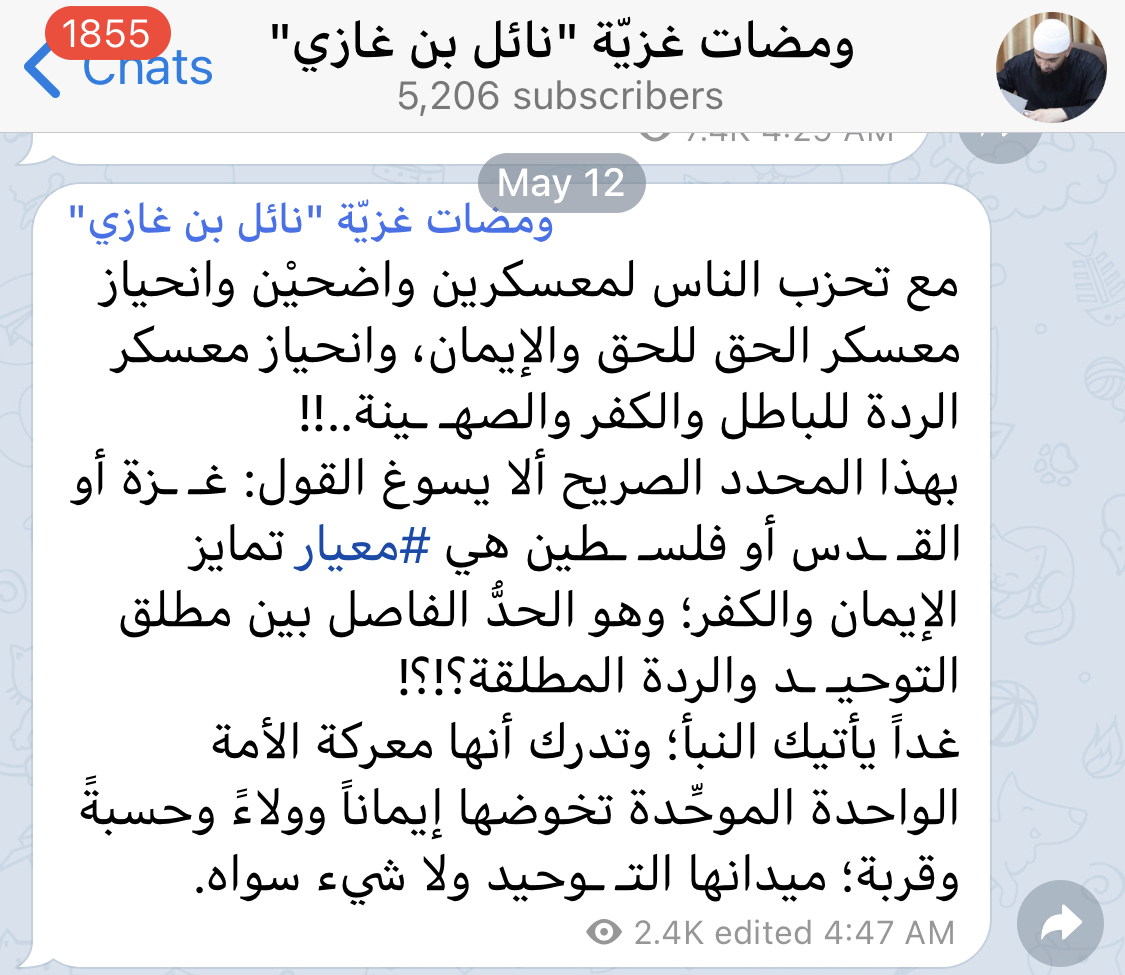
The war of words over Hamas, which played out on the messaging app Telegram, began on May 13 when al-Maqdisi responded to a comment by the jihadi scholar Na’il ibn Ghazi Musran, who is aligned with Abu Qatada. Musran had written that Gaza was “the standard of distinction between faith and unbelief, and the line separating monotheism (tawhid) in its entirety from apostasy in its entirety.” The author was referring to the different reactions in the Arab world to the Gaza conflict, his point being that those unsupportive of the Palestinian belligerents were in “the camp of apostasy” and those supportive were in “the camp of truth.” In his response, al-Maqdisi ridiculed the idea that “Gaza is the standard,” as the ongoing battle was not one between tawhid and unbelief. He cited what he saw as the outright apostasy of some Palestinian youth and their adherence to pagan nationalism. Addressing the people of Palestine, he wrote: “Do not expect victory from God so long as you are silent about the reviling and cursing of God around you.”

Later that day, Abu Qatada authored a brief response in which he objected to such casual dismissal of unspecified Palestinian youth as apostates. “It is incumbent upon us,” he wrote, “to treat the Muslim youth, even if they are people of sin, as belonging to us. We should understand them as belonging to us and being of us, for the call to expel them from the umma means making them the soldiers of Satan, and making them against us and against Islam. This is a profound error.” Abu Qatada did not believe that Hamas’s efforts would achieve “complete victory and the elimination of the Jewish state,” but nonetheless “these winds of faith in Palestine,” he said, referring to Hamas’s military operations, keep “the spirit of jihad” alive and renew faith in “the necessity of waging jihad against the unbelievers and the apostates.” And likewise, “they teach us to keep in check our quarrels with the Muslim sinner, the Muslim innovator, and the Muslim who errs.”

If Abu Qatada’s view was that the Gaza conflict ought to teach jihadis to be more tolerant and openminded, al-Maqdisi’s view was the opposite. In a post published on May 14, al-Maqdisi accused a certain unnamed shaykh (ba‘d al-shuyukh) of “exploiting these events to spread error and confusion.” “What is necessary,” he retorted, “is that these occasions and battles and wars be exploited to teach people their tawhid and their true religion, not to dilute it, change it, and distort it with false conceptions.” The problem with “making Gaza and Palestine the measure of unbelief and faith,” he reiterated, was that it overlooked the transgressions of the those purporting to wage jihad. “It is impossible for victory to come,” he declared, “from the exaltation of the Rejectionists of Iran and its affiliated parties that attack the honor of the Prophet’s wives, pronounce takfir on the Companions, and kill the Sunnis in Iraq and al-Sham.” In a subsequent post published the next day, al-Maqdisi clarified that while he supports the military efforts of Hamas and Palestinian Islamic Jihad against the Jews, he nonetheless does not consider them “jihad in the path of God”; for the path of these groups is not “tawhid and dissociation from all forms of polytheism and idolatry,” but rather “exalting and burnishing of the image of Rejectionist Iran.”

Al-Maqdisi vs. al-Qaida (and Abu Qatada)

The war of words between al-Maqdisi and Abu Qatada went on hiatus for about two weeks. It resumed on June 1 when al-Maqdisi authored a post condemning al-Qaida’s statement mourning the death of the Hamas military commander Basim ‘Isa. In the post, titled “Questions Posed to the Brothers at al-Sahab,” al-Maqdisi presented his criticism in the form of questionings attributed to others. “Many mujahid brothers, shaykhs, and preachers were displeased,” he wrote, “by the al-Sahab statement’s exaltation of the al-Qassam leader who was killed in the recent war in Gaza, and they wondered astonishedly: ‘Are our brothers not aware of the deviation of Hamas and its leadership from the path of tawhid in favor of the path of democracy, and their alignment with Hizb al-Lat [i.e., Hizbullah] and Bashar [al-Asad] and Iran?’” Al-Maqdisi continued in this way, referring to the “surprises, shocks, and perturbations” that have succeeded one after the other since the mourning of former Egyptian President Mohamed Morsi by some of the al-Qaida leadership. “Has the methodology (manhaj) changed?” he asked. “Or have the ranks of al-Qaida been penetrated by those who pay no heed to the purity of the manhaj? … It is presumed that al-Qaida continues to condemn the advocates of democratic Islamism and to dissociate from their manhaj, so how can it mourn their dead when they died on behalf of democracy? And how can it exalt their military leaders who in turn exalt Iran and Bashar and choose the path of democracy?” Al-Maqdisi was putting it out there that a lot of supporters of al-Qaida, himself included, were aghast at such praise for Hamas, even if the praise was restricted to Hamas’s military wing.

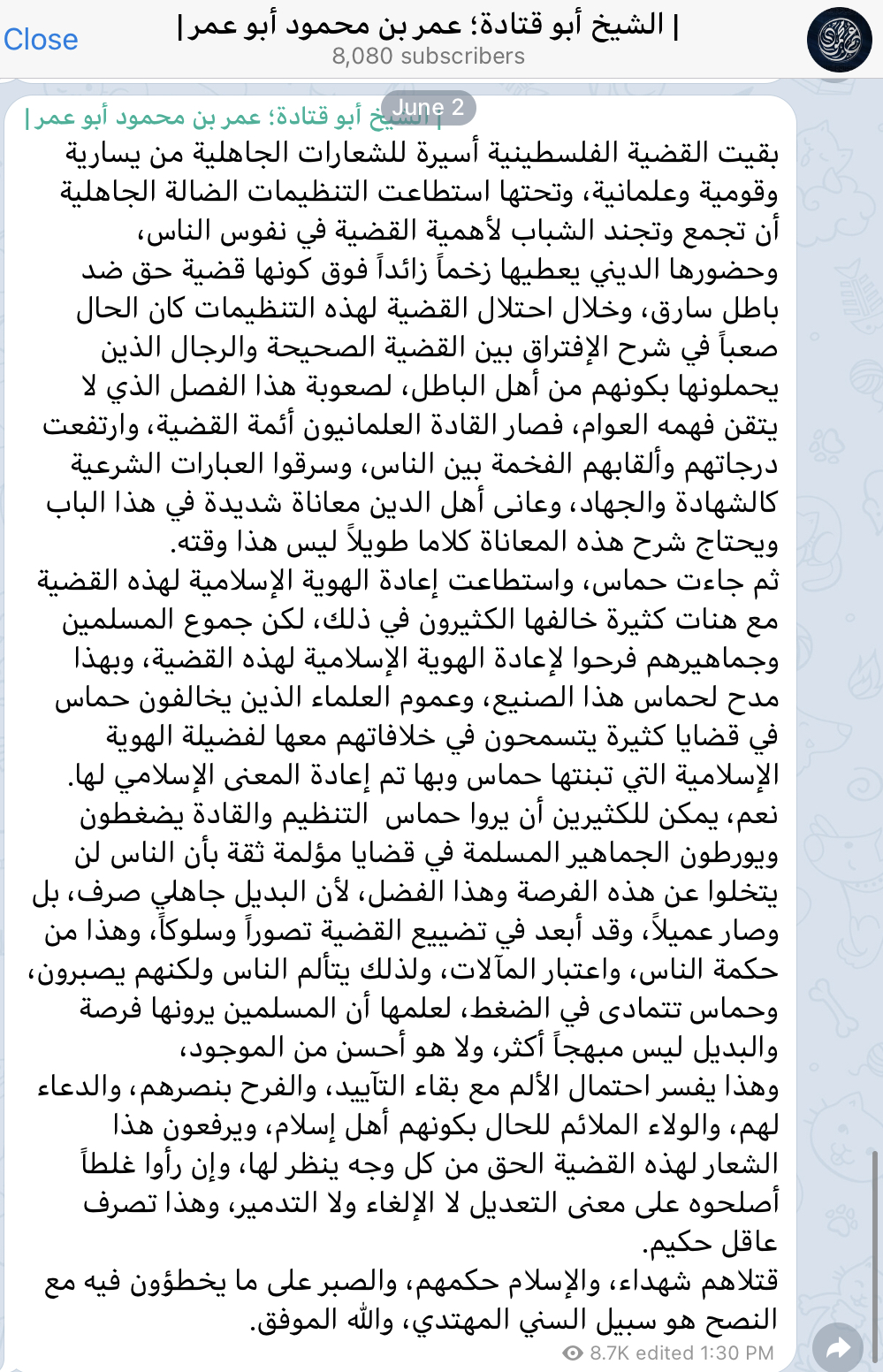
The following day, Abu Qatada responded to al-Maqdisi with a brief post implicitly rebuking him for suggesting that Hamas’s war dead were not martyrs (al-Maqdisi had pondered how al-Qaida could “mourn their dead when they died on behalf of democracy?”). Hamas was far from perfect, Abu Qatada explained, yet it nonetheless deserved praise for having “returned the Islamic identity” to the Palestinian cause that had been dominated by leftist and secularist parties. For this reason, he said, and because the secularist alternative is far worse, the critics of Hamas have generally been restrained in their criticism. The right way to deal with them, he declared, was to seek their improvement (ta‘dil) and not their destruction (tadmir). “Their dead are martyrs and their legal status is Islam,” he concluded. “Patience concerning their errors, together with the proffering of advice, is the right-guided sunni way.”

Al-Maqdisi’s response, which appeared the next day, was to insist that “whoso is killed in the path of democracy, and in support of a group that refrains from implementing the Sharia and chooses democracy, is not a martyr; rather he is a corpse (fatis), bother some though it will.” In the same post, al-Maqdisi launched into a comparison of Hamas and the Islamic State, both of which, as he explains, have killed their opponents and exposed their civilian populations to bombardment. Though al-Maqdisi has long been a critic of the Islamic State, here he suggests that the caliphate is superior to Hamas in that it has implemented the Sharia as opposed to democracy and does not show loyalty to idolatrous tyrants (tawaghit). Why then, he asks, addressing Abu Qatada (though not by name), is it your view that we must approach the Islamic State as something to be destroyed (tadmir) but Hamas as something to be improved (ta‘dil)? Al-Maqdisi’s point here was not that the Islamic State is improvable while Hamas is not. His point, rather, was that if the Islamic State is irredeemable then Hamas is doubly so, since Hamas is worse than the Islamic State in certain ways.

This time Abu Qatada did not respond. Al-Maqdisi would follow up to reaffirm that “whoso dies in the path of democracy is a corpse, not a martyr,” and later he would author a long post quoting some of Abu Qatada’s older works that were highly critical of Hamas and its ilk. The most recent post by Abu Qatada regarding Hamas was actually a statement condemning the group for allying with Iran and its Shiite proxies, and particularly the Houthis whom a Hamas representative had recently honored with a medal. Yet even here it was clear that Abu Qatada considered Hamas a Muslim group; the criticism was harsh but still intended as constructive.

Whither al-Maqdisi and al-Qaida?

As noted above, the jihadi reactions to last month’s Israel-Hamas war point to two fault lines in the Sunni jihadi movement: one between the Islamic State and al-Qaida, and one in the pro-al-Qaida side of the movement between the followers of al-Maqdisi and the followers of Abu Qatada. Al-Qaida, as I have written before, almost certainly would like to hold on to both ideological camps, but increasingly it is alienating al-Maqdisi and his followers. The change in approach appears to be by design. With the Islamic State representing the more extreme and intolerant version of Jihadi Salafism, al-Qaida is intent on presenting itself as the movement’s more moderate face. To that end, it has taken a softer line on mainstream Islamist groups like the Muslim Brotherhood and Hamas and played down the emphasis on ideological exclusivism promoted by al-Maqdisi and his camp.

Al-Qaida has long wavered between a more pan-Islamist and a more Salafi (i.e., doctrinally exclusivist) tendency, and today the pan-Islamist tendency has the edge. Al-Maqdisi has taken note of this development, hence his questioning whether al-Qaida has “changed its methodology.” For the supporters of the Islamic State, the answer to this question is obvious and al-Maqdisi knows it. As one Islamic State supporter recently wrote, addressing al-Maqdisi, “Yes, it has changed, and you have ceased to have any value to them and they no longer pay any heed to what you say. Soon they may issue a statement in which, implicitly or explicitly, they dissociate from you and your extremism.” The writer was probably overstating the divergence between al-Maqdisi and al-Qaida; neither is eager for a divorce. But if al-Maqdisi continues to express outrage at what he see as the accumulating deviations of al-Qaida, then a breakup of sorts may well be inevitable.

Living Long Enough To See Yourself Become The Villain: The Case of Abu Muhammad al-Maqdisi

It has become a trope within the jihadi studies field to describe Abu Muhammad al-Maqdisi (born ‘Isam Bin Muhammad Bin Tahir al-Barqawi) as being the most important jihadi ideologue alive. Part of this derives from a study written by Will McCants in 2006 that notes he is the most cited living jihadi ideologue within jihadi primary source literature. At the time, in many ways, al-Qaeda (AQ) was also the unipolar leader of the jihadi world. Since then, cracks in the foundation of AQ’s leading role have created alternative visions for the future of the jihadi movement. Most notable has been the case of the Islamic State (IS), but another is that of Hayat Tahrir al-Sham (HTS). In attempting to bolster their legitimacy, these different currents have moved away from al-Maqdisi and even derided him. The story of al-Maqdisi’s issues with the leader of IS’s predecessor, Abu Mus‘ab al-Zarqawi, and of IS toying with him during fake negotiations over the Jordanian pilot Mu‘adh al-Kasasbah, are well-trodden at this point. But more recent recriminations between al-Maqdisi and HTS are also worth exploring since they signal a change in tone. Although there have been vigorous debates between al-Maqdisi and HTS over decisions to move away from AQ and HTS’s alleged “diluting” of its ideology, this latest round of argument augurs another broken chain within the jihadi movement and further cements the fact that claiming HTS is some kind of front for AQ is incorrect in the same way that saying ISIS was still within AQ in 2013 was wrong.

Background: HTS Dismantles Hurras al-Din and the So Be Steadfast Operations Room

Hurras al-Din (HD) was established in February 2018 as AQ’s official branch in Syria, after HTS publicly distanced itself from its parent organization. Later, in October 2018, HD set up the Wa-Harridh al-Mu’minin (And Incite the Believers) Operations Room in conjunction with two smaller AQ-aligned groups, Jabhat Ansar al-Din and Jama‘at Ansar al-Islam. HD and the operations room were allowed to operate at the behest of HTS and received food and ammunition provisions from HTS. Therefore, as I noted in September 2019, “If [HD] were to grow significantly stronger, HTS may try to suppress it and arrest its leaders in order to preserve its own power base. In that sense, HD’s local growth potential is somewhat limited.”

And in many ways this is what happened. On June 12, 2020, HD, alongside its two partners in the operations room, established a new operations room called “Fa-thbutu” (So Be Steadfast) that also included the groups Tansiqiyat al-Jihad and Liwa’ al-Muqatilin al-Ansar. The leaders of these latter groups, Abu al-‘Abd Ashida’ and Abu al-Malik al-Talli respectively, both had falling-outs with HTS over the direction of the jihad, relations with Turkey, and corruption issues. Similarly, ahead of this announcement, Abu Salah al-Uzbeki, leader of Katibat al-Tawhid wa-l-Jihad, switched its alliance from HTS to Jabhat Ansar al-Din, thereby adding another strength to this alternative jihadi bloc.

As a consequence of these shifting alliances and the bolstering of the HD-led alternative jihad, HTS arrested al-Uzbeki on June 17 and al-Talli on June 22. This led the new Fa-thbutu operations room to warn HTS that it would “bear the consequences” if it did not release its leaders or subject itself to a religious court. HTS retroactively claimed, in a circular by its Higher Follow-Up and Supervision Committee, that individuals needed authorization to either leave the group or join other groups. Anticipating a policy that would be set out in a statement days later, HTS was showing that it would not allow others to have a monopoly on violence in the territories it controlled. The arrests and perceived lack of transparency behind them led to infighting between the two factions in the towns of ‘Arab Sa’id, al-Hamamah, al-Ya’qubiyah, Jdaydah, Armanaz, Kuku, and Shaykh Bahar over the next few days until truces were brokered due to HTS overpowering HD and its allies.

This led HTS on June 26 to proclaim that the only military efforts that could be conducted would be via itself or through its own al-Fatah al-Mubin (The Clear Conquest) military operations room, thereby banning any other efforts outside this infrastructure such as HD and its own operations room. As a result, HD’s military bases were shut down by HTS. Since then, neither HD nor its Fa-thbutu operations room have publicly operated, frustrating the ability of AQ to return to the forefront of the insurgency in Syria (for now, at least).

Abu Muhammad al-Maqdisi Responds

Two days later al-Maqdisi responded to these events. In an online essay he described two categories of groups that he sees as working against the interests of the true jihadis in northwest Syria: overt and covert client groups. The former are those directly backed by Turkey such as the Syrian National Army/National Liberation Front, which is operating in the Turkish-controlled zones that were taken from the Kurdish-backed Syrian Democratic Forces in parts of northwest and northeast Syria. The latter groups are an unstated reference to HTS, which al-Maqdisi sees as more dangerous since it claims the mantle of being a jihadi group but in reality is helping Turkey pursue its aims in the region. In particular, al-Maqdisi highlights how HTS protects Turkish patrols and forbids the true jihadis from targeting the Russians when Russia conducts joint patrols with Turkey. Furthermore, al-Maqdisi alludes to the above infighting and dismantlement of HD and the Fa-thbutu operations room by noting that these so-called “manipulated factions have killed the jihad of al-Sham, broken it up, and subjected it to the secular Turks.”

In response, al-Maqdisi suggests two possible ways of overcoming these assaults on the legitimate jihadis. The first involves eradicating the overt client groups and reforming the covert client groups by getting defections from sincere individuals among them and then slowly replacing and overtaking their leaders. Of course, this is easier said than done. Therefore, al-Maqdisi advises that the true jihadis follow the second possible course of action, which is to disband themselves and lay in wait for the right opportunity to return. It is plausible that new and more clandestine formations like Kata’ib Khatab al-Shishani (which announced itself in mid-July) and Sariyat Ansar Abu Bakr al-Siddiq (which announced itself in late August) are examples of this at play.

Al-Maqdisi Disavowed By HTS

Two months later, on August 21, the feud between al-Maqdisi and HTS was reignited when al-Maqdisi shared a post on his Telegram channel by an AQ supporter called Ya Sariyat al-Jabal (Oh Mast of the Mountain). The post repeats claims and affirmations about secret dealings between HTS and Turkish intelligence. The most controversial part is about how these alleged actions have essentially pushed HTS away from faith: “Everyone with knowledge of the nullifiers of Islam who is aware of these details [in relation to actions HTS has allegedly taken with Turkey] will see after considering them carefully that the leadership of [HTS] day after day gets closer to disbelief and draws farther away from faith.” Members and partisans of HTS thus interpreted al-Maqdisi’s sharing of this as his excommunicating HTS from Islam.

One of HTS’s top ideologues, Dr. Muzhir al-Ways, responded that day to this in a Twitter post, republished by the unofficial HTS support media outlet al-Bayyinah under the title “After Being Accused of Diluting and Deviation and Stultifying the Jihad [in Syria], al-Maqdisi is Now Excommunicating HTS.” Al-Ways writes that al-Maqdisi’s false accusations against HTS today are no different from those that IS lodged against the jihadi groups in Syria some years ago. Therefore he is the “shaykh of the khawarij.” More damning and possibly embarrassing if true for al-Maqdisi is al-Ways’s suggestion that the account al-Maqdisi shared was in fact something he himself created to try and amplify the message while making it seem like he didn’t say it himself. The charge is not far-fetched since al-Maqdisi has been known to write content under pseudonyms before.

The next day al-Bayyinah released a fuller take down of al-Maqdisi by al-Ways derisively titled “The Monotheism of Barqawism,” a reference to al-Maqdisi’s real last name and a way of stripping him of honorific legitimacy. Here al-Ways calls al-Maqdisi out for having his own version of monotheism (tawhid) that he uses to attack and discredit his opponents. Al-Ways also states that al-Maqdisi is not only out of touch in regard to sharia and scholarly limits related to excommunication (takfir), but also ignorant of what is going on the ground in northwest Syria since he is basing his views of events on television reports and social media. Interestingly, al-Ways claims that al-Maqdisi practices taqiyyah (dissimulating one’s true beliefs) by using euphemisms such as “dilution” of ideology instead of outright doing takfir on HTS.

Al-Bayyinah Media shared a number of other anti-al-Maqdisi releases in the following week via its Telegram channel. Of note is the claim that al-Maqdisi is in fact an asset of Jordanian intelligence and that his attacks on other jihadis are intended to damage and break up the movement. Al-Bayyinah Media highlights examples of suspicious timings in the past when al-Maqdisi has been released from prison and the fact that he has legitimized his dealings with the Jordanian government over the negotiations with IS regarding the captured Jordanian pilot in 2015.

To further discredit al-Maqdisi, al-Bayyinah Media set up a mock website that appears to look like al-Maqdisi’s old Minbar al-Tawhid wa-l-Jihad library of jihadi primary sources. Yet unlike the original, this is a spoof that seeks to delegitimize al-Maqdisi by highlighting articles that expose his extremism and incorrect views. On the top of the site, the creators of it state that the original Minbar al-Tawhid wa-l-Jihad website was set up as a “cartoon media platform for himself” and sarcastically exclaim that “tawhid is a trademark registered in the name of al-Maqdisi,” who was allowed at his own whim to determine who was legitimate. The site is clearly set up to expose al-Maqdisi’s problematic views over the years. Interestingly, the site also features quotes from IS’s founder Abu Mus‘ab al-Zarqawi and one of AQ’s top ideologues historically, Atiyat Allah ‘Abd al-Rahman al-Libi, discussing al-Maqdisi as being important and having made a contribution to the jihadi movement but rejecting the idea that his word is infallible truth on everything.

As a consequence of all of this, Jallad al-Murji’ah (Executioner of Those Who Postpone), a pro-AQ supporter on Telegram, complained that HTS was essentially conducting a disinformation campaign and that HTS is like the “pharaoh’s magicians, when they were bewitching the eyes of people, misleading them, making the truth void, and falsehoods correct.”

A Splintered Jihadosphere

Based on all of this, unlike in the past when HTS was willing to tolerate al-Maqdisi’s broadsides and even responding civilly, a redline has clearly been crossed. With accusations of creeping apostasy and extremism going back and forth, it appears unlikely that some form of reconciliation is a possibility. Back in 2013-14 we saw similar dynamics play out between jihadi groups and the ideologues of the jihadi movement, leading to an irrevocable split and the division of jihadism into a bipolar world, one torn between AQ and IS. It seems in many ways that we are now entering an era of a tri-polar jihadosphere.

Although some perceived HTS’s initial breaking of ties with AQ as a fig leaf to cover up a strong and enduring relationship, evidence from the past few years in northwest Syria—of arrests, infighting, ideological arguments, and now these latest dynamics between HTS and AQ factions since June—run counter to such a view. The dynamic between HTS and AQ is not similar to that between the Taliban and AQ, whose relationship has been tight and never foundered. HTS truly has created its own pole of jihadism outside the framework of the historical AQ network or the more contemporary IS network. What this means for the future of the broader movement is difficult to say since it does not appear (yet) that HTS has ambitions beyond Syria in comparison with the globalized networks of AQ and IS. The implications for al-Maqdisi are clearer. Considering the antipathy that both IS and now HTS have for him, al-Maqdisi’s influence continues to diminish due to the erosion in consensus amongst the broader jihadi movement over the past 15 years. And although there is no one who has likely eclipsed al-Maqdisi’s influence, it does not make sense anymore to say that al-Maqdisi is the most important jihadi ideologue in the world today when two of three jihadi poles are against him.

From Goods and Services to Counterterrorism: Local Messaging in Hay’at Tahrir al-Sham’s Propaganda

[Editor’s Note: Jihadica is pleased to welcome Lina Raafat and Charles Lister. Lina is a research assistant for the Extremism & Counter-Terrorism Program at the Middle East Institute. Her research focuses on militant propaganda with a particular focus on foreign fighter mobilization and logics of martyrdom. Charles is a senior fellow and the director of the Extremism & Counter-Terrorism Program at the Middle East Institute.]

The fall of southwestern Syria to Bashar al-Assad’s regime marked a significant turning point in the Syrian conflict, effectively shifting attention to the northwestern province of Idlib, the last remaining opposition stronghold. Home to a wide array of armed resistance groups, including groups with former and current ties to al-Qaeda, as well as defeated opposition fighters recently exiled from elsewhere in Syria, Idlib’s dynamics are incredibly complex and warrant special consideration. As the threat of an impending regime offensive continues to develop, with both Russia and Turkey bolstering defenses, armed opposition groups find themselves under unprecedented pressure to adapt to the evolving dynamics, both on the ground and in surrounding geopolitics.

A prime example of such adaptation is Hay’at Tahrir al-Sham, or HTS. Previously known as Jabhat al-Nusra, this former al-Qaeda affiliate has rebranded itself twice—first as Jabhat Fatah al-Sham (JFS) in July 2016, and later as HTS in January 2017—in a relentless effort to expand its power and present itself as a sustainable model capable of continuing the fight against the Assad regime. Today, HTS has asserted military dominance in the northwest, has established a “Salvation Government,” and is reportedly engaged in active political discussions with several regional states.

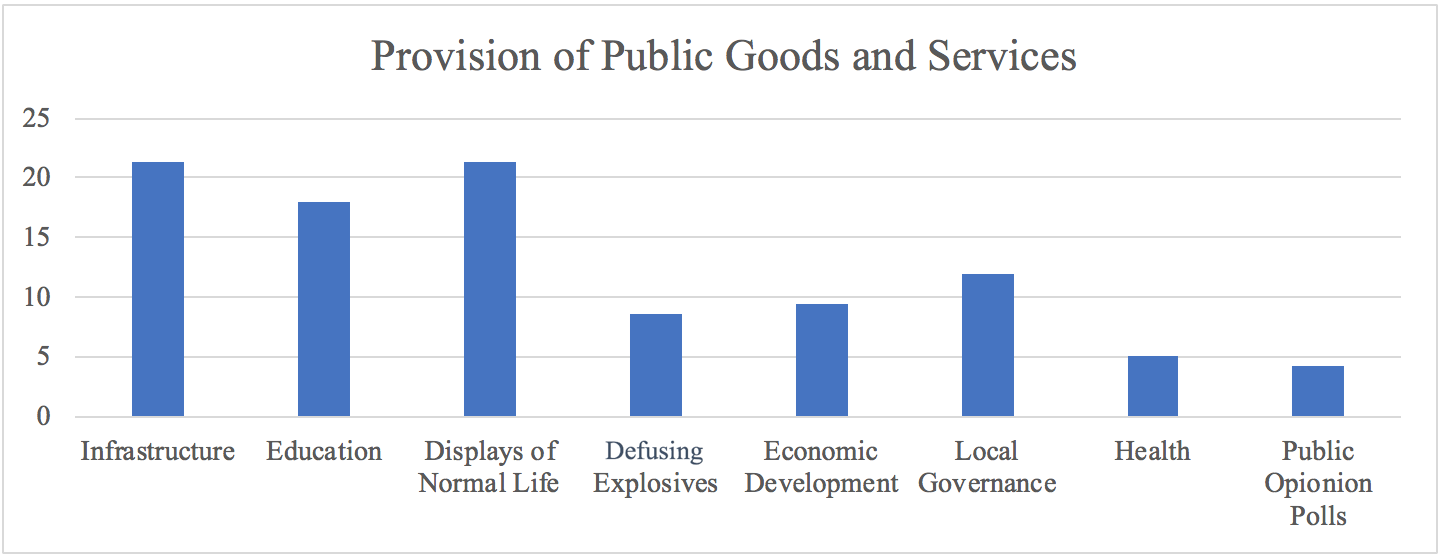
Central to the HTS model is its propaganda apparatus, which the group has employed effectively to achieve its broader strategic objectives. Faced by the impending threat of all-out hostilities, mainstream armed opposition groups have focused their propaganda on highlighting military operations and their willingness and plans to target regime forces. HTS, on the other hand, has substantially amplified its governance efforts, especially emphasizing three pillars: the provision of public goods and services; the maintenance of law and order, including through fighting terrorism (mainly ISIS); and delegitimizing any attempts of “reconciliation” with the regime.

Through a complete mapping of HTS’s entire propaganda output between June 18, 2018 and August 31, 2018, this article takes an in-depth look at how the explosion of hostilities in southwest Syria has propelled HTS to adapt its media strategy to gain (or regain) local support and to legitimize itself. The data implies that, at least when it comes to its online dissemination, HTS propaganda is geared overwhelmingly towards local messaging and aims to highlight steps taken by the group to tackle issues that are most pressing for its local constituents.

Our data set is comprised of every piece of propaganda published by HTS’s official media arm, Ebaa News Agency, during the period in question. This includes statements, video reports, photo reports, newsletters, infographics and opinion articles. Each of these individual data points was coded and analyzed to draw patterns on how the group’s strategy has been changing, and why. When examined closely, the data demonstrates a concerted attempt by HTS to expand its governance efforts and focus on issues that touch the daily lives of its people, or at least it is creating the illusion of doing so. According to the data, 57 percent of HTS propaganda focuses on governance and local grievances, while only 21 percent focuses on military activities. The remaining 22 percent is geared towards delegitimizing regime soldiers, militias, and opposition factions that have agreed to “reconcile” with the Assad government.

At this critical juncture in HTS’s trajectory, maintaining local support could be just as important a survival strategy as achieving battlefield dominance, if not more important. In a little over two months, HTS has released over 900 reports and statements highlighting the active steps taken by its officials to deal with issues critical to its perceived constituents. Those include: building roads, restoring water access, providing employment opportunities, diffusing explosives, arresting criminals, and restoring the rule of law. As the Assad regime continues to expand its grip on power and regain control of formerly “liberated” areas elsewhere in Syria, HTS appears to have re-examined its prioritization of anti-Assad military operations and pivoted to emphasizing its governance efforts in Idlib as “an exemplary model for contemporary revolutions.”

Figure 1.1

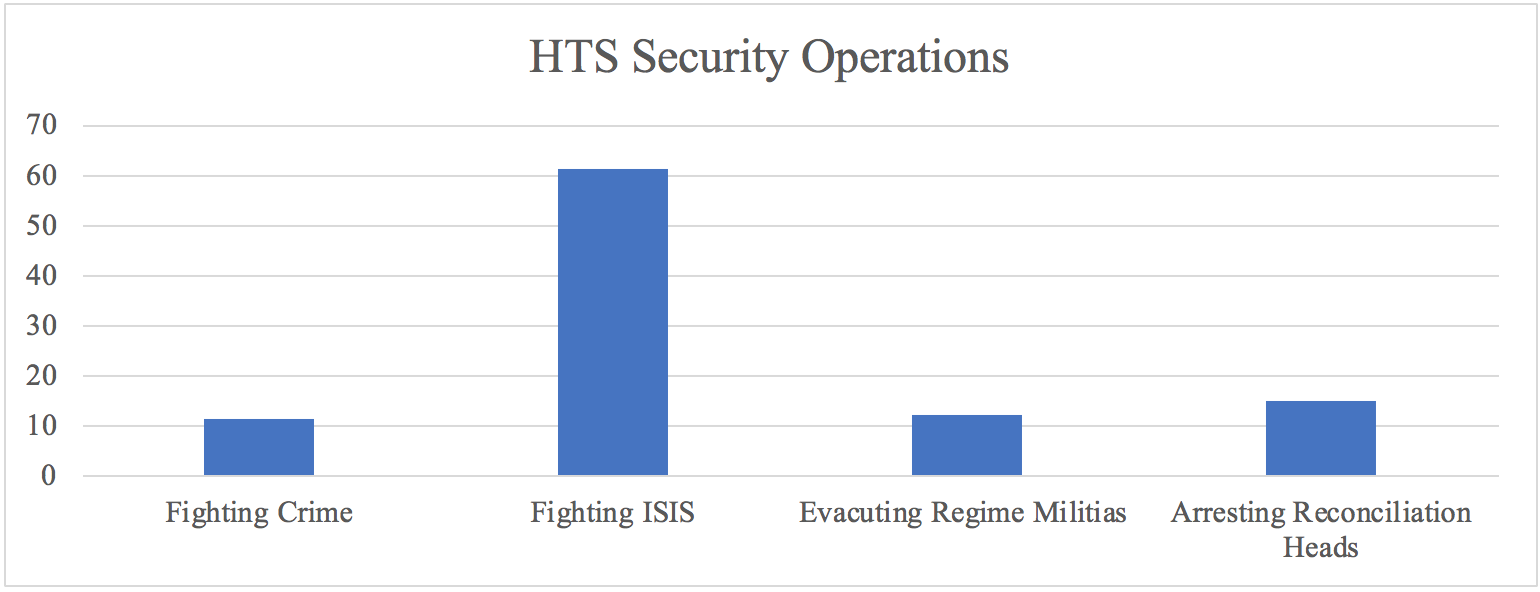
A key element of this model is, perhaps ironically, HTS’s campaign to combat terrorism. Though itself deemed a terrorist organization by many, including the United States, HTS has launched an extensive counterterrorism campaign targeting ISIS sleeper cells in Idlib. As figure 1.2 demonstrates, the group’s law-and-order campaign has predominantly focused on tracking down ISIS sleeper cells, with over 60 percent of its security operations explicitly aimed at arresting alleged ISIS members, confiscating their weapons, and in some cases publicly executing captured members and commanders. Since the beginning of the Dar’aa offensive, HTS has claimed responsibility for the capture of at least 97 ISIS fighters and commanders and the killing of another 23.

Figure 1.2

At first glance this may seem a departure from the group’s earlier strategy of steering away from public spectacles of violence, a technique which its foe—ISIS—has used to demonstrate supremacy and to attract recruits. However, this should come as no surprise, since the Assad regime has framed its war as a fight against “terrorists” and has used the presence of ISIS cells or groups linked to al-Qaeda as justification for launching large-scale offensives. By actively targeting and fighting one of the world’s most notorious terrorist organizations, HTS is attempting not only to strip away the regime’s credibility of using terrorism as an excuse to attack Idlib, but also to portray itself as a legitimate non-terrorist actor, especially in the eyes of local populations which have, on occasion, compared it to ISIS.

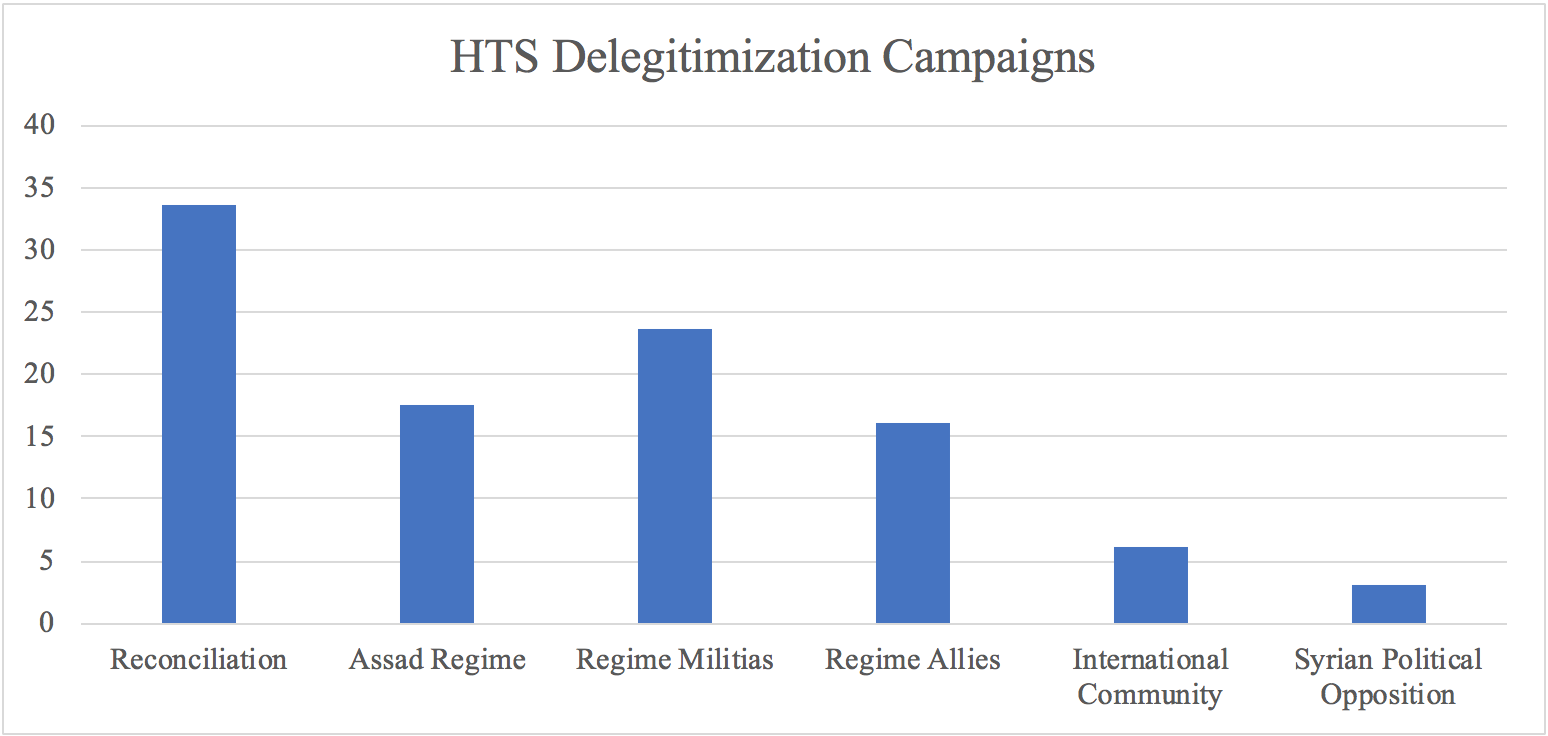
In addition to providing basic services and fighting terrorism, another important component of HTS’s recent propaganda effort is directed at the delegitimization of identified enemies of the group. Targets of this campaign include: the Assad regime along with its militias and allies; the international community for its perceived complicity in the war against innocent Syrian civilians; Syria’s exiled political opposition for failing to provide an effective political solution; and most importantly “reconciliation,” which HTS depicts as an existential threat to the people of Idlib.

Figure 1.3

As figure 1.3 indicates, 33 percent of HTS delegitimization campaigns since mid-June have been directed at “reconciliation”—the Assad regime’s chosen mechanism for regaining control of opposition-held areas. Such “reconciliation” scenarios have played out in each of Syria’s de-escalation zones, first in Eastern Ghouta in April 2018, then Homs in May and Dar’aa in June. Now, finally, the regime’s eyes are on Idlib as its next and perhaps final target. In truth, the regime’s “reconciliation” strategy represents an offer of surrender to avoid the prospect of a catastrophic, brutal attack from the air and ground. Frequently, “reconciliation” deals have followed long-drawn-out sieges, or bombing campaigns, or even chemical weapons attacks in the case of Eastern Ghouta in April.

However, both the regime and HTS understand that the situation in Idlib is far more complex than in previous cases. In a video statement released on August 21, 2018, HTS leader Abu Muhammad al-Jolani stressed that people in the “Liberated North” are well aware of regime plans and refuse to concede:

The phase through which the jihad in al-Sham is passing today needs us, as fighting factions, to pledge before God, Glorified and Sublime, then before our patient people, that the weapons of the revolution and jihad—that trust which the Muslims have bestowed on us—are a red line that will never be bargained with and will never be on the negotiating table. For our weapons are the source of our power and pride, and they are our bedrock. The very moment one of us thinks about negotiating his weapon, he has effectively lost it. Just thinking of surrendering to the enemy and turning over our weapons is a betrayal of God and His prophet, of the blood of the martyrs, and of the prisoners and the displaced—a betrayal of our people who have sacrificed and given so much, our people who have remained steadfast for seven years in the face of oppression and criminality. What happened in the south, the honorable sons of al-Sham will not allow to happen in the north.

Jolani’s statement comes at a critical time when HTS is under immense pressure to dissolve itself and merge with the Turkish-backed National Liberation Front (NLF), which has become the largest armed actor in Idlib, comprising ten Free Syrian Army (FSA) factions, the Syrian Liberation Front, or SLF (Ahrar al-Sham and Harakat Nour al-Din al-Zinki), Jaysh al-Ahrar, and Suqour al-Sham. HTS has issued multiple statements refuting all rumors of any impending dissolution and reiterating its commitment to defend its people from the looming threat of a regime offensive as an independent group. On the contrary, a recent statement issued on August 28 indicated that dissolution remained “an internal matter” and that HTS was “working hard” to come to a workable solution that “spares our people from likely attack.”

Though adamant about maintaining its independence, HTS’s core leadership understands very well that it needs to cooperate with the other factions if it stands any chance of survival. This was made clear in Jolani’s remarks, where he emphasized the urgency of higher degrees of military coordination between different fighting factions on the battlefield and announced the establishment of a joint operations room in the north to defend and protect “the honorable people of al-Sham.” As with other components of its recent propaganda strategy, this talk of “unity” is clearly aimed at convincing local communities that HTS is their defender and an intrinsic part of the broader “revolutionary” movement. Jolani stressed:

Our sorrows and our hopes are one, and our fate is one. Our enemy is out for all of us and does not differentiate between us, and will observe toward none neither bond nor treaty. The best way to confront our enemy is to be a unified front, together in love and brotherhood. All of us must play our role in this crucial battle: fighters, civil society, clergy and scholars, tribes and families. Everyone is targeted.

Whether or not HTS’s propaganda accurately reflects realities on the ground remains unclear and hard to measure, but that should not be the focus of our attention. What HTS propaganda shows is that it is appealing to its local constituents by advertising such products as services and security, creating an image of a functioning society with happy kids, busy markets, and security checkpoints at a time when people are craving any sign of normalcy in the midst of chaos. Though local skepticism of HTS is commonplace in northwestern Syria, the threat of overwhelming attack by the regime and its Russian and Iranian allies may be the one chance for HTS to regain popular legitimacy. Its propaganda is aimed entirely at achieving that result.

The fate of Idlib appears to have been sealed. The chances of Turkey and Russia being able to negotiate a political solution seem increasingly remote. The eventual regime victory will certainly lead to unprecedented levels of death and destruction, which will in all likelihood be used to fuel extremist narratives like that espoused by HTS for years to come. As the regime tries to isolate armed opposition groups by driving a wedge between them and the people, HTS is fighting for its survival by actively seeking to embed itself within society. Whether or not it has been successful, the fact remains that once the fighting begins, HTS fighters will be the first ones on the frontlines, and this more than anything will give the group the chance to bolster its credibility and justify its narrative for years to come.

A House Divided: Origins and Persistence of the Islamic State’s Ideological Divide

Last month, a jihadi Telegram user called “And Rouse the Believers” leaked a series of documents related to the Islamic State’s internal ideological rift. As discussed in a previous post, this dispute revolves around the doctrine of excommunication (takfir), and specifically whether those hesitating or refusing to excommunicate unbelievers are themselves to be excommunicated. Heading up the more moderate side in this debate was Turki al-Bin‘ali, the emir of the Islamic State’s Office of Research and Studies, until his death in an airstrike in May 2017. The more extremist side was represented by the Delegated Committee, the Islamic State’s executive council, until Abu Bakr al-Baghdadi reconstituted it late last year and instituted a theological compromise of sorts.

“And Rouse the Believers,” whose name comes from Qur’an 4:84, is something of an anomaly: he is even more extreme than the extremists in this contest, believing that the Islamic State has lost its way. But that is beside the point. The documents he has unearthed shed considerable light on the origins of a struggle that continues to plague the ailing caliphate.

The Methodological Committee

One document is an internal memo on the activities of the so-called Methodological Committee (al-Lajna al-Manhajiyya), a body that was responsible for investigating the beliefs of the Islamic State’s scholars. It has also been referred to as the Office for Methodological Inquiry (Maktab al-Tadqiq al-Manhaji). As was seen before, the committee led an inquisition into senior Islamic State scholar Abu ‘Abd al-Rahman al-Shami al-Zarqawi, accusing him of holding too moderate a position on takfir.

According to the memo, the committee was formed in February 2016 as the result of a meeting between three Islamic State senior officials, Abu Muhammad al-Furqan, Abu Sulayman al-Shami, and a certain Abu Khabbab al-Masri. Al-Furqan, an Iraqi who headed the Islamic State’s Media Department, was killed in an airstrike in September 2016. Al-Shami, a Syrian-American known for his editorial work on the group’s English-language magazines, was killed by the same means in January 2017. The purpose of the committee was to take the measure of the numerous scholars, or “sharia officials” (shar‘iyyin), who had flocked to the the Islamic State, and to determine if any were guilty of ideological “transgressions.” The committee met with the scholars individually, asking them about their backgrounds, their journeys to the caliphate, and their views on takfir.

The committee was initially concerned, the memo explains, with the alleged “extremism” of some of the scholars, but it soon came to the conclusion that the greater problem was “Murji’ism,” a theological term denoting, in this context, undue leniency in takfir. The end of the memo comprises a chart with brief notes on the results of meetings with 29 scholars, including al-Bin‘ali, who is described as vehemently opposed to the work of the committee.

Called to repent

The entry on al-Bin‘ali also refers to his involvement in the case of Abu al-Mundhir al-Harbi, a Saudi scholar with the Office of Research and Studies who was accused of being soft on the issue of man-made law. Al-Harbi, who was affiliated with al-Qaida in Pakistan and Afghanistan from 2010 onward, arrived in Syria in 2014. Like al-Bin‘ali, he had an association with the jihadi ideologue Abu Muhammad al-Maqdisi, who wrote the introduction to his 2009 book defending al-Qaida’s terrorism. Sometime in 2015, he came under fire for his written answers to a series of questions put to the Islamic State by a group of prisoners in Baghdad. The answers were never published.

One of the questions was whether it was permissible to appeal to courts administering man-made law in order to recover something, such as property, that was wrongfully seized. In other words, is it allowed to take advantage of the court systems of unbelievers? Al-Harbi’s answer was yes, and al-Bin‘ali, among others, signed off on the response. But when the collected answers were brought to the Delegated Committee for review, some of its members balked. Seeking the judgment of other than God, as jihadis are keen to point out, is tantamount to ascribing partners to God, i.e., polytheism. Yet in the view of men such as al-Harbi and al-Bin‘ali, there are exceptions to such rules, and this was one of them.

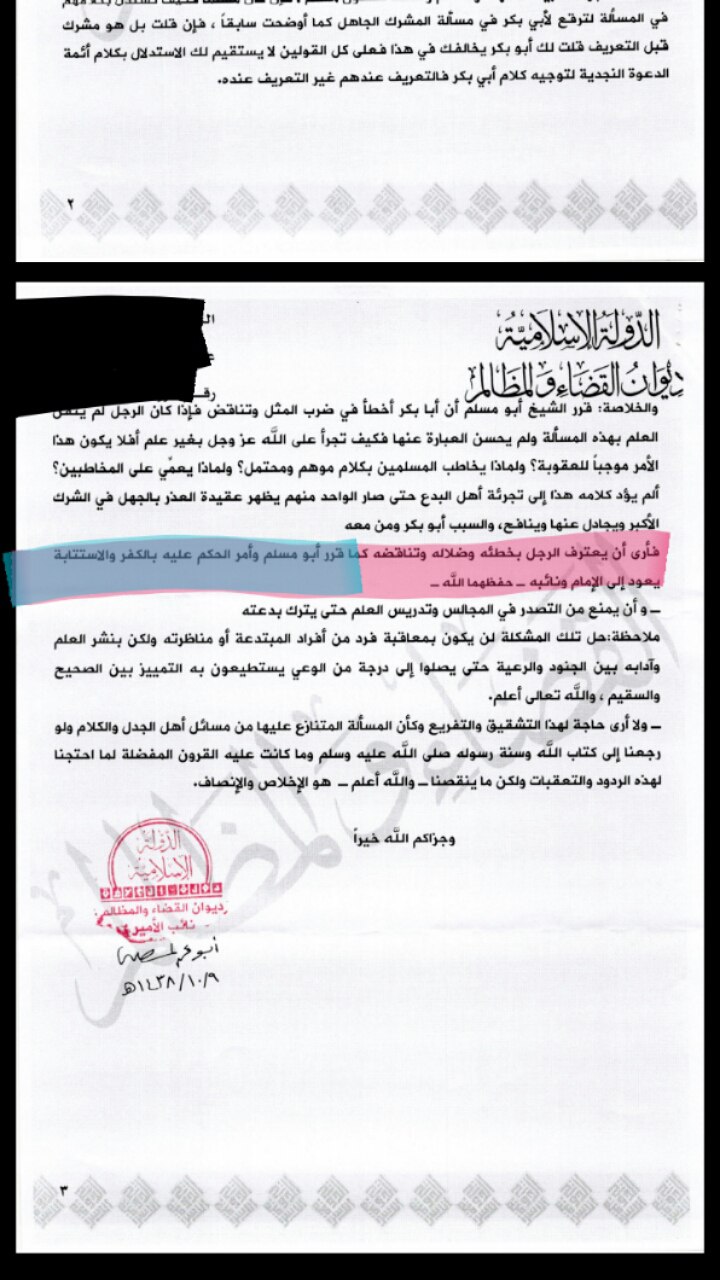
“And Rouse the Believers” leaked two documents related to this episode. The first is a four-page brief on the Methodological Committee’s meeting with al-Harbi, written by Abu Sulayman al-Shami. It accuses al-Harbi of “permitting polytheism” and recommends that he be made to repent. The second document is a letter from al-Bin‘ali to the Office of the Caliph and the Delegated Committee, complaining that he too has been called to repent for “permitting polytheism.” Al-Bin‘ali was furious.

In his letter, dated November 2015, he explains that the accusation against him was brought by Abu Muhammad al-Furqan, who, he laments, refuses to see shades of grey in the issue of appealing to infidel courts. Though regretting some of the ambiguous language in al-Harbi’s response, he is firm in his view that the issue is not black and white. Even al-Furqan, he says, believes it permissible to pay ransoms to the Iraqi judiciary.

The letter also reveals that al-Furqan was serving as the “adviser” (mushrif) of the Office of Research and Studies, a role that al-Bin‘ali did not think him qualified for. Portraying him as deeply suspicious of the scholars, al-Bin‘ali advises that men with greater knowledge assist him in advising the office. Al-Furqan, he says, is reliant for his views on Abu Sulayman al-Shami, who is described as not very learned in religion. Al-Bin‘ali underscores his “severe displeasure” with the charge brought against him and “the extent of the divide between the Office of Research and Studies” and al-Furqan.

But if al-Bin‘ali saw al-Furqan and al-Shami as anti-intellectual extremists, he would soon be looking back at them as relative moderates.

Letter to Baghdadi

In late January 2017, about two weeks after the death of al-Shami, al-Bin‘ali wrote a letter to Baghdadi warning him against including the “extremists” in the power structure of the Islamic State. For months he had been hearing, he said, of a new policy intended to appease them by giving them a share of the top posts. But this “theory of balance” would needlessly embolden them. The fact of the matter, he went on, is that “the extremists’ numbers, even if they are great, are not greater than those who follow the truth.” Their power should therefore be curtailed, not enhanced.

This was a time, however, when the “extremists” were on the rise in the organization and the likes of al-Bin‘ali were losing out. In a lecture delivered in Raqqa back in late 2014 or early 2015, al-Bin‘ali had confidently stated, “What we proclaim is the creed of the Islamic State, and it is the creed of the Commander of the Believers … The methodology of the [Islamic] State, and the creed of the [Islamic] State, are issued by the Department of Research and Fatwas … this is by the seal of the Commander of the Believers [i.e., Baghdadi].” But soon the “department” was reduced to an “office” and the word “fatwas” was replaced with “studies,” symbolizing the decline in the influence of al-Bin‘ali and his outfit. The Methodological Committee was created soon afterward, and during the next year the Delegated Committee would release its explosive statement on takfir, prompting a strong reaction from the scholars.

One of the most senior scholars to object was a Saudi named Abu Bakr al-Qahtani, himself a member of the Delegated Committee at one point. “And Rouse the Believers” leaked part of a document, dated July 2017, advising that he repent of his all-too-tolerant position on takfir. This was about a month before he died in an airstrike. Like al-Bin‘ali, who met the same fate two months earlier, al-Qahtani was posthumously vindicated by the new statement on theology issued in September 2017. This statement—the “compromise” referred to above—was released in six installments. The most significant point that it makes is that takfir is “not part of the foundation of the religion” but rather “one of the requirements of the religion.” This was precisely al-Qahtani’s view. The internal memo on the Methodological Committee had complained that he relegated takfir to a subordinate status, as “one of the necessities of the foundation of the religion.”

A house divided

Al-Bin‘ali and al-Qahtani may have won the argument over takfir, but the new statement endorsing their views has been no salve to the ideological dispute. The Islamic State, and particularly its online support community, are more divided today than ever before. The ideological battlefield can be outlined as follows.

On one side stand the al-Wafa’ Media Foundation and the al-Turath al-‘Ilmi Foundation, two online media groups closely aligned with the Office of Research and Studies, or whatever is left of it. (The office is rumored to be headed today by a Jordanian named Abu Ya‘qub al-Maqdisi, but it is not clear that it is functional.) Al-Wafa’, which was created in April 2014, produces mostly unofficial written materials in support of the Islamic State, though occasionally it breaches the official-unofficial line. For instance, it recently published several pieces by Ahlam al-Nasr, the “poetess of the Islamic State” (see here, here, and here). Al-Turath, which was founded in October 2017, is primarily concerned with publishing the “heritage” (turath), written and otherwise, of the Islamic State’s scholars who were or still are with the Office of Research and Studies. Its releases include a six-volume collection of books and fatwas that runs to nearly 3,000 pages. According to al-Turath, this was assembled by al-Bin‘ali in August 2016, but the Delegated Committee and the Media Department obstructed its publication. Related to al-Wafa’ and al-Turath is a discussion group called “The Group for Constructive Criticism among the People of Islam,” a Telegram chatroom where like-minded Islamic State supporters congregate.

On the other side are a number of high-profile, pseudonymous activists and writers such as “Tarjuman al-Asawarti,” “Yemeni and Proud of My Islam,” and “Uncovering the Jews of Jihad and the Suspect Ones.” All of these are allied with the Islamic State’s Media Department, which the supporters of al-Wafa’ and al-Turath contend is a den of extremists. The Media Department, which is still very much active, is responsible for producing the Islamic State’s weekly Arabic newsletter, al-Naba’, which al-Wafa’ and al-Turath never promote or link to. Al-Asawarti and his allies often refer to the followers of al-Wafa’ and al-Turath as “the suspect ones” (al-mashbuhin), calling into question their support for the caliphate. The “suspect ones” consider their accusers “extremists.”

The two sides, the “suspect ones” and the “extremists,” frequently trade insults and refutations online. Back in February, Tarjuman al-Asawarti published a lengthy report about al-Wafa’, claiming that it is working against the interests of the caliphate, even that it is a spy cell. A prominent contributor to al-Wafa’ shot back with two rebuttals (see here and here). One of the biggest complaints against the “suspect ones” is that they are publishing official Islamic State products without the consent of the group’s leaders. Other complaints, such as that they work for the Rand Corporation, are not to be taken seriously.

It is hard to know which side has the numerical advantage online. Telegram has cracked down hard on the accounts of both sides, making it difficult to observe trends clearly. But the activity of the “extremists” seems to be the greater. Within the Islamic State itself, the dispute is less visible, but rumors abound that it remains intense. Al-Turath often leaks information about the scheming of the “extremists” and the periodic arrests of certain scholars.

A candle in the dark

In March of this year, al-Wafa’ published an essay by one of its senior writers calling on both sides to bury the hatchet and unify ranks. It does not seem to have had any effect. Yet there may be potential for reconciliation of another sort—with the more hard-line supporters of al-Qaida

Last month, one of the more prominent al-Qaida supporters on Telegram, “the Son of al-Qaida,” noted his “surprise” at the emergence of a “more open and balanced tendency” in the Islamic State, one following the teachings of al-Bin‘ali and less inclined to dismiss al-Qaida as heretics. Those belonging to this tendency, he says, are standing up to the “extremism” of the Islamic State. He further claims, perhaps too optimistically, that they are gaining ground, both “in the online space and on the ground.” From his point of view, this a welcome development, one that his pro-al-Qaida colleagues ought to embrace and encourage. “Don’t curse the darkness,” he tells them.“Rather, light a candle.” There is hope yet, he suggests, for this faction of the Islamic State.

The possibility of an al-Qaida-Islamic State merger has been oversold by some analysts, but another kind of jihadi reconciliation is conceivable. With the al-Qaida support network riven by its own factions of “moderates” and “extremists,” one can imagine a scenario where the “moderates” of the Islamic State and the “extremists” of al-Qaida eventually link up. This is probably a ways off, and may well require the dissolution of both jihadi organizations as a precondition. But the ideological common ground is there should a light be shone on it.

The Video of Anis Amri, the Berlin Christmas market attacker

Via Telegram channels operated by IS, the Amaq Agency released a brief video featuring Anis Amri (his name is in Arabic Anis ‘Amari) pledging allegiance to Abu Bakr al-Baghdadi and vowing for more revenge operations. The video is entitled “testimony of the soldier of the Islamic State who undertook the attacks in Berlin and Milano”, dated to December 23, 2016.
He appears to be standing on pedestrian bridge in Berlin where he filmed himself using is cell phone and headphones. The somewhat three minute long video is a brief but firm statement that he has submitted himself under the authority of IS and the application of sharia rule by the “state”, presented often by sympathizers and propagandists as “proof” of the IS’ theological coherence and sincerity.
Amri cites several theological references justifying revenge for the suffering imposed on Muslims, pledging that we shall drink from the same cup of pain, a popular reference within jihadist writings, statements and videos, while calling on Muslims worldwide to respond to actions, to strike everywhere especially in Europe. “Jihad against the enemies of God” is a divine obligation. He ends the video in a sermon styled supplication.

The role of ideologues

This is the fourth Q&A of the interview series with Ahmed Al Hamdan (@a7taker), a Jihadi-Salafi analyst and author of “Methodological Difference Between ISIS and Al Qaida“. Al Hamdan was a former friend of Turki bin Ali, and a student of Shaykh Abu Muhammad Al Maqdisi under whom he studied and was given Ijazah, becoming one of his official students. Also, Shaykh Abu Qatada al Filistini wrote an introduction for his book when it was published in the Arabic language. The interview series contains contains five themes in total and will all be published on Jihadica.com. You can find the first Q&A here, the second here and the third here.

Tore Hamming:

Part of the struggle between IS and AQ happens through ideologues either part of or sympathetic to one of the two movements. AQ has consistently been supported by major ideologues like Abu Muhammad al-Maqdisi, Abu Qatada al-Filastini and Hani Siba’i, while IS has relied on younger people, most famously Turki al-Bin’ali. How do you see the role of these ideologues for the broader struggle within Salafi-Jihadism?

Ahmed Al Hamdan:

In fact, this question has been phrased wrongly.

We must realize that the problems of ISIS are no longer confined to a conflict with Al Qaeda in just the Arab region only making the Arabs to be the only influential speakers for Jihad. Rather ISIS has come to every language and nationalities! And they have come into conflict with groups that are not Arabs. These nationalities and groups have speakers that speak in their languages and influence them more than the Arab speakers.  I will give you an example:

Amongst the English speakers, Shaykh Anwar al Awlaki is considered to be one of the main leaders and ideologues of Jihad, while amongst the Arabic speakers he is considered to be a Jihadi commander only. Why? It is because all the Shariah treatises of Shaykh Anwar have been released in the English language. They were not released in the Arabic language with the exception of 4 statements, which were all exhortative statements.

So if we compare for example the influence of Shaykh Anwar al Awlaki amongst the English speakers with that of the influence of the Shaykhs such as Abu Muhammad al Maqdisi and Abu Qatada al Filastini, there is no doubt that Shaykh Anwar al Awlaki would be much more influential. And this can also be seen with the American Shaykh Ahmad Jibril. I myself and some of those occupied with the Arab Jihadi issues had never heard of him at all until recently when communicating with the English Jihadi media. And we came to know that this person has a lot of influence and is widely known, despite us having not heard about him at all before.

And this is a general principle: The more material exists for a person in a specific language, the more will be his influence upon the speakers of that language. How many materials of the ideologues of Jihadi groups in Arabic have been translated into Turkistani language for example? Maybe 2 or 3. So is this sufficient to influence the Turkistanis in the battle against ISIS? The answer is no. However when a person like Mufti Abu Dhar Azzam break away and release a statement criticizing ISIS, this will have a greater effect than translating some articles of al Maqdisi and al Filistini about ISIS into the Turkestan language, even if he is less knowledgeable than them. Why is this so?  Because Abu Dhar is known amongst the Turkistanis and he speaks in their language and he has held lectures and lessons among them. And so, being previously known as well as a common language is what becomes effective for having influence in battles, and not just Shariah knowledge.

Who is the foremost ideologue for Jihad and the Jihadi groups in Europe? We don’t know. Perhaps a Shaykh who is young in age and who speaks French will have a greater influence than Shaykh Abu Muhammad al Maqdisi or Abu Qatada al Filistini upon the Jihadis who speak in French.

So the person who speaks directly to you and who always keeps you at the center of the events will be more effective than a person with Islamic knowledge who does not speak directly to you and who has to use interpreters who may be late in translating his statements or may not translate all of his statements.

However because of the worldwide battle against ISIS, there have emerged communication bridges between groups who are fighting against ISIS who speak different languages. For example, we see that Dr. Ayman al Zawahiri’s words get translated into Russian by the Islamic Emirate of the Caucasus (1) or get translated into Turkistani by the Turkistan Islamic Party, (2) and we have seen Shaykh Ayman trying to address these organisations by mentioning their merits. And we have seen how the ideologues and the leaders of the Arab groups have released statements in solidarity with the Islamic Emirate of Caucasus against the attempts of ISIS to split its ranks, (3) and we have seen how when the Turkistan Islamic Party released a speech from its top most leader refuting ISIS, they put the Arab scholars of Jihad in the background. (4)

So I think we are facing a situation known as “the globalization of the Jihadi organisations” in contrast to “the globalization of ISIS.”

And this has resulted in intermingling and openness towards each other due to the existence of a common enemy. Previously the Russians were fighting the Caucasians and the Chinese were fighting the Turkistanis and the Americans were fighting Al Qaeda, most of whom have been Arabs. However these organisations have now found themselves against a united common enemy, which is ISIS, which is trying to dismantle them. And this has led to them eventually coordinating with each other to fight this new enemy which is threatening the fortresses from within, as opposed to the enemy which is not common to them all and threatens the fortresses from the outside.

And this is another principle: Whenever there is a single enemy, there is a larger chance of unity and cooperation.

So due to this, there began to circulate writings which refute ISIS and translated works have begun to spread in different languages about a single issue only, that is refuting the misconceptions caused by ISIS. And I think this is something that has not happened before.

This is one matter. As for the other matter, it is why have younger ideologues inclined towards ISIS, while their teachers have inclined towards Al Qaeda?

I have answered this question in my previous reply, and I have said that the greater a person’s age and the more his experience in life, the greater will be his caution in dealing with any newly occurring matter, as opposed to the one who has no experience and whom you mostly see acting without forethought and who is more emotional rather than being logical.

Secondly, these students took the lead at a time when those Shaykhs were imprisoned- I mean the two Shaykhs Abu Muhammad al Maqdisi and Abu Qatada al Filistini. And I think they said to themselves that “we must fill the vacuum left by our Shaykhs”, and they put themselves on the same level of their Shaykhs, and they began to speak on fresh matters which are very complicated, in a manner which is different from that of their Shaykhs who used to be calm and careful. And here let me write a historical testimony:

Turki Bin’ali had gone to Syria twice. The first time, he claimed, he wanted to send relief aid, and the second time was the one in which he did not return. And before he went for his first time, he was told not to listen to only one side, specifically in the matter of the dispute between Jabhat un-Nusrah and ISIS. But when he returned from Syria, we sat down together, and there was a change in his tone of speech about Jabahat al Nusra and it had become very harsh. (5) And when he was asked and told “Have you tried to hear from Jabhat un-Nusra when you were in Syria to understand their point of view?” he said “No, rather the Islamic State and its representatives are trustworthy and they do not lie!”… And so there is no need to hear both sides…!

This is not something which someone else has told me, rather I saw it with my own eyes and heard it with my own ears. So all his books and speeches and articles with which he supported ISIS were built upon this foundation, which is hearing only from one side which as per his claim, does not lie. Then it became clear to us with the passage of time that these representatives would lie even in their official publications. So look at what happens when a student takes the place of a teacher while he is not qualified!!

On the other hand, Shaykh Abu Qatada was asked after 20 years, did he benefit from the events in Algeria when he was young. And he said “Yes, I have benefitted greatly, one of the most important of which was to not be deceived by the way how a questioner formulates his question, because sometimes he will lie and deceive and formulate questions which are not in accordance with reality in order to get the Fatwa he wants to support his stance against his opponents. So whenever I feel that a person is doing this, I would ignore his questions so that he does not take my Fatwas to misuse them in an improper manner”. (6)

But the person with little experience will fall into this mistake and he will sympathise with the questioner who has formulated his question showing him being oppressed, and he will issue a Fatwa according to what he likes and desires.

What makes a person forget himself or forget his real position is those around him, especially when they praise and exaggerate in praising the student of knowledge, and when he is addressed as ‘Shaykh’ and ‘scholar’ and with other such names. And when many people repeat these words it causes him to actually think that he has become a Shaykh and a scholar and that he is entitled to speak on the most complex matters. Therefore he should not be misled by such words of praise, and they must not cause him to forget his actual position. And if he knew what his actual position is, he will not be affected by such praises and speak on critical issues while not being qualified for it, because he knows his true worth, and he will not be carried away by these people who praise him as he knows that they are exaggerating or maybe they are exaggerating for other purposes, such as to cause you to fall into this trap, and hence you would be careful. But the one with little experience is often naïve and not cautious or aware.

In the end, how is it possible for the gap between the generations to have an effect in supporting different organisations? There is no doubt that the influence of the teachers is much greater, and the level of their fame and their positions are greater than these students who emerged only through the internet. Shaykh al Maqdisi is a person who is well-known to the most prominent leaders and to all the chiefs of the Jihadi movement, and likewise Shaykh Abu Qatada. They are considered by many as sources of reference on religious matters for Al Qaeda, (7) as opposed to these students who are not famous, because many of the students used to write under pseudonyms and some of them did not reveal who they are even to this day. So some are hesitant in promoting or mentioning people who are unknown, and many of them have stopped writing after joining ISIS.

And this is because of two issues. First, they are busy in teaching and education because ISIS have seized large areas in Iraq and Syria and it needs to fill this vacuum by teachers of Sharia, who hold seminars, speeches and lessons. And the one who becomes busy with that will find it difficult to write replies and research on the internet. The second issue is that which Shaykh Al Maqdisi himself informed me, from his contact with people in ISIS which was that the minister of information who was recently killed had prevented these people from writing under their real names, fearing that they would achieve high status and then split later, which could be used as propaganda to dissuade people from joining ISIS. Apart from that there is no doubt that the teachers are the ones with more influence and credibility than the students and they are ahead of them for the following reasons:

  1. Because their knowledge on religion and awareness on Islamic and religious matters is more than the students.
  2. Because they are well known and are people who had their stances and sacrifices and firmness that are known for over three decades, unlike many of the students who write under pseudonyms and who only jumped towards the forefront in few years and who are actually unknown, except to a small group of people, and their stances, sacrifices and firmness are unknown. And because of previous security issues there was a fear of promoting people who are unknown. (8) Thus many of these people have been ignored. As for those from the students who are known, they are not widely known amongst the Mujahideen and their sacrifices are nothing in front of those of their teachers who suffered trials and tribulations.
  3. Another issue is that the style of the Shaykhs when they respond would remain within the confines of scientific method, as opposed to the response of their students to their teachers. They would respond to their teachers by transgressing the boundaries of scientific method and go in a method which contains insults, rudeness and by using words of filth, derision and mockery, which would make them in a weaker position in the sight of the neutral observer.

ISIS knows that the teachers have a greater influence than their students. Because of that, even if some of the students join them, they would still not be content with that, rather they would be determined to discredit the Shaykhs by tarnishing their image. For example, the publication which was released under the title “Smashing the idol of Al Maqdisi” after Shaykh al Maqdisi became a mediator between them and the Jordanian government in the matter of the Jordanian pilot, Muadh al Kasasbah, they deliberately tried to confuse between “mediation” and “representation”, and they portrayed him as a representative of the government which he makes Takfeer upon. And hence because he has become their ‘representative’ then he has deviated from his path in the matter of disassociating from these governments. This is despite the fact that in the same recording, there are words which confirm that he is not a representative, such as him describing the Jordanian pilot as an apostate..!!

Another matter is that they have gone beyond the stage of confusing and gone into the stage of lying. They stated in one of their magazines, that Shaykh Abu Qatada has alliance to the Tawaghit! (9) This is despite the fact that just one week before the release of the magazine, Shaykh Abu Qatada wrote in a tweet “The Muslims have not stopped falling into the same mistakes which they made before, the crime of allying with the Tawaghit”…!! (10)

But why does ISIS strive so hard to do this? It is because they know that the students are not enough and that it is the teachers who have a greater influence.

ISIS is trying to neutralize the influence of these Shaykhs, and when they will no longer have influence, then their students will at once take a superior position. Shaykh Abu Ahmad al Jazaairi, who is a Shariah leader of Al Qaeda in the Islamic Maghrib, has spoken the truth when he said: “Bringing down the symbolic personalities means necessarily the rising of the inferior ones. The Prophet, peace be upon him, said “When there doesn’t remain any scholar then the people will take the ignorant ones as their leaders and they will be asked, and they will give Fatwas without knowledge, thus becoming misguided and misguiding the others”. (11)

==========================

Footnotes:

(1) It is the speech entitled “The scholar in action” which is part of the series “Carry the weapon of the martyr”. It has been translated by the media committee of the State of Dagestan VD.

(2) It is the speech “Turkistan- Patience and then victory” from the series (The Islamic Spring). It has been translated by “Sawt ul Islam” which is the media wing of the Turkistan Islamic Party.

(3) The joint statement “A statement about the recent events in the Causasus” issued on 28 January 2015, which had the participation of a group of Shaykhs the most notable being Shaykh Ibrahim Rubaish, Shaykh Harith al Nadhari, Shaykh Khalid Batarfi, Dr. Sami al Uraidi , Abu Maria al Qahtani and Dr. Abdullah al Muhaysini.

(4) A special interview by Sawt ul-Islam with the leader of the Turkistan Party, Shaykh Abdul Haq, in Feburary 2016

(5) As a fact, the tone of Turki Bin’ali regarding al Nusra was different in the past. I had written a response to one of the opponents, but before publishing it, I sent it to Turki Bin’ali in his Facebook account,  on 20 October 2013. So he replied to me privately and said “May Allah bless you. These are beautiful points, but do not cause differences between JN and ISIS, for we are with JN against the Tawaghit and their lackeys, but we condemn their mistake in leaving ISIS”. But when he returned back from Syria, his stance became different and he no longer even agreed to spread the videos showing the operations carried out by Al Nusrah against the Tawaghit and their stooges. And he would compel you to take your stance and choose to support ISIS and be hostile to everyone who oppose them, the first and foremost being Jabhat al Nusra.

(6) Shaykh Abu Qatada said in his third audio meeting in Al Fajr room on Paltalk on 22 April 2015: “We benefited a lot from the experience in Algeria, and the greatest of them was in the problem of lying and using different technical words. For example, if a Sunni man from one of the Jihadi groups in one of the countries send you a message saying “Oh Shaykh, an innovator has appeared amongst us and we have found with him documents indicating that he will contact the regime to reconcile with them, and we have found with him documents showing that he is planning a coup to overthrow the leadership in order to reconcile with the regime and deviate the Jihad into such and such path etc.”, and you think that he is a Sunni. So what answer will you give him if you are a student of knowledge? The answer would be: He is causing corruption in the land, and the least you can do is stop him, and if you cannot end his innovation without killing him, then kill him. This is what the scholars say. But we would discover later on that the innovation was not like how the questioner had mentioned but it was something else. So is the mistake in your Fatwa, or is the mistake and the lie from the questioner? And because of that, the questions asked by some brothers would remain with me pending for months and I would not reply to them. They are trustworthy brothers but they narrate the incidents as they like and as they see.

(7) Shaykh Ayman Al Zawahiri in his book “The Exoneration” has considered Shaykh Abu Muhammad al Maqdisi as a reference point for Al Qaeda (p.44) as well as Shaykh Abu Qatada (p.47). And Turki bin Ali wrote a book entitled “Al Qawl An-Narjisi Bi Adaalat Sheikhina Al Maqdisi” (a book containing collections of statements from different scholars who spoke about the virtue of Sheikh Maqdisi and praised him) and another book “Al Qilaada Fee Tazkiyath Sheikhina Abu Qatada” and in these two books Bin’ali gathered a collection of testimonies of Jihadi leaders from all the fronts of Jihad regarding these two Shaykhs. The students of these Shaykhs did not gain even a small fraction of the trust that the leaders of Mujahideen have in these Shaykhs.

(8) Leadership status in the Jihadi organisations should only be given to a person who has undergone hardships and trials and has remained firm. Shaykh Usama Bin Ladin says while putting down the condition to qualify for leadership that “It is necessary that the top level leadership be from those who have been tested and examined thoroughly.” [First set of Abbottabad Documents, Index number- SOCOM-2012-0000016] And one of the types of this test is to go to battles and fight, because the spy often sells his principles in exchange for money in order to live, but in the battles there is a very big possibility for him to get killed and so his true nature will be seen. Shaykh Usama bin Ladin says: “For example, here we feel reassured when people go to the front lines and get tested there” [First set of Abbottabad Documents, Index number: SOCOM-2012-0000003]. And from previous experience, the Jihadi groups learnt about the problem of the leadership being taken over by people who are unknown or who did not have any previous experience in the field of trials. Muhammad Suroor Zayn al Abideen (the one to whom the Suroori movement has been ascribed to, which is a Salafi school of thought) who had associated with some people who were involved in the Syrian Jihadi during the Eighties, had mentioned the incident of the infiltration into the leadership by a person named as Abu Abdullah al Jasari who used to read the Quran a lot and offer prayers at night and wake the youth for prayer, and just because of these actions he was made part of the leadership even though he was unknown and no one from the Islamic groups knew him. Then he took part in the arrest of Adnan Al Uqla and the top leadership and in aborting the armed struggle. (Refer to his book: How to protect the Islamic ranks from the hypocrites, p.77) Shaykh Abu Mus’ab al Suri has confirmed this information in his book “The Jihadi Islamic revolution in Syria – Experiences and Lessons” (p.150)

(9) The “Rumiyah” magazine, first issue, page 29-30, September 2016

(10) His personal twitter account is “@sheikhabuqatadh” on 25 August 2016.  Link here

(11) His personal twitter account is “@ahmed_karim25” on 15 May 2016.  Link here


Tore Hamming:

In terms of ideologues, the struggle between al-Qaida and the Islamic State could be framed as a struggle between teachers and their students. Have the teachers been rendered irrelevant by the fierce rhetoric or do they continue to influence Jihadi followers in great numbers? Or are new elements, like language, implying that new ideologues are shining in the increasing globalised Jihadi environment?

It is actually all about the language. Or almost. That could easily be the initial conclusion of Al Hamdan in his assessment of the influence of contemporary Jihadi-Salafi ideologues. The prominence of an ideologue is not necessarily dependent on his knowledge, or cultural capital, but to a great extent on his way of connecting with listeners. It is interesting to hear from a keen Jihadi follower like Al Hamdan that Ahmad Jibril was unknown to him until recently although he is a household name in many Jihadi circles in the West.

The above statement about the importance of language is only true to some extent. Despite the fact that most of their statement are in Arabic, the Jordanian ‘teachers’ of Abu Qatada and al-Maqdisi, who have been extensively studied in several articles on Jihadica, continue to be dominant voices among individuals sympathetic to the Jihadi project all over the world.

In a discussion I had with the London-based Abu Mahmoud al-Filistini about the importance of ideologues in the fitna between al-Qaida and the Islamic State, he told me that ideologues are by far the most actors in influencing people. “Even more than any military commander”, Abu Mahmoud said. This is also why it is so interesting to follow how these ideologues intervene in the fitna, who they side with and how they manage to influence ‘the masses’. As a result, it is not surprising that Jihadi groups and media organisations put a lot of effort into translating speeches, statements, videos etc. Almost every time I check my Telegram, there is an update on a new language added to the repertoire of a channel.

The competitive nature of the al-Qaida – Islamic State relationship is affecting the logic of the entire Jihadi field. Lately, this has been very evident in the case of Jund al-Aqsa. This competitive environment and the flexible position of many groups is not only considered a risk from an al-Qaida or an Islamic State perspective, but also as a potential. This is a central issue for Jihadi ideologues and the media supporting them as they seek to warn people against the opposing group, while promoting their own camp. In the case of Maqdisi, Abu Qatada, and Hani Siba’i they all have +50,000 followers on Twitter and their statements are discussed intensively and listened to. This mobilising power continues to be important for al-Qaida and is something the Islamic State is envying.

Initially, the students proved capable substitutes of the teachers, but as time is passing it is my impression that the latter is slowly regaining their importance in the eyes of Jihadis around the world.

The generational divide

This is the third Q&A of the interview series with Ahmed Al Hamdan (@a7taker), a Jihadi-Salafi analyst and author of “Methodological Difference Between ISIS and Al Qaida“. Al Hamdan was a former friend of Turki bin Ali, and a student of Shaykh Abu Muhammad Al Maqdisi under whom he studied and was given Ijazah, becoming one of his official students. Also, Shaykh Abu Qatada al Filistini wrote an introduction for his book when it was published in the Arabic language. The interview series contains contains five themes in total and will all be published on Jihadica.com. You can find the first Q&A here and the second here.

Tore Hamming:

One of the differences between IS and AQ is the generational divide; the veteran Jihadists in the camp of AQ and the younger generation being attracted by IS. Do you think this is still the case and, as IS is loosing momentum, what do you think will happen to the younger generation of Sunni Jihadists – will they abandon Jihad, seek refuge in AQ or try and establish a new group?

Ahmed Al Hamdan:

The answer to this question will be complex and overlapping. Yes, the majority of the youth are inclined towards the ISIS, and that is because the majority of the young people have a strong impulse and are drawn towards violence, and towards rushing for maximum revenge and killing and torture without carefully considering the benefits and harms which will come as a result of their actions. And these actions of theirs in many cases are not in accordance with the Shariah, rather they stem from that which satisfies them. Hence Dr. Ayman al Zawahiri warned Shaykh al Zarqawi about that and he said in his letter to him that O” ne of the most dangerous matters for the leaders is the enthusiasm of their supporters, especially the youth who are excited and burning to support the religion of Allah. So it is important that this enthusiasm is moulded with wisdom” .(1)

And Shaykh Usamah bin Ladin illustrated this point in a letter to Shaykh Abu Baseer al Wuhayshi saying “The enthusiasm of the youth is a necessary element to win the battles. However it should never be what determines the course of the war by making the leadership to run behind the enthusiasm of the youth. It is as the poet Al Mutanabi has said: “Thoughtfulness comes before the courage of the brave -This (thoughtfulness) comes first and that second”. (2)

So according to Al Qaeda, the matters are not measured by enthusiasm but rather by looking at what they result into.

It is not only myself who has noticed this matter that the youth mostly incline towards the one who speaks the harshest and the hardest. In fact even Shaykh al Maqdisi has said that “Many of the youth are lacking in education and upbringing due to them not sitting sufficiently in the gatherings of the scholars and due to their weakness in the knowledge of the manners of the Prophet, may peace and blessings of Allah be upon him, and his noble companions and our righteous predecessors. Therefore there has spread among them sicknesses and diseases and bad manners, and they incline towards extremism which is mostly caused by ignorance and due to their assumption that the best path is the harshest path.” (3)

Previously the enthusiastic youth had no choice other than Al Qaeda. And their policy which we have just stated previously, did not allow them to unleash themselves as they wish, and so they were forced to go along with that policy and suppress this excessive desire. However now there is another outlet for the youth to do whatever sadistic things they want and to unleash themselves without thinking about any outcomes or consequences or without looking into the benefits or harm resulting from these actions. And hence many of the enthusiastic youth found their long desired objectives getting fulfilled in this group ISIS.

Secondly, many of the youth are new to the Jihadi experience and this is different from that of the elders who have lived through the previous Jihadi experiences and have seen the reasons for its failure and have seen that those same reasons are being repeated by the Islamic State. For example, antagonizing everyone and opening battle fronts with everyone and preferring to fight the Islamic groups more than fighting the enemies that are agreed upon by all, and extremism and breaking away from the Ummah, and other such things which have made them stay away from supporting this state so that it does not lead to them falling into those same mistakes again. The Prophet, may peace and blessings of Allah be upon him, has said “The believer is not stung from the same hole twice”(4), and this is contrary to this new generation who did not know anything about Jihad except from an audio speech or a video clip, and who did not live through the real experience in the field from which one can learn how to distinguish between the right and the wrong.

Another matter which causes ISIS to attract more youth than Al Qaeda, is the hugeness of their media campaign which is directed specifically towards the youth and their continuous communication with these youth, and we mean here the non-Arabic speakers. For example ISIS is keen to translate its publications and spread the statements made by the people of a specific country (such as England) and for directing their message to the youth in their country urging them to come (to them). Also the main official magazine of this group is published in English and they have opened a channel, Al Amaq News, which is also in the English language.

This group ISIS is very eager to make sure it attracts the youth. Perhaps they intensified their propaganda in English because it is a universal language understood by many nationalities. So they hit many birds with one stone. In contrast, there is a very huge shortage from the side of Al Qaeda in focusing on the call towards the youth to join them, and it has not translated its recent releases, and there would be no continuous and direct contact with them in the English language. And its magazines which are released in the English language are not regular, meaning two months may pass without an issue getting released. And this is what causes many of the youth to interact with those who are addressing them and who try to make events revolve around these youth.

On top of that which we have previously stated, the delay by Al Qaeda in responding (to the allegations of ISIS against it), by them hoping that the situation could be rectified through reconciliation, has led many of the youth into joining the ranks of the Islamic State. Then these people gradually went further to the point of being a partisan to their group at an early stage. Then they began to call their friends or those who have just been released from prisons to support or join the Islamic State. I myself, for example, when I was released from prison and I saw that most of my friends are supporting the ISIS, then I would mostly end up supporting them, and I would give priority to their statements for judging the events and matters in which there were disagreements in Shaam (Syria).

And another thing is that if ISIS loses momentum, then the existence of its old propaganda materials can still be effective for recruitment in the long term. For example, Shaykh Anwar al Awlaki was killed in the year 2012 and his words still recruit and inspire the people despite the Shaykh having departed 4 years ago. So the only solution for Al Qaeda is to use the existing cadres they have to match the efforts of ISIS in their media propaganda. Otherwise ISIS will be the only choice for one who wants to join the Jihad.

But there is another matter which may help Al Qaeda without them having to engage in daily media wars with ISIS. That is that a lot of Arabs and non-Arabs who joined ISIS after watching the videos released by ISIS which portrayed itself as the perfect ideal, when they entered it, they were shocked by the security controls. These security controls emerged at a later time after the Islamic state gained control over Raqqa and Sharqiyya, and after al Adnani announced that whoever wanted to split the ranks would have their heads split. So that resulted in a fear of leaving ISIS and the dissidents then participating in recording personal experiences in which they state the mistakes and the negative aspects of ISIS and then this becoming a strong obstacle in their recruitment and propaganda. So ISIS has taken preemptive steps amongst which is that it has restricted the role of many of the well-known people who pledged allegiance to it, such as Bin’ali, Dr. Sa’d al Hunaiti and Mahdi Zaydaan and others who had a heavy presence in the media, due to their fear that they may defect later on. And so the appearance of these personalities in the media almost became non-existent under ISIS. Their second step would be to bring forward the one who expresses doubt. And the existence of this doubt would lead to a preemptive attempt to find out which person may possibly defect so that they may deal with him early. And due to this doubt some actions of the members would sometimes be misinterpreted, and thus there would be abuse and exaggerations by wrongly interpreting some actions of the members in a way in which they were not intended. For example, one of the soldiers asked for a biography of Al Adnani and Baghdadi as they were the leaders of his state and he wanted to know more about them, and so he was accused of being a spy. This mania in their dealings has made many of the soldiers annoyed, especially since their loyalty comes under doubt. For this reason many have started wanting to leave because they find themselves living under a dictatorial regime. This is with regards to the youth. As for the young women, the matter which has made some of them to strive to leave is that they have been forcefully married. The young women who migrate to the land of the Khilafa without a guardian, she will not be left like this, rather she will be made to marry, and even if she is already married previously then she will be separated from her husband and made to marry again. Likewise the woman who migrates with her husband, if he gets killed, then she will be made to marry with or without her consent. And this has happened on many occasions with the women. And now I will leave the issue to the previous Amir of Jabhat al Nusrah in Albukamal to tell us some of what he has witnessed from the stories of those who have defected:

One of them sent to me an audio recording of the leader of the Muhajireen in Jabhat Fath al Sham ‘Abu Hajar At-Tunisi’ in which he said these words:

“I will narrate to you some of the stories of some of the women and men who have fled to me. Some of them are funny and some will make one cry, there are various types, and the stories are many. I will narrate one such story to you.

Two British women came to me, one of them is now in the custody of Jabhat. They had fled. They narrated to me that there was a large house there where they put the widowed women and those women who had fled from their parents after they had convinced them that their parents were Kuffar who are living in western countries and in the apostate states. So these women came and they put them in this house and they said to them “It is compulsory for you to marry. Not a single one would remain without being married, whether a widow or one who has come newly”.

And they said: “The house was very narrow. Some apartments were above others and there was difficulty in living, eating, drinking and using bathrooms because for every hundred women there were only two bathrooms”.

They said that there was an Iraqi woman with them who spoke English well, that is she was an Iraqi woman who was like Al Anbari in criminality and rudeness, and she would behave badly towards the women. She would bring men who would mostly be Iraqi leaders and she would choose the most beautiful of them and her face would be uncovered forcibly in front of them. And if he wanted to marry her she would be married to him. Marriage was mostly forced; otherwise they would have to sit in the house in difficulty until the woman would think to herself and say “I will get married… It is okay.” (5)

And these two women who fled did so about a year and a half ago when the situation was a little easier. They made an agreement with a Taxi driver and gave him money and he got them out. He moved them from place to place under the pretence that they were his wives. They arrived at a place and then I went and received them and brought them to my house. With me were my wife and her mother and sisters. It was extremely cold and they were shivering. They asked me about someone they knew who was married to a British sister whom they knew previously. And they also knew him. He used to live in Britain. I put them in my house with my wife, gave them food and drink and then took them to that brother.

They sat with the brother for some days and then they made Takfeer on him. And after they left, the brother told me “they made Takfeer on you also”. Of course, they were saying that ISIS is oppressive and criminal, and we thought that they had repented. However it became clear that they were Takfeeris and the brother said to me “they say you are a Kaafir.”..!

So I said “why did they say I am a Kaafir? What did I do?” 

And he said to me “they said that you support the Zionists”

I said “How do I support the Zionists? Do I have a weapons factory?”

He said to me “No, it is because you bought “Pepsi” and one of them said “he is an apostate, him and his wife because they made us drink Pepsi” and the other said “only he is an apostate because he is the one who brought us Pepsi”.

As for the youth whom I took them out, one of them was imprisoned by Ahrar. And when the leader in Ahrar “Muhammad Najeeb” asked him,”What is your opinion about ISIS?”, he said “apostates”. So he started laughing and asked “how are they apostates?”

I had gone to take him out by virtue of having known him in Tunisia and I knew that he was a very simple and naive person. So I brought him out. And I once asked him “Do you consider Baghdadi as a Kaafir?”

He said “yes I consider him to be a Kaafir”.

So I said “why do you consider him to be a Kaafir?”

He said “He is from the 5 heads of the Tawaghit who call the people to worship them.”

So you would feel…, glory be to Allah…, that they are strange people. You would find him making Takfeer on all the people and having lost faith in all the people. And the first ones who they make Takfeer upon are ISIS…! And they believe that the most evil people on the face of the earth, even more evil than Israel are ISIS…!

Naturally more than 90% of them believe all the factions to be apostates and Kaafirs even though they act towards them with goodness and even though the Free Syrian Army who helped them to get out were good towards them.

Once I helped one of them to get out alongwith his family and he used to cry. And after he left the areas under ISIS, he remained for a period of three months in Azaz, meaning he remained 5 months in total before leaving. And one of the brothers told me that when he reached Turkey he said “There is a lot of good in Abu Hajr and many things, but he is still an apostate because he remains with Jabhat”. Glory be to God..! Strange minds…! I say that if the door is opened for them, not one of them would remain (in ISIS). There are now a very large number of defectors with Faylaq and with FSA, and only Allah knows how many. Hundreds, possibly thousands have left them, and if the door is opened not one would remain with them.

There even is a very large number of men and women who have spoken to me and who want to get out, and as it is known, whoever wants to leave and is caught, then the judgment upon him according to them is either prison or death, as they consider it as incitement against the Islamic state.

Their prisons are full and they have a large number of prisoners, the majority of whom are Muhajireen. There was a man there called Abu Harith at Tunisi who knew me and his friends left before him, and I sent him my number. But then when he wanted to leave, they caught him. And I later received the news that they killed him. One time two youth from Tunisia left them and one of them stayed with one of the youth for five days, and he stayed those five days without praying because his commitment in religion was only recent. And they were in Idlib smoking and would have a cup of coffee in their hands and be playing billiards as if they were hanging around in the capital of Tunisia. Then they went to Turkey and I heard that one of them went to Europe and he has a girlfriend who was an ISIS supporter, who also fled from there, and he went to be with her in Sweden.

Of course those of them who are not polluted with the perverted Takfeeri mentality are very few. One of them was a businessman from Tunisia who was not too old. He was 24 or 25 years of age. And he did not become polluted much by Takfeeri mentality. But on the other hand the majority of those who leave believe that ISIS are apostates, and some of them even make Takfeer on the one who does not make Takfeer on ISIS.

They have a very strange hopelessness and they no longer believe that there is Jihad.

There are a number of them who have gone to Sudan and a number of them went to Europe. And there are those who surrendered themselves and there is a very large number of them in Turkey. Naturally they make Takfeer on all the people and they say that as all the people are Kuffar, then it is better to remain with the Kuffar in Turkey than with the Kuffar in Syria or to go to another country.”

We come to know from the testimony of the brother that many of them abandoned Jihad for various reasons, whether that was due to increasing extremism which made all the groups disbelievers in his opinion (ie. disbelievers fighting against disbelievers), ‘so why should I fight?!’ Or due to his reaction when he saw the opposite of his idealised dreams which this defector had hoped for, that this would be the desired Islamic state under which we would lead a life of ease and comfort. But what he saw disappointed him and so his convictions got shattered and he lost hope and got frustrated and wanted to abandon everything and return back to where he was originally. And this has happened before, even with one of the greatest leaders of Al Qaeda, and that is Shaykh Athiyatullah al Libbi, if Allah had not kept him firm with the brothers who were with him. He said after he took part in the Algerian experience how the extremists in Algeria contributed to the corruption of the Jihad until it deteriorated and became weak. He said “I personally went through a difficult experience in Algeria and came through surviving by my skin, and I thought that there will be no Jihad in the foreseeable future in my life, and I was almost in despair and I was afflicted by sadness, worry, gloom and despondency and similar things which are difficult to describe…!! It was only that Allah had protected me by giving me some firmness and benefited me through the company of the brothers, and by being consoled with the people of previous experience and goodness.” (6).

And both of these are harmful to the Islamic State – if they returned back to their countries and gave their testimonies about what they went through, and if they spoke about the huge difference between the media and the reality. And this is especially so if the one who returns back or the one who defects is someone who is obeyed and has followers. This will cause many to re-examine themselves and change their path.

ISIS fears that Al Qaeda will be an alternative, and so it took another preemptive step, that is they considered it a priority to speak about it and attack it and to try to distort it. If you see the magazine “Dabiq” which belongs to ISIS, you would feel that Al Qaeda is targeted more than the Americans, the Rafidhah (Shi’a) and the Nusayris by the media propaganda of this group. So when you become filled with this propaganda whether it is based on truth or falsehood, then even if you split from ISIS, you will not join Al Qaeda. And this is the practical application of the theory

of the propaganda of lies as spoken about by Shaykh Abu Qatada in his audio series on globalization. He says, ‘A certain party will tell lies to their supporters and will continue lying to them until they reach the point where these lies take the place of certainty, and even if the truth is revealed to them after having reached this stage, then it will have no effect upon them as they have lived with the lie until they have reached the point of no return. This principle can be summed up in the saying of the Nazi minister of propaganda, Joseph Gobbels “Lie and continue to lie until the people believe you”.

So we have 3 options:

  • Join Al Qaeda and resume the stage of Jihad
  • Abandon Jihad altogether and all that is related to it, and return to the stage that was prior to migration and prior to practicing the religion (And this is if the governments accept this, because sometimes you may want to make such a step but because you participated in Jihad, the governments will mostly throw you in prison when you return back to your country. And rather than live a new life your association with the Jihadi prisoners in prison will compel you to continue on the same path rather than give up.)
  • The formation of a new entity, independent of Al Qaeda which will attract all those who have lost faith in Al Qaeda and ISIS alike.

As for which will be the most chosen option, it is difficult to judge that for now.

Footnotes:

[1] Letter to Shaykh Abu Musab al Zarqawi, p. 14.

[2] Complete letters and directives of Shaykh Usama bin Ladin, p. 771.

[3] Answering the questioner on matters of new issues (1/16).

[4] “The believer is not stung from the same hole twice” Saheeh Muslim: 2998, Saheeh al Bukhari :6133.

[5] A long time ago I asked Shaykh al Maqdisi about women travelling to the Khilafa state after one of them asked me about this. And I wrote an article about that which is translated into English, and he sent this audio recording in which he says: “This is one of the calamities which we have advised them about, and they disregarded our advice. They have even taken their passports from them, and the widows from amongst them are married off by the will of the judge whenever their husbands are killed. They cram the women along with their children in crowded and neglected places like stables of animals, in large groups. One of them comes and proposes marriage to them and they accept it just to get out of this overcrowded and neglected place. The situation is very miserable. Many of them are regretful and wish that they were able to flee. Despite all that, there are still those who are naïve and leave their countries and go there. We have heard several misfortunes.

I have sought permission from Shaykh al Maqdisi before spreading this recording as well as the answer, and he agreed to it, and modified and added to the text. Both these recordings are exclusive and have not been published before.

[6] Answers to the Hisbah forum, p. 14.


Tore Hamming:

I will add in with a brief comment to the topic of the generational divide.

Joining the ‘hottest’ Jihadi outlet of the time has always been the choice of the youth. We know from the Sinjar records that in the time of al-Qaida in Iraq, the average age of people joining was between 24 and 25. From internal Islamic State documents, processed in the CTC’s “The Caliphate’s Global Workforce” we see an almost similar average age of people joining the Islamic State, with recruits being between 26 and 27.

The Islamic State has thus become the standard choice of the youth wanting to join a Jihadi project. It has provided the youth an outlet where they can channel their frustrations violently and especially their media machine has been of essential importance to attract people. The hope of al-Qaida is that although the Islamic State propaganda machine has been efficient in attracting people, then the experience of having witnessed the state from the inside will cause them to leave. However, the big question is then where will they go? Will they join al-Qaida, leave Jihad altogether or will a new movement see the light as the Islamic State is losing momentum?

At the moment, it is still too early to come up with an answer to the question. Al-Qaida will, of course, do its best to attract people who become disillusioned with the Islamic State project – both al-Zawahiri and al-Maqdisi have kept the door open for people to join al-Qaida. The al-Qaida leadership has been criticised for its ‘long and boring’ lectures, which were in contrast to the more aggressive rhetoric of Islamic State leaders. However, al-Qaida is currently experiencing renewed popularity. Al-Zawahiri is on a charm offensive in his recent video statements and a younger generation of al-Qaida sympathetic ideologues like Abdallah al-Muhaysini is helping to increase the cool-factor of the movement in the eyes of the younger generation.

A whole generation is currently growing up with violence as a normality. Some of them will eventually continue of the road of Jihad, but that they necessarily choose either the Islamic State or al-Qaida is not a certainty.

“Come Back to Twitter”: A Jihadi Warning Against Telegram

It is hard to avoid a feeling of déjà vu. Back in 2013, an established al-Qaida ideologue lamented the decline of the jihadi web forums, warning users against migrating to social media platforms Twitter and Facebook and calling for a revival of the forums as the “main theater” of internet jihad. The appeal of course failed to persuade, as the platforms, and Twitter in particular, surged in popularity and left the forums in the dust. Fast forward three years, and again things are changing. Now, a jihadi author is lamenting the decline of the social media platforms, warning users against migrating to Telegram, an encrypted messaging service, and calling for the revival of Twitter and Facebook as the locus of web-based jihad.

The al-Qaida ideologue from 2013, while ultimately unpersuasive, was right on one count. He predicted that a day would come when the social media platforms would “shut their doors in our faces.” And indeed, the crackdown on the jihadis of Twitter has finally come. (Even my ghost accounts for following them are being deleted.) Yet those targeted have not gone running back to the forums, as this ideologue would have liked. Rather, they have gravitated towards the new hot commodity, Telegram, which has gradually replaced Twitter as the primary online home for the Islamic State and its supporters. Not everyone, however, is so pleased with the relocation.

The Warner

One of those speaking out is the pseudonymous Abu Usama Sinan al-Ghazzi, a pro-Islamic State writer who authored a short essay last month titled “O Supporters of the Caliphate, Do Not Withdraw into Telegram,” published by the al-Wafa’ Media Foundation (wafa’ meaning “faithfulness”). Al-Ghazzi, whose name suggests a Ghazan origin, has been writing in support of the Islamic State since at least July 2013, when he penned a post calling for greater coordination of media efforts between the Islamic State and its supporters. The importance of the online support network is a running theme in his writings. In his 2013 post, he described the need to fight back against “the greatest campaign of disinformation…history has known,” urging his readers “not to be satisfied with fighting [alone]; rather, confront [the enemies] with both the tongue and the spear.” While not a particularly distinguished author, al-Ghazzi’s work deserves attention for being published by an important media outlet.

Al-Wafa’ belongs to an elite group of semi-official media organizations that promote the Islamic State online, previously by means of Twitter but now mostly via Telegram. (Al-Wafa’s decline on Twitter is captured by the pictures of pears it is currently using to hide from the censors.) The other big two organizations are the al-Battar Media Foundation (Battar meaning “saber”) and the al-Sumud Media Foundation (Sumud meaning “steadfastness”). The three are known primarily for their ideological output in the form of essays, poems, and books, and they often work hand-in-hand with the Islamic State’s official media organizations. For example, al-Battar is responsible for producing the transcripts of Islamic State speeches and videos, and al-Sumud has the privilege of publishing the new poems of the Islamic State’s official poetess, Ahlam al-Nasr, every week or so. When the Islamic State launches a concerted media campaign across its provinces, such as its December 2015 campaign calling for jihad in Saudi Arabia, the semi-official organizations also participate. In the Saudi campaign, they released dozens of essays by dozens of anonymous authors, all encouraging jihad there.

It is unclear how many of these authors, like Ahlam al-Nasr, reside in the lands of the caliphate, but occasionally they claim to be speaking from there, or they seem to possess insider knowledge. Neither is the case with al-Ghazzi, though he certainly speaks for more than just himself on the subject at hand.

The Warning

In his essay, al-Ghazzi bemoans the fact that Twitter and Facebook have been losing members to Telegram. This shift, as J.M. Berger has explained, can be traced to September 2015, when the Telegram service introduced a feature called broadcast channels, which added Twitter-like functionality to an app that was previously much like WhatsApp. For many jihadis, Telegram’s arrival was a welcome development, providing a permissive environment for communicating and spreading their message online at a time when Twitter was deleting their accounts more rapidly. But for al-Ghazzi, it was unwelcome, even disastrous.

The Telegram frenzy began, in al-Ghazzi’s telling, at a crucial time in the online war between the “crusaders” and the Islamic State and its supporters. The two sides were engaged in an all-out war for control of the Twittersphere, a war that al-Ghazzi believed his side was winning. The crusaders were being forced to delete thousands and thousands of accounts, but to no avail. Unable to do anything more, the crusaders had “surrendered to reality.” Then along came Telegram, and the jihadis began abandoning the battlefield.

The allure of Telegram was the security and stability it offered relative to Twitter. The chances of one’s account being deleted were much lower, as they still are. “Many of the brothers preferred Telegram over other [platforms],” al-Ghazzi explains, “in view of the small number of deletion operations to which the supporters were exposed on Telegram.” Another attraction was the ability to hide from those who might report one to the censors. On Telegram, channel operators can “change the channels…into private channels,” so as to avoid being targeted for deletion. Here al-Ghazzi is referring to the two different kinds of broadcast channels that Telegram offers.

For those unfamiliar, here is how Telegram defines channels: “Channels are a tool for broadcasting public messages to large audiences. In fact, channels can have an unlimited number of members.” And here’s its explanation of the difference between public and private channels: “Public channels have a username. Anyone can find them in Telegram search and join. Private channels are closed societies—you need to be added by the creator or get an invite link to join.”

Most of the channels supporting the Islamic State, in my experience, are of the private kind. This means they are not accessible to the broader public. When a new private channel is formed, the other Telegram channels circulate an invitation link that usually expires within hours. The result is that the Islamic State’s supporters on Telegram are a rather isolated community. They create an echo-chamber. (Only some of the private channels maintain parallel public channels, as do al-Wafa’ and al-Sumud, but not al-Battar.)

It is this introverted orientation of Telegram that, according to al-Ghazzi, makes it so unattractive. Among Telegram’s “negatives” he lists the fact that channels are limited to “a specified group and faction determined by the owner of the channel,” and that “searching for channels is not allowed.” “The other platforms,” by contrast, such as Twitter and Facebook, “are open to the masses,” which means they can reach a much larger audience. Telegram, in other words, is bad for outreach.

Al-Ghazzi sums up his warning thus: “Do not withdraw into Telegram.” And he ends with a plea: “Come back to Twitter and Facebook, for our mission is greater than this and deeper. Those we seek to reach, we will not find them on Telegram in the way desired, as we will find them on Twitter and Facebook.”

The Warned

Al-Ghazzi’s essay raises the question whether the Islamic State’s supporters will heed his warning or not. For the moment, the answer seems to be not. His appeal looks to be going the way of the ideologue’s who warned against migrating to Twitter and Facebook back in 2013. Momentum is clearly in Telegram’s favor. The jihadis, it seems, are just not willing to create new Twitter accounts every day when there exists a perfectly good alternative that goes little patrolled.

The more diehard pro-Islamic State Twitter accounts are also, like al-Ghazzi, complaining of a lack of dedication to the platform. “O supporters of the Islamic Caliphate,” a prominent account tweeted a few days ago, “be you warned against laziness and negligence on your battlegrounds!” Less prominent accounts are also complaining. One tweeted two weeks ago: “Where are the supporters, where are their accounts? Where is our power on Twitter that the nations of polytheism were being terrified by?” These are expressions of nostalgia. Twitter has ceased to be the jihadi playground it once was—at least for fans of the Islamic State.

Latest Jihadica
Subscribe to receive latest posts
Follow us